He's 58 and has quietly realized that every time he watches a YouTube tutorial to learn something his father should have taught him - how to tie a Windsor knot, how to change a faucet washer, how to grill a steak properly - the tightness in his chest is not frustration with the algorithm but grief for a version of fatherhood he was promised by every television show and never actually given
Last Saturday I watched a twenty-three-year-old kid with a ring light and a sponsored apron teach me how to properly season a cast iron skillet. He was cheerful, patient, thorough. He said things like “don’t worry if you mess this up the first time” and “take your time, there’s no rush.”
I’m fifty-eight years old. I’ve raised two kids. I’ve owned a home for twenty-six years.
And I sat there at my kitchen counter with my phone propped against the paper towel holder, following along like a student, and felt something rise in my throat that I couldn’t swallow down. It wasn’t embarrassment. It wasn’t frustration. It was something older and heavier than both of those things - something I’ve been carrying for decades without ever naming it.
The search bar knows something I’ve never said out loud
I’ve typed “how to” into YouTube more times than I can count. How to sharpen a knife. How to bleed a radiator. How to check your oil properly. How to tie a tie for a funeral.
Every single time, there’s a half-second pause before I hit search. A flash of something unnamed. A flicker in my chest that comes and goes so fast I used to think it was impatience.
It’s not impatience. It’s grief.
It’s the recognition - quiet, automatic, almost unconscious at this point - that I’m about to learn something from a stranger that should have been handed to me by someone who loved me. That the knowledge I’m seeking has always been available, and the thing that was missing was never the information. It was the man standing beside me while I learned it.
My father was alive for seventy-one years. He lived in the same town as me until I was thirty-four. And I cannot recall a single instance of him saying the words “here, let me show you.”
What everyone calls resourceful is actually something else entirely
People say things to me. They say I’m handy. They say I’m a self-starter. My wife tells friends that I can fix anything, and she means it as a compliment, and I receive it as one, and somewhere underneath both of those things is a truth neither of us says.
I can fix anything because no one ever fixed anything for me.
Every skill I have was earned in solitude. Every piece of competence was built from a screen or a manual or trial-and-error in the garage at eleven p.m. after the kids were asleep. The handiness everyone admires is not a personality trait. It’s a scar that happens to be useful.
A 2019 study published in the Journal of Family Psychology found that men who reported low paternal involvement in childhood were significantly more likely to describe themselves as “self-reliant” in adulthood - but also scored higher on measures of emotional loneliness. The researchers called it compensatory autonomy. The men had built independence not from confidence but from the absence of anyone to depend on.
I read that and felt seen in a way that made me want to close the browser tab immediately.
The comments section is full of us
The thing that gets me - the thing that cracks something open every time - is scrolling down below a tutorial video and finding the comments.
“My dad never taught me this either.”
“Wish my old man had shown me this when I was a kid.”
“I’m 62 and just learned how to do this. Better late than never I guess.”
Thousands of them. Tens of thousands. Quiet confessions from men who found the same video I did, looking for the same skill, carrying the same absence. We’re all sitting in our separate garages and kitchens and driveways, learning from the same cheerful twenty-something, and the real thing we have in common is not the leaky faucet or the dull blade.
It’s the father who wasn’t there. Or who was there physically but never turned toward us. Never slowed down. Never said “come here, I’ll walk you through it.”
A 2021 paper in Psychology of Men and Masculinities found that men process paternal absence differently than women - they tend to externalize it as self-sufficiency rather than articulating the loss. The grief doesn’t disappear. It gets rerouted into competence. Into fixing things alone. Into never asking for help because asking was never modeled as safe.
The instructor is younger than my son
This is the part I think about most. The twenty-three-year-old teaching me to season a skillet - he’s younger than my oldest. He’s confident and generous with his knowledge. He makes eye contact with the camera and says “you’ve got this.”
And some part of me receives those words like water in a drought.
Not because I need encouragement to season a pan. I’m a grown man. I’ve managed harder things than cookware. But because the posture of someone patiently teaching you - unhurried, kind, expecting nothing in return - is so close to what fatherhood was supposed to feel like that my body can’t tell the difference.
My body responds to a stranger’s patience the way it would have responded to my father’s, if my father had ever offered it.
That’s not pathetic. I’ve decided it’s not pathetic. It’s just honest.
What television promised and the living room never delivered
I grew up watching fathers on television who built things with their sons. Who stood behind them at the workbench and guided their hands. Who said “not like that - like this” without impatience, without contempt. Ward Cleaver. Charles Ingalls. The dad from The Wonder Years.
I watched those scenes as a boy and assumed that was normal. That my house was the exception. That eventually my father would turn to me and say “come on, let’s go work on something together.”
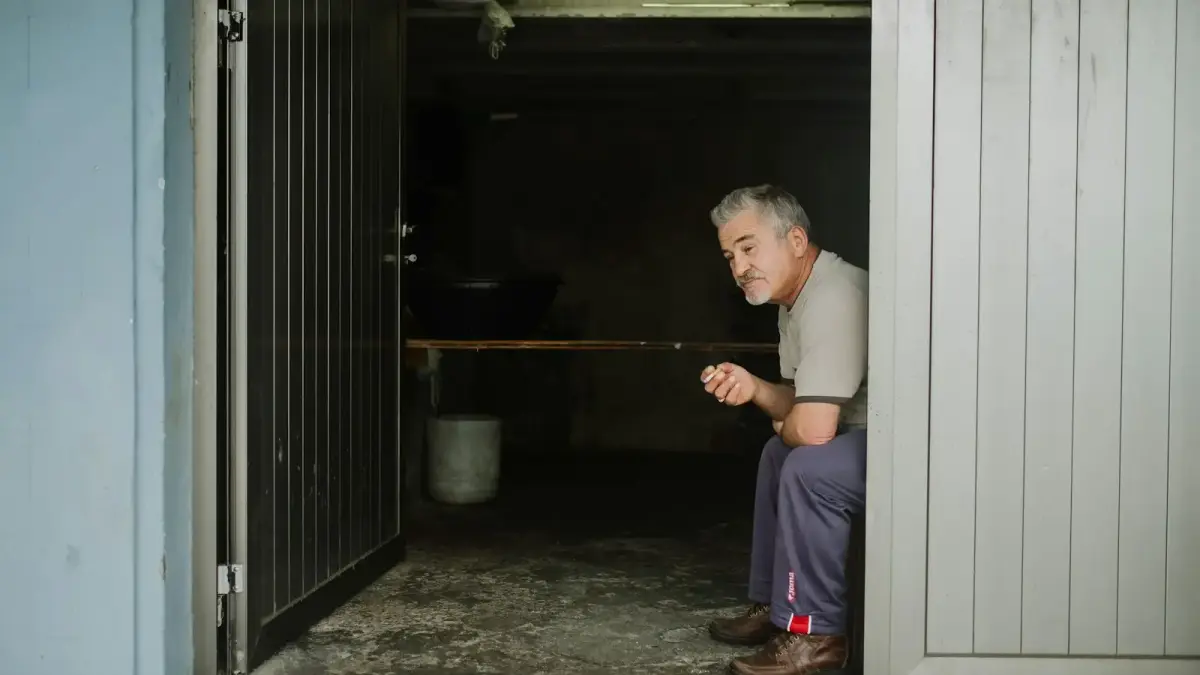
He never did. He read the paper. He watched the game. He went to work and came home tired and disappeared into a chair that might as well have been another city.
I don’t say this with anger anymore. I’m fifty-eight. The anger burned out a long time ago. What’s left is quieter than anger. It’s just the slow, steady recognition of what wasn’t there. The negative space in a life shaped like a father’s hand that never landed on my shoulder.
Daniel Goleman wrote about emotional inheritance - how the skills a parent never develops become the skills their children must build from scratch. My father didn’t know how to show up because his father didn’t know how to show up. The absence goes back further than I can trace.
But knowing that doesn’t stop the ache when I’m watching a tutorial about something simple and essential, and a stranger is doing what my father never could.
The decision I made in the garage
Three years ago, my youngest son was home for Thanksgiving. He mentioned his bathroom faucet had been dripping for months.
I said “bring your tools over next weekend. I’ll show you.”
He looked at me like I’d said something strange. Because I hadn’t done that before - not really. I’d fixed things for my kids. I’d fixed things near my kids. But I hadn’t stood beside them and walked them through it, step by patient step, the way I’d always wanted someone to walk me through it.
So we stood in his bathroom for two hours on a Saturday. I showed him how to turn off the water supply. How to identify the washer. How to reassemble without cross-threading. He made a mistake and I said “that’s fine, try again” and my voice cracked just slightly on the word “fine” and he didn’t notice and I was grateful.
I was teaching him a fifteen-dollar repair. But I was also doing something my father never did for me. And the weight of that - the strange, bittersweet fullness of it - almost knocked me sideways.
The competence is real, and so is the loneliness underneath it
I want to be clear: I’m not diminished by this. I’m not broken by it. The skills I built are mine. The hundreds of tutorials I’ve watched, the things I’ve figured out alone, the competence I carry into every room - that’s real and earned and nobody can take it from me.
But I’m done pretending it doesn’t cost anything. I’m done telling myself that self-sufficiency is purely a virtue when some of it was built on the foundation of not having a choice.
You can be capable and grieving at the same time. You can be the most resourceful person in your family and still carry a quiet ache for the man who should have been your first teacher.
If you’re reading this and you know exactly what I mean - if you’ve felt that tightness in your chest while a stranger on a screen patiently shows you something fundamental - I want you to know something.
You are not pathetic for feeling it. You are not weak for naming it. And the fact that you learned it anyway, alone, without the person who should have been beside you - that is not a small thing. That is the kind of quiet strength that deserves to be witnessed.
Even if the person who should have witnessed it first never did.