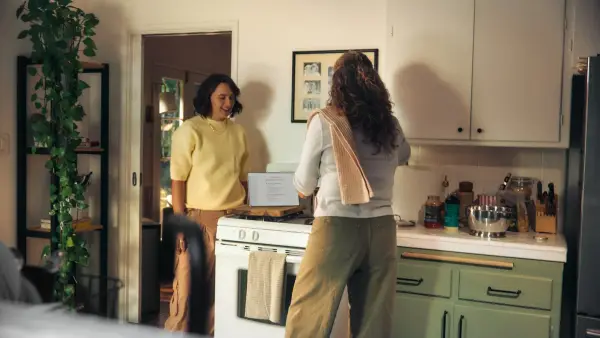
He is 58 and has realized that his wife laughs differently with her best friend than she has ever laughed with him - not less in the marriage but something unguarded and full and free that he understands now no husband was ever meant to hear, because that laugh belongs to a version of her that only exists when the quiet performance of being someone's wife is not required

The Laugh I Heard From the Kitchen
I was standing at the counter slicing tomatoes on a Saturday afternoon when I heard my wife laugh from the living room.
Not her regular laugh. Not the one I hear at dinner parties when someone tells a story she’s already heard, or the polite one she gives my brother when he makes the same joke for the third time at Thanksgiving. Not even the real laugh - the one I get sometimes when I catch her off guard with something genuinely funny, the one that makes her cover her mouth and lean into my shoulder.
This was something else entirely.
It was full-bodied. Loud. Almost reckless. The kind of laugh that comes out of a person who has completely forgotten that anyone else can hear them. She was on the phone with her best friend, Karen, and whatever Karen had said had unlocked something in my wife that I recognized as joy but couldn’t quite claim as familiar.
I stood there holding a tomato knife and I felt something I didn’t expect. Not jealousy. Not anger. Something quieter and harder to name. The slow, strange ache of realizing that the woman I’ve shared a bed with for thirty-one years has a version of herself I have never fully met.
A Woman You’ve Never Been Introduced To
Let me be careful here, because this isn’t a story about a bad marriage.
My marriage is good. I believe that honestly and without qualification. We raised two kids who turned into people we actually like. We’ve survived job losses, her mother’s illness, that stretch in our early forties when we couldn’t have a conversation about the dishwasher without one of us leaving the room. We stayed. We chose each other again and again, and I don’t take that lightly.
But there is a version of my wife that exists only in the company of her closest friend - and maybe two or three other women - that I have never had access to. Not because she’s hiding it. Not because our marriage lacks something essential. But because that version of her requires a kind of space that a husband, no matter how devoted, was never designed to provide.
I first noticed it years ago, but I didn’t have words for it then. She’d come home from dinner with Karen and she’d be different. Lighter. Not happier exactly - she’s happy with me - but unburdened in a specific way that I couldn’t replicate. Like she’d set down a weight I didn’t know she was carrying, and the setting down had made her buoyant, and the buoyancy lasted for hours after she walked through the door.
I used to think that meant something about us. Something insufficient. If she could be that free with Karen, why wasn’t she that free with me?
It took me until fifty-eight to understand the answer, and the answer is this: the freedom has nothing to do with me. It has to do with a kind of intimacy that exists between women that no man was ever taught to build, because we were never given the blueprints.
The Frequency Men Can’t Hear
Shelley Taylor, a psychologist at UCLA, published research in 2000 that changed how scientists think about stress and connection. For decades, the standard model of human stress response was fight-or-flight - your body perceives threat and either attacks or runs. Taylor and her colleagues noticed that almost all the original research had been done on men. When they studied women specifically, they found something different.
Women under stress don’t just fight or flee. They tend and befriend. Their bodies release oxytocin - the same hormone involved in breastfeeding and bonding - and their instinct under pressure is to move toward connection, not away from it. To call someone. To gather. To talk.
This isn’t socialization, or not only socialization. It’s biology. It’s chemistry. It’s the body saying: the way I survive this is by finding another person who understands.
And here’s the part that stopped me. The tend-and-befriend response doesn’t just function during crisis. It operates constantly, quietly, like a low hum underneath everything. My wife’s friendship with Karen isn’t recreational. It’s structural. It’s the architecture of how she processes being alive.
Robin Dunbar, the evolutionary psychologist, has spent decades studying sex differences in friendship. His research shows that women’s closest friendships are primarily face-to-face. They are built on disclosure, emotional exchange, mutual vulnerability. Women sit across from each other and say the unsayable. They narrate their interior lives in real time. They say things to their best friend that they haven’t yet said to themselves.
Men’s friendships, Dunbar found, are shoulder-to-shoulder. We stand next to each other and watch the game. We fish. We work on the car. We express closeness through shared activity, and the closeness is real, but it doesn’t require the same kind of nakedness.
I don’t say this as a criticism of how men love. I’ve written before about the beauty of shoulder-to-shoulder intimacy, about the full gas tank, about the drive to nowhere that says everything. Men’s love is real and deep and costs us more than most people know.
But when I hear my wife laugh like that on the phone - that loose, wild, ungoverned laugh - I’m hearing the sound of a woman inside a bond that operates on a frequency my wiring was never built to receive. And the ache I feel isn’t because something is wrong. It’s because I’m standing on one side of a window I can see through but cannot open.
The Permission He Was Never Given
I want to talk about the ache itself, because I think it’s important and I think most men my age will recognize it even if they’ve never named it.
It isn’t jealousy. Jealousy implies threat - the fear that someone is taking something that belongs to you. This isn’t that. Karen is not taking my wife from me. Karen is giving my wife back to herself, and I’m grateful for that even as it stings.
It isn’t inadequacy, exactly. Though it borders inadequacy the way a river borders a field - always there, always close, occasionally flooding.
What it is, I think, is grief. A very specific, very quiet grief for a kind of closeness that I was never taught to build. Not with my wife. Not with anyone.
Niobe Way, a developmental psychologist at NYU, spent years studying adolescent boys’ friendships. Her research found something that still rattles me every time I think about it. Before the age of fifteen, boys describe their best friendships in language that is almost indistinguishable from romantic love. They talk about needing their friend. They talk about trust, vulnerability, the terror of being betrayed. They say things like, “He’s the only person who really knows me.”
Then they turn fifteen. Sixteen. And something happens.
The culture intervenes. The message arrives - through coaches, fathers, peers, movies, a thousand invisible signals - that this depth of feeling between men is suspect. It’s too much. It’s not what men do. And so they dial it back. They pull away. They learn to stand shoulder-to-shoulder instead of face-to-face, and the loss is so gradual that most men don’t even register it as a loss. They just wake up at forty-five with a group of guys they golf with and a vague, persistent loneliness they can’t explain.
That’s the grief I feel when I hear my wife laugh with Karen. Not grief for my marriage. Grief for the version of closeness I was trained out of before I was old enough to know what I was losing.
The Version She Doesn’t Have to Manage
There’s something else happening in that laugh, and I want to name it because I think it matters.
When my wife is with me, she is - and I say this with full love - slightly managed. She is aware of herself as a wife, a partner, a person inside a shared system with negotiated roles and thirty-one years of accumulated patterns. She’s aware of my moods. She’s aware of what topics are easy and which ones have land mines buried underneath them from arguments we had in 2007. She’s tracking my state while she’s being herself, and the tracking costs something, even when it’s invisible.
With Karen, the tracking stops.
She’s not managing Karen’s ego. She’s not calibrating her honesty against Karen’s sensitivity. She’s not performing the small, constant labor of being someone’s partner - the labor that is worth it, that she chooses willingly, but that is labor nonetheless.
The laugh I heard from the kitchen is the sound of a woman who has temporarily set down the weight of being someone’s wife. Not because the weight is bad. Not because she resents it. But because every person who carries something heavy deserves a place where they can set it down, flex their hands, and remember what their body feels like without it.
Karen is that place. The laugh is the sound of the setting down.
What I’ve Learned to Do With the Ache
I’m fifty-eight years old and I’ve stopped trying to be the person who gives my wife everything she needs.
That sentence looks like failure when I write it down, but it doesn’t feel like failure when I live it. It feels like the most mature understanding I’ve arrived at in three decades of marriage.
No single person - no matter how devoted, how attentive, how emotionally present - was ever meant to be the complete architecture of another person’s emotional life. That’s not a marriage. That’s a prison with better lighting. My wife needs me for certain things, and those things are real and irreplaceable. She also needs Karen for certain things, and those things are also real and irreplaceable, and the two needs don’t compete with each other any more than oxygen competes with water.
A 2022 study published in the Journal of Social and Personal Relationships found that individuals who maintained strong friendships outside their marriages reported higher marital satisfaction, not lower. The friendships didn’t drain the marriage. They fed it. The people who came home from an evening with their closest friend came home fuller, softer, more generous. They’d been refilled at a well that their partner didn’t have to maintain.
That’s Karen. That’s what she does for my wife. And when my wife walks through the door after an evening together - lighter, brighter, carrying the afterglow of that laugh - she brings the lightness home to me. I benefit from a friendship I am not part of. I receive the overflow of a love I was never meant to provide.
Standing in the Kitchen, Letting It Be
Last Saturday I heard it again. The laugh.
I was making lunch and my wife was in the other room and Karen had called, and within five minutes the laugh arrived - that big, unguarded, full-body laugh that uses her whole chest and makes her tip her head back and sometimes makes her snort, which makes her laugh harder.
I stood in the kitchen and listened. I felt the ache. I let it be there. I didn’t try to fix it or outrun it or analyze it away.
The ache is real. I want to be clear about that. It is the specific loneliness of a man standing in his own house, hearing his wife be a version of herself he cannot access, and knowing that this is not a problem to solve. It is a boundary to respect. A limitation to grieve. And then, eventually, a grace to be grateful for.
Because the alternative is a wife who has no one. A wife whose entire emotional world runs through a single person - me - and who slowly, imperceptibly becomes smaller under the weight of that constraint. I’ve seen that marriage. I’ve watched women disappear into it. I don’t want that for her. I don’t want her laughter to only come in the sizes I know how to produce.
I want her to have the big laugh. The Karen laugh. The laugh that belongs to the version of her I’ll never meet, the one that exists only in the absence of the wife performance, the one who is just herself - unmanaged, untracked, free.
If you’re a man who has stood in a doorway or a kitchen or a hallway and heard your wife be someone you didn’t recognize - lighter, louder, more alive than she is with you - I want you to know that the ache you feel is not a symptom of a bad marriage.
It’s the sound of a good one. One that is honest enough to admit that love, no matter how deep, has edges. And what lives beyond those edges isn’t betrayal or insufficiency.
It’s just a woman, laughing with her friend, being the full, unedited version of herself.
And that might be the most beautiful sound you were never meant to hear.