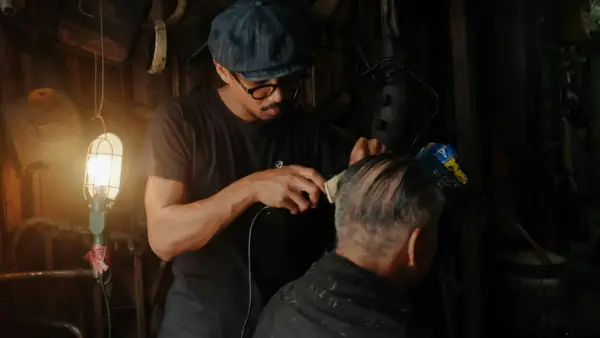
He is 58 and has realized that his wife has been cutting his hair for twenty-three years, and the forty-five minutes she spends on it every six weeks - the warm water, the towel around his shoulders, her fingers on his scalp, the careful way she tilts his head to check the length - might be the only sustained, unhurried, purely tender physical contact he receives in his adult life, and the man who tells people 'it is just easier than going to the barber' is not talking about convenience but about the only recurring appointment with gentleness his body has ever been willing to keep

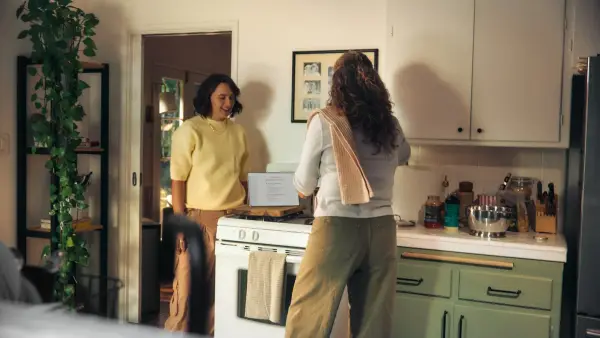
She pulls the kitchen chair into the middle of the tile floor and drapes an old towel around my shoulders. She runs warm water from the sink into a spray bottle she bought for houseplants but repurposed years ago. She says the same thing she always says - “tilt your head down for me” - and her fingers find the back of my neck.
And for the next forty-five minutes, I am held.
Not in the way anyone would recognize as holding. She’s standing behind me with scissors, working section by section, pausing to comb through a spot, tilting my head gently to the left, then the right. Her fingertips press against my temples when she trims around my ears. Her palm rests on the top of my skull when she checks the length. She blows stray clippings off my forehead with a little puff of breath that I have felt maybe four hundred times now, and every single time my chest does something I don’t have a word for.
I am fifty-eight years old. My wife has been cutting my hair for twenty-three years. And I only recently allowed myself to understand what those forty-five minutes actually are.
The cover story I have been telling for two decades
When people ask why I don’t go to a barber, I have a line ready. “It’s just easier,” I say. “Saves time. Saves money. She does a good job.”
All of those things are true. None of them are the reason.
The reason is that my wife’s hands on my head is the only sustained, unhurried, purely tender physical contact I receive in my adult life. And I couldn’t say that out loud until very recently, because saying it would mean admitting how little tenderness I actually get, and admitting that would mean feeling the full weight of the deficit, and feeling that weight is something my body has spent decades learning to avoid.
So I wrapped the need in a practical excuse. I gave it a cover story. I let it live inside the word “easier” because “easier” doesn’t require anyone to feel sorry for me, least of all myself.
What touch actually looks like in a man’s life after forty
I want to be careful here because this isn’t a complaint about my marriage. My wife loves me. I know that the way you know gravity - not because anyone proves it, but because you feel it holding you to the ground every day.
But love and touch are not the same thing. Not after decades.
There’s the brief kiss goodbye in the morning, lip-adjacent, half-aimed, already thinking about the car keys. There’s the brush of hands passing a dish. There’s the occasional hug at the end of a hard day, which lasts about three seconds and is usually initiated by her. There’s the pat on the back. The foot nudge on the couch.
It adds up to maybe ninety seconds of physical contact in a given day. And most of it is functional. Most of it is transit - touch on the way to something else.
A 2014 study published in the American Journal of Public Health found that men in the United States report significantly less non-sexual physical affection than women across virtually every relationship type - friendships, family, and romantic partnerships. The gap widens after age forty. By fifty, many men describe their wife or partner as the only person who touches them at all.
I read that and didn’t feel surprised. I felt caught.
The forty-five minutes where the rules change
The haircut is different from every other form of contact in my life because it has no destination. There’s no rush to finish. There’s no agenda beneath it. She’s not touching me on the way to something else. She’s touching me because the task requires it, and the task takes as long as it takes.
Her fingers run through my hair to check where it’s uneven. She cups the back of my head to angle it toward the light. She rests her wrist on my shoulder while she studies the sides. She brushes clippings off my neck with her hand, slowly, like she’s smoothing a tablecloth.
None of these gestures are romantic. None of them are sexual. They are something more rare than either of those things - they are casual and sustained and gentle and completely without performance.
I don’t have to earn them. I don’t have to initiate them. I don’t even have to acknowledge them. The haircut gives me permission to sit still and be touched without having to explain why I need it.
Dacher Keltner’s research at UC Berkeley has shown that brief, caring touch - even just a hand on a shoulder - activates the vagus nerve, lowers cortisol, and releases oxytocin. His work suggests that humans are neurologically wired to regulate each other’s stress through physical contact. We are not built to go without it. We just learn to.
And men, in particular, learn to go without it so thoroughly that they forget they’re going without anything at all.
How a boy learns to stop reaching
I don’t remember when I stopped being touched easily. I remember when I started noticing its absence, which is a different thing.
I was maybe twelve or thirteen. Old enough that my mother stopped pulling me into hugs without asking. Old enough that my father’s hand on my shoulder became rare and then ceremonial - graduations, funerals, the handshake that replaced the embrace sometime around my fourteenth birthday.
William Pollack’s research on what he called the “Boy Code” describes exactly this process. Boys are pushed toward emotional and physical independence earlier than girls, often by age six or seven. They learn that needing touch is childish. That asking for comfort is weakness. That the appropriate male response to loneliness is to get busy, get useful, or get quiet.
I got quiet.
By my twenties, the only people who touched me regularly were romantic partners, and even that touch was wrapped inside desire. It had a direction. It was going somewhere. The tenderness was real, but it was always bundled with something else - attraction, sex, the performance of wanting.
What I didn’t have - what I haven’t had since I was a child - was someone touching me slowly, carefully, without wanting anything from me. Just tending to me the way you tend to something you love.
Until the haircuts started.
She probably doesn’t know what she’s giving me
My wife started cutting my hair in 2003 because we were broke. Young, two small kids, and sixty dollars at the barber every month felt like a luxury we hadn’t earned yet. She watched a few videos, bought a pair of clippers and some shears, and figured it out.
The first few times were rough. Uneven sides. A nick behind my ear. We laughed about it. She got better.
And somewhere along the way, long after we could afford a barber again, neither of us suggested stopping. I said it was easier. She said she didn’t mind. We both agreed it was practical.
But I don’t think either of us was telling the full truth. I think she kept doing it because she liked the closeness too - the rare quiet of standing behind someone you’ve loved for decades, no screens, no kids interrupting, just the sound of scissors and breathing. And I kept letting her because those forty-five minutes are the only time in my life when I am tended to.
Not cared for in the abstract way that a good marriage cares for you - the bills paid, the groceries bought, the quiet loyalty of showing up year after year. Tended to. Physically. The way you tend to a garden or a wound or a child’s hair after a bath.
She combs and clips and brushes and adjusts. She steps back and looks at me with this focused expression that has nothing to do with attraction and everything to do with attention. She touches my face to turn it toward the window. She runs her thumb along my hairline to check the edge.
And I sit there like a man getting a haircut, because that is the only way I know how to sit there.
The language men never learned
Here is the thing I couldn’t say for twenty-three years, the thing I am only barely able to write now: I am touched so rarely that a forty-five-minute haircut from my wife has become the emotional anchor of my entire physical existence.
That sentence embarrasses me. It shouldn’t, but it does. Because I was taught - not by anyone in particular, but by everything in general - that a man who needs to be touched is a man who needs too much. That tenderness is something you provide, not something you require. That the correct posture for a grown man is to be fine, to need nothing soft, to stand like a wall and let other people lean on you.
A 2020 study in the journal Psychology of Men and Masculinities found that men who endorse traditional masculine norms report the highest levels of touch deprivation and the lowest likelihood of seeking physical comfort from others. The researchers called it a “touch paradox” - the men who needed comfort most were the least equipped to ask for it or receive it.
I have never once said to my wife, “I need you to touch me.” I have never said, “Could you just put your hand on my back while we watch television?” I have never asked for what I need because asking would require admitting the need, and admitting the need would crack something I have spent a lifetime sealing shut.
So instead, every six weeks, I sit in a kitchen chair and let her cut my hair.
What the haircut actually is
It’s not a haircut. It never was.
It’s the forty-five minutes where I don’t have to be strong or useful or fine. It’s the recurring appointment my body makes with gentleness, disguised as maintenance. It’s the way I’ve learned to receive tenderness without having to name it, ask for it, or feel the full grief of how rarely it comes.
It’s the warm water on my neck. The towel on my shoulders. The pressure of her fingers. The little puff of breath on my forehead. The way she says “hold still” and I do, and I feel held, and I don’t say so.
I think there are millions of men like me. Men whose only tender touch comes wrapped in something functional - a massage for a bad back, a haircut from a partner, a doctor’s exam. Men who have organized their entire physical lives around these narrow corridors of acceptable contact because the open field of simply being touched was closed to them decades ago.
And I think most of those men have a cover story too. “It’s just easier.” “She doesn’t mind.” “Saves the trip.”
The cover story isn’t a lie. It’s a translation. It’s the only language we were given for something we were never taught to say.
My wife will cut my hair again in a few weeks. She’ll pull the chair out and drape the towel and spray the warm water. She’ll tilt my head and run her fingers through what’s left up there and take her time, because she always takes her time.
And I will sit still. And I will be tended to. And I will call it a haircut, because that’s the word I have.
But my body knows what it actually is. It has known for twenty-three years. The only recurring appointment with gentleness it has ever been willing to keep.