He's 59 and has quietly realized the reason he washes his car every Saturday morning regardless of whether rain is forecast for the afternoon is not about the car and never was - it was the only hour his father ever seemed unreachable by the world, standing in the driveway with a hose and a chamois in the kind of silence only men who don't have words for peace know how to build, and the ritual at fifty-nine is not maintenance but the closest thing to stillness a man who was never given permission to simply sit down has ever allowed himself
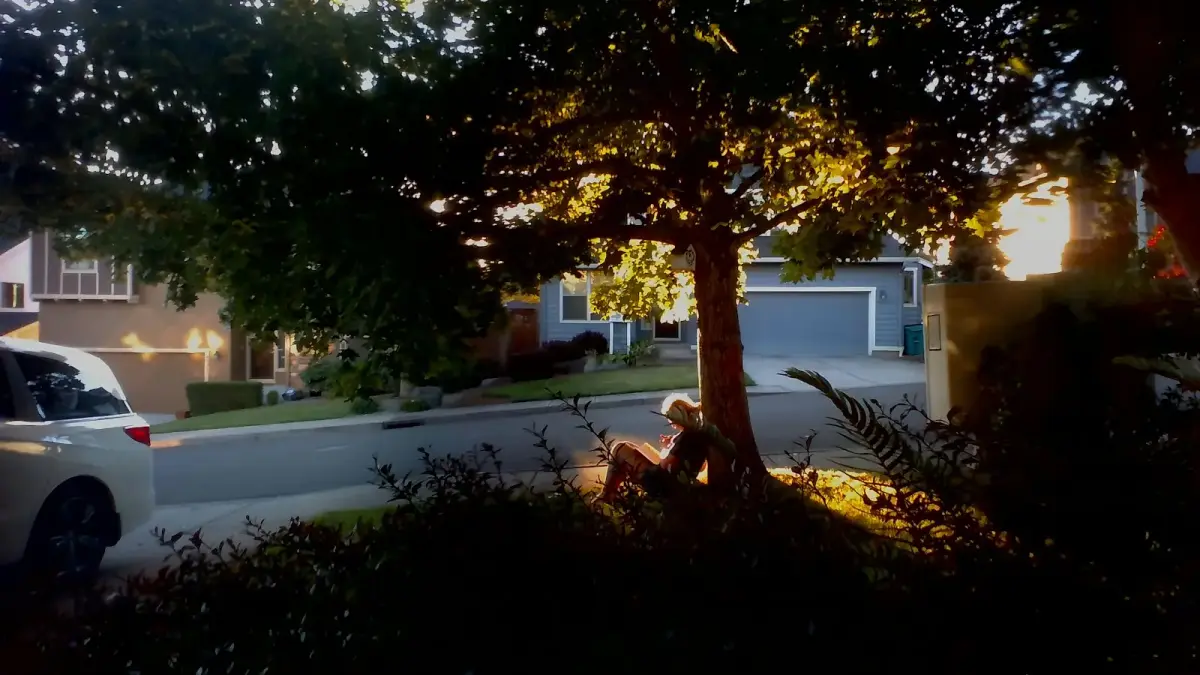
Last Saturday it rained from seven in the morning until well past noon. A slow, steady kind of rain that turned the street dark enough that the porch lights across the road clicked on by reflex.
I went outside at eight-fifteen, pulled the hose from the reel, filled the bucket with warm water and dish soap, and washed my car.
My wife stood at the kitchen window with her coffee and watched me for a while. She didn’t say anything. She stopped saying anything about it years ago.
There was a time - maybe twenty years back - when she’d point out that it was raining, that the car would be dirty again by lunch, that I was going to catch a cold. She doesn’t bother anymore. I think she understands now that whatever I’m doing in the driveway on Saturday mornings, the car is almost beside the point.
I didn’t understand it myself until a few weeks ago. I’m fifty-nine, and I have been washing a car on Saturday mornings for longer than I haven’t. And it took until now - standing in the driveway with a chamois that was already soaked through before I wrung it - to realize what I was actually doing out there.
I was visiting my father.
The driveway on Maple Street
My father was not a calm man. He carried the kind of tension that other people could feel when he walked into a room - a tightness in his jaw, a way of holding his shoulders like he was bracing for something that was always just about to happen.
He worked at a plant that made industrial seals. He came home most days with grease on his forearms and a silence that nobody in the house was brave enough to interrupt.
My mother would set dinner on the table without asking how his day was. My sister and I would eat quickly and excuse ourselves. The evening would pass in the careful, measured way that evenings pass in houses where everyone is managing one person’s weather.
But Saturday mornings were different.
Saturday mornings, my father would be out in the driveway by eight with the hose already uncoiled and the bucket filled. He washed the car the same way every time - roof first, then the hood, then the sides, then the wheels. He used a chamois he kept folded in the garage next to a tin of wax he replaced every spring whether it needed it or not.
And here is the thing I didn’t have language for as a boy but can see now with the painful clarity that only comes at the end of middle age: that hour in the driveway was the only hour of the week my father looked peaceful.
Not happy. I’m not sure I ever saw my father happy in the way people mean when they use that word. But peaceful. Settled. Unreachable by whatever it was that kept his jaw tight and his voice clipped and the house on edge.
He’d stand there with the hose running over the hood, and his face would go slack. His shoulders would come down. He’d hum sometimes - not a song I could recognize, just a low, tuneless vibration that seemed to come from somewhere deeper than his throat.
Nobody talked to him while he washed the car. That was understood without ever being spoken.
My mother didn’t bring him coffee. I didn’t ask if I could help. Even the dog would lie down on the front step and watch him from a distance, as if she understood that this hour belonged to him in a way that the rest of the week didn’t.
What men of that generation built instead of peace
My father was born in 1938. He grew up in a house where men worked, provided, endured, and kept quiet about whatever was happening inside them.
His father - my grandfather - was a man I knew through a single photograph on the mantle and the three facts my father ever shared: he drove a truck, he never missed a day of work, and he died at sixty-one.
That was the entire eulogy. Not what he loved. Not what he feared. Not whether he was kind. Just that he showed up, didn’t complain, and died.
A 2020 study published in the Journal of Men’s Studies found that men born before 1950 were significantly less likely to use emotional vocabulary to describe their inner lives - not because they lacked emotional complexity, but because they were never given a framework for naming what they felt. The researchers called it “emotional compression” - a lifetime of internal experience forced through a channel so narrow it could only exit as action, never as words.
My father had emotional compression in a way that I can only fully appreciate now that I’ve lived long enough to recognize it in myself. He didn’t know how to say he was overwhelmed. He didn’t know how to say he needed quiet.
He didn’t know how to tell my mother that he loved her in a way that sounded like anything other than making sure the oil was changed and the gutters were clean.
But he knew how to wash a car on Saturday morning. And in that hour, something in him opened just enough to breathe.
The inheritance nobody names
I bought my first car at twenty-two. A used Civic with a dent in the passenger door and a tape deck that only played the left channel. The first Saturday I owned it, I bought a bucket, a sponge, and a chamois, and washed it in the apartment parking lot.
I didn’t think about why. It was Saturday. You wash the car on Saturday. That’s just what you do.
I have owned seven cars since then. Every single one of them has been washed on Saturday mornings. In apartments with no driveway, I’d find a hose bib on the side of the building and drag the bucket across the lot.
In the winter, I’d do it fast, gloveless, fingers going red. In the rain - and this is the part that should have told me something decades ago - I’d do it anyway.
A 2022 study in Frontiers in Psychology examined what the authors called “behavioral inheritance” - the unconscious adoption of parental routines that serve emotional rather than practical functions. The researchers found that adult children were most likely to replicate the specific behaviors their parents exhibited during moments of visible calm or safety, even when those behaviors had no rational utility in the child’s own life.
They weren’t replicating the task. They were replicating the peace they saw while the task was happening.
I read that finding in a magazine at my dentist’s office three months ago and sat in the waiting room staring at the wall for ten minutes, because I understood for the first time in thirty-seven years of Saturday mornings that I was not washing a car.
I was standing in a driveway on Maple Street, watching my father’s shoulders come down.
The meditation nobody taught him
Here’s what I want someone to understand about men like my father, and the men who became their sons.
Nobody told my father he was allowed to rest. Nobody told him he could sit on the couch on a Saturday morning and do nothing. His own father never modeled that.
His culture never permitted it. The entire economy of his identity was built on usefulness - a man is what a man does, and a man who is not doing is a man who is failing.
But a man who is washing a car is doing something. He is maintaining property. He is taking care of what he owns.
He is being responsible, productive, domestic in a way that looks like work even though the car was already clean.
And inside that performance of productivity, my father hid an hour of stillness.
Nobody tells men over sixty that what they’ve been doing all along in the garage, in the shed, in the driveway with a hose and a chamois - the puttering, the tinkering, the Saturday rituals that have no urgency and no audience - is meditation. Not the kind with apps and guided breathing and cushions. The kind that men who never learned the word invented for themselves, because the pressure had to go somewhere and they were not given permission to simply sit down and let it leave.
A 2019 study in Psychological Science found that repetitive manual tasks performed in familiar environments produce measurable decreases in cortisol and increases in parasympathetic nervous system activity - the same physiological shifts associated with formal mindfulness practice. The researchers noted that participants were often unaware that the activity was serving a regulatory function. They simply reported feeling “calmer” or “more settled” afterward, without connecting the feeling to the task.
My father would have never used the word meditation. He would have said he was washing the car. He would have said the car needed it.
But the car didn’t need it. He did.
The grief that lives inside the chamois
My father died eleven years ago. Heart attack in the kitchen on a Wednesday afternoon. He was sixty-nine.
He had just come in from the garage, where he’d been reorganizing a shelf of paint cans that didn’t need reorganizing.
I flew home for the funeral. My mother asked me to clean out the garage - her way of saying she couldn’t bear to look at his things yet. I spent two days in there with garbage bags and a lump in my throat that wouldn’t dissolve.
On the top shelf, behind the tin of wax, I found his chamois. Folded in thirds the way he always folded it. A little stiff, slightly yellow.
It smelled like soap and something else I couldn’t name - something metallic and faint that I realized, after holding it for a long time, was him.
I took it home. I still have it. It’s in my garage, on a shelf, folded in thirds.
I don’t use it. I bought my own years ago. But it sits there, and sometimes I take it down and hold it for a minute before I put it back.
My wife has seen me do this. She doesn’t ask. I think she knows that some things don’t need to be explained, only witnessed.
What I didn’t understand until this year - until I was standing in the rain on a Saturday morning, fifty-nine years old, washing a car that didn’t need to be washed - is that the ritual was never about maintenance. It was never about the paint, the wax, the water spots.
It was the only way I knew how to sit with my father. The only space where his presence still made sense.
The driveway, the hose, the slow circles on the hood - these were the coordinates of the only peace he ever showed me. And every Saturday morning for thirty-seven years, I have been returning to those coordinates the way a bird returns to a coast it has never been taught to find.
You’re not wasting a Saturday morning
If you are the man who mows a lawn that doesn’t need mowing, or sorts tools in a garage that’s already organized, or drives to the hardware store every Saturday for screws you could have ordered online - I want you to sit with the possibility that the task is not the task.
The task is the container. What’s inside it is something you were never given the vocabulary to name.
Maybe it’s grief. Maybe it’s prayer. Maybe it’s the only way you ever learned to be still without feeling guilty for not being useful.
Maybe it’s a conversation with someone who’s gone, conducted in the language of repetition and soap and water and the slow, circular motion of a cloth over something you’re pretending needs to be clean.
You’re not wasting time. You’re not being rigid or obsessive or peculiar. You built a cathedral out of a Saturday morning errand, and you’ve been going to services every week for decades without knowing it.
Your father - or whoever taught you this particular silence - didn’t give you the words. But he gave you the rhythm. And the rhythm held you when nothing else did.
I washed my car last Saturday in the rain. It’ll rain again this Saturday, probably. I’ll be out there at eight-fifteen with the bucket and the hose and a chamois that is not the one on the shelf but serves the same purpose.
And for one hour, my shoulders will come down. My jaw will unclench. I’ll hum something tuneless and low.
And my father will be standing next to me in the driveway on Maple Street, not saying anything, not needing to, the two of us finally still in the only way we were ever taught to be.
That’s not maintenance. That’s not a habit. That’s love, in the only language we were given.
And it’s enough.