He's 60 and has never once said the words 'I'm sorry' to his wife - not because he doesn't feel remorse but because a boy who grew up where apologies were either weapons or weaknesses learned to say sorry with his hands instead of his mouth, and the woman who has been married to him for thirty-five years can tell you exactly what 'I love you' sounds like when it's disguised as a repaired kitchen faucet
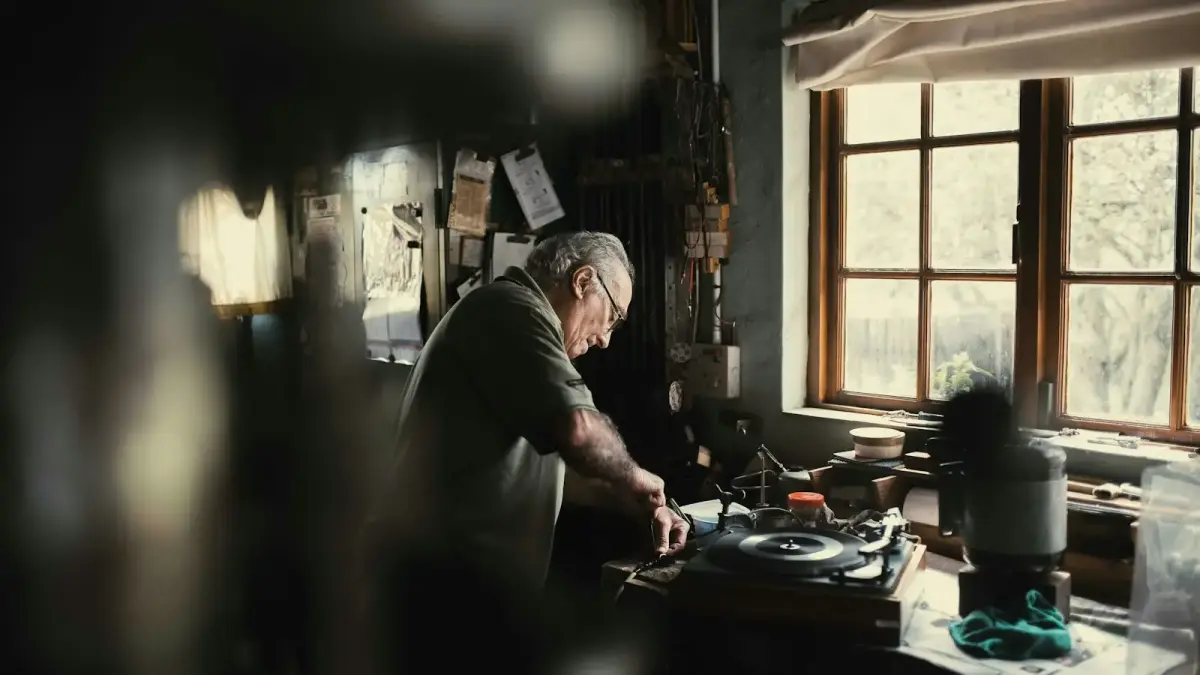
The morning after he raised his voice about something that didn’t matter - the recycling, the thermostat, the way she loaded the dishwasher - he is in the garage by 6 a.m.
She hasn’t asked him to be there. No one has assigned this task. But the cabinet door under the kitchen sink has been catching for three weeks, and this morning, without a word spoken between them, he is sanding down the edge, realigning the hinge, testing the swing until it closes with a whisper instead of a fight.
He doesn’t say anything when he comes back inside. He pours his coffee. She opens the cabinet, notices the difference, and closes it again slowly.
Both of them know what just happened.
I’ve been thinking about this man - this version of a man I recognize in my own father, in friends’ fathers, in the quiet men at hardware stores on Saturday mornings who seem to be shopping for something that has nothing to do with hardware. Because what he’s doing under that kitchen sink isn’t maintenance. It’s language. It’s the only dialect of remorse he was ever taught.
And the woman who married him thirty-five years ago has become so fluent in this language that she can tell the difference between a regular repair and an apology. She knows which fix-it project means “I’m sorry” and which one means “I love you.” Sometimes they’re the same thing.
The apology that ended arguments by winning them
To understand why a man reaches sixty without ever saying the words “I’m sorry” to the person he loves most, you have to go back to the kitchen table where he first heard those words used.
In his house, “I’m sorry” was not an opening. It was a closing argument.
His father said it the way you’d slam a briefcase shut. “I said I was sorry, what more do you want?” It came after the yelling, after the silence, after his mother’s face had already gone somewhere far away. The apology wasn’t an attempt at repair. It was a demand that the other person stop being hurt.
He learned, before he had the language to name it, that “I’m sorry” was a transaction. You said the words, and in exchange, the other person was obligated to forgive you. If they didn’t - if they still seemed upset, still held their body a certain way, still needed time - then they were the problem. They were “holding a grudge.” They were “making it worse.”
A 2019 study published in the Journal of Social and Personal Relationships found that children who witness apologies used coercively - as tools to terminate conflict rather than repair connection - often develop deep ambivalence about verbal expressions of remorse. They understand that sorry is supposed to mean something. They just never saw it used that way.
So the boy learned something specific and lasting: the words themselves are contaminated. Saying “I’m sorry” makes you either a manipulator or a target. His father used them as weapons. His mother received them and was expected to perform forgiveness on demand. Neither version looked like something worth becoming.
The language he built instead
What nobody talks about is that these men don’t lack remorse. They are often drowning in it.
The guilt after a sharp word, a dismissive tone, a door closed too hard - it doesn’t dissipate because he can’t name it. It stays in his chest. It wakes him up early. It sends him to the garage, to the yard, to the toolbox under the stairs.
He fixes things because fixing is the one form of care that was never corrupted in his childhood. No one in his house weaponized a repaired screen door. No one used a replaced light bulb as leverage. The physical act of making something work better than it did before was the one unambiguous good he could locate in the wreckage of his family’s emotional landscape.
Psychologists call this “instrumental support” - the expression of care through practical action rather than verbal affirmation. Research by Dr. Ronald Levant on normative male alexithymia describes a pattern in which boys raised in emotionally restrictive environments develop a limited vocabulary for internal states but an expansive capacity for demonstrating care through doing.
She mentions the faucet drips. He fixes it the morning after a fight. She says the garden gate sticks. He rehangles it on a Saturday when they haven’t spoken since Thursday.
Each repair carries a message, and the message is always the same: I know I hurt you. I don’t know how to say that. But I can make this one thing in your life work the way it should.
His wife’s fluency
Here is the part that rarely gets written about: she learned to read him.
Not because she had to. Not because it’s her job to decode a man who can’t use his words. But because she loved him, and love over decades becomes its own form of literacy.
She knows that when he gets up early on a Sunday to wash her car - really wash it, with the chamois and the tire shine and the interior wipe-down - it means the thing he said at dinner on Friday is still sitting on his chest. She knows that when he replaces the batteries in every smoke detector in the house on the same afternoon, something is weighing on him that has nothing to do with fire safety.
John Gottman’s research on emotional bids in long-term relationships describes how couples develop private systems of meaning - gestures, rituals, recurring patterns that carry emotional weight invisible to outsiders. What Gottman calls “turning toward” a bid for connection doesn’t always look like a conversation. Sometimes it looks like a man who has been on his knees in the bathroom for two hours replacing the caulk around the tub.
She reads it all. She has been reading it for thirty-five years.
But here’s the part she might not say out loud, or maybe she’s said it once or twice in a way that slid off him: sometimes she wishes he could just say it.
Not because the repairs aren’t enough. Not because she doesn’t understand. But because there are moments - after a real argument, a deep one, the kind that leaves a bruise on the air between them - where she needs the words. Where the faucet isn’t enough. Where she needs to hear his voice break a little, needs to see his face do the thing it does when he’s fighting himself, and hear him say, just once, “I’m sorry. I was wrong. You didn’t deserve that.”
She has never received that sentence. She has received a remodeled bathroom, a patio he built with his own hands, a car that always runs. But never that sentence.
The cost his children pay
His son is forty-two and thinks his father doesn’t feel things deeply.
This is the cruelest inheritance of all, because the opposite is true. The man feels everything. He felt it when his son’s first marriage fell apart and he drove four hours to help him move into a smaller apartment without saying a word about what happened. He felt it when his daughter called crying at midnight and he stayed on the phone, mostly silent, because he didn’t know what to say but couldn’t bring himself to hang up.
He felt it, and his children will probably never fully know that, because he never learned to let them see.
His son grew up watching repairs instead of apologies and concluded that his father operated on a shallow emotional frequency. That the silence after a disagreement was indifference. That the fence he built in the backyard the week after missing the school play was just a man who liked building things.
His daughter is thirty-eight. She married a man who also communicates in repairs rather than words. She didn’t realize until her late thirties that this was a pattern - that she had been drawn to the familiar rhythm of silence followed by fixing, a cycle she mistook for peace because it was the only version of conflict resolution she’d ever witnessed.
A 2021 study in Developmental Psychology found that children’s understanding of emotional repair is overwhelmingly shaped by what they observe between their parents. When repair happens nonverbally, children often internalize that emotions are problems to be solved through action rather than experiences to be shared through language.
He gave his children everything he could. But the one thing he couldn’t give them was a model for saying “I was wrong, and I want to do better.” Not because he didn’t want to. Because the words themselves feel like a door he nailed shut forty years ago, and he has no memory of where he put the hammer.
What the research actually says about men and silence
The clinical framework for this pattern has a name that sounds colder than it should: normative male alexithymia. It describes a culturally produced difficulty in identifying and expressing emotions verbally - not a disorder, but an adaptation. A learned response to an environment that punished vulnerability and rewarded stoicism.
Gabor Mate has written extensively about how emotional suppression in childhood doesn’t eliminate emotion - it reroutes it. The feelings don’t disappear. They show up in the body, in the hands, in the compulsive need to stay useful. The man who can’t say “I’m sorry” often has a body that is screaming it - in the tension he carries in his shoulders, the insomnia he’s had for decades, the way his jaw tightens when someone in a movie says something tender to their father.
He isn’t emotionally incompetent. He is fluent in a language that nobody taught him to translate.
He can feel remorse so deep it rearranges his entire Saturday. He can carry guilt for a week over a tone of voice he used for three seconds. He can love someone with the full weight of his body and his time and his hands and never once find the words to say so.
This is not a deficit. It’s a wound shaped like competence.
The repair that can’t be made with hands
There is a version of this man who, at sixty or sixty-five or seventy, finds a way to say the words.
Sometimes it happens in a therapist’s office, though he probably called it “someone to talk to” rather than therapy. Sometimes it happens in a hospital room, when the machinery of mortality makes the machinery of pride seem absurd. Sometimes it happens on a long drive, when the road is dark enough that speaking feels less like exposure and more like thinking out loud.
It almost never happens smoothly. The words come out wrong, or too small, or wrapped in qualifiers. “I know I wasn’t always…” or “I probably should have…” He can’t look at her when he says it. His hands are gripping the steering wheel or the arm of the chair or each other.
But she hears it. And she knows what it cost him.
Not because the words are difficult to pronounce. Because saying them means becoming the thing his father’s house taught him never to be: a person who admits to damage without immediately fixing it. A person who sits in the space between causing hurt and receiving forgiveness without reaching for a tool.
If you recognize this man - if you married him, or were raised by him, or if you are him - I want you to know something that the toolbox and the garage and the early Saturday mornings have been trying to say for years.
The repairs were never about the house.
Every sanded edge, every tightened bolt, every leveled shelf was a sentence he couldn’t say out loud. And the fact that he got up early to say it anyway - that he chose the harder route, the one that took hours instead of seconds, the one that left sawdust on his clothes and calluses on his hands - that is not the absence of love.
It’s love in the only language he was given.
And if he ever finds the words - if they ever make it past the lock his childhood installed - he deserves to know that she’s been waiting to hear them. Not because the repairs weren’t enough. But because some doors can only be opened from the inside, with nothing in your hands at all.