He's 60 and has just realized that his adult children communicate love in a language he was never issued - emoji hearts sent at midnight, memes that mean 'I was thinking about you,' voice notes rambling about nothing important - and the father who replies with 'Nice' or a single thumbs-up is not detached or disinterested but a man whose generation was handed one narrow vocabulary for closeness, and he is watching his children speak a fluent second one nobody ever taught him
My father called me every Sunday for eleven years after I moved out. The call lasted between four and seven minutes. He asked about the weather. He asked if the car was running okay. He told me what he’d done in the yard that week. And then he said, “Alright, well,” and that was it.
I never once heard him say he missed me.
But the calls came every Sunday. Every single one. Through a decade of my twenties, through moves and breakups and stretches where I didn’t pick up on the first ring because I was busy being young and careless. He called anyway. Same time. Same questions. Same quiet sign-off.
I am sixty now, and I have a daughter who sends me a string of red hearts at eleven-thirty at night for no apparent reason. She sends me memes I don’t fully understand. She leaves voice notes that meander for three minutes about a candle she bought or a weird dream she had. And I reply with a single thumbs-up, or “Nice,” or sometimes just “Ha.” And I know - I can feel it in the small silence after I hit send - that my reply landed like a closed door.
But here is what I need someone to understand. The thumbs-up is not a closed door. It is the only door I was ever shown.
The language he was handed
I grew up in a house where love was structural. It was the roof that didn’t leak. It was the fact that the electricity stayed on. It was my father driving forty-five minutes each way to a job he never once complained about, five days a week, for thirty-one years.
He did not tell me he was proud of me. He showed up to every single game.
He did not say “I love you” at bedtime. He checked the locks on the doors every night at ten-fifteen. He kept the oil changed in my mother’s car before she ever had to ask. He built a bookshelf for my room one Saturday without being prompted because he noticed my paperbacks were stacked on the floor.
That was the vocabulary. Love was not a word you said. It was a thing you proved, quietly, over and over, through decades of showing up and not leaving.
A 2019 study published in the Journal of Social and Personal Relationships found that men who came of age before the 1980s were significantly more likely to express affection through instrumental support - acts of service, physical presence, financial provision - rather than verbal or written declarations. The researchers didn’t frame this as a deficit. They called it a “restricted but deeply consistent affective style.”
Restricted but deeply consistent. That is the most accurate description of my father’s love I have ever read.
What his children learned instead
My daughter grew up in a different country. Not geographically - emotionally. She was raised in a world that handed her an entirely different alphabet for closeness.
She says “I love you” at the end of every phone call. She sends paragraphs of feeling via text. She uses emoji like punctuation - hearts to mean warmth, the crying-laughing face to mean connection, a simple fire emoji to mean “I see you and I think you’re doing great.”
She leaves voice notes. Not because she has something urgent to say, but because the sound of her voice arriving in my phone is itself the message. The content barely matters. The voice note that rambles for two minutes about a song she heard on the way to work is not about the song. It is about the fact that she thought of me while driving.
This is her language. She is fluent in it. She was taught by a culture that told her that emotions should be named, that vulnerability is strength, that closeness is performed through expression rather than endurance.
And she is not wrong.
But I was taught something else entirely, and the distance between those two educations is where the ache lives.
The thumbs-up at eleven-thirty
Here is what happens when my daughter sends me hearts at midnight.
I see the notification. I feel a warmth I cannot describe - a kind of fullness that starts in my chest and reaches my throat. I know exactly what she means. I know she is saying, “I love you, Dad, and I wanted you to know before I fell asleep.”
I know this because I am not stupid, and I am not cold.
And then I open the message, and I try to respond, and every option feels either insufficient or excessive. I don’t know how to send hearts back. Not because I don’t feel them, but because my fingers don’t know how to form those shapes. It feels performed. It feels like wearing someone else’s clothes.
So I send the thumbs-up.
And I know, in the quiet afterward, that she probably looked at it and felt a flicker of something - not hurt, exactly, but the small disappointment of speaking into a room and hearing only a brief echo back.
Daniel Goleman wrote about emotional intelligence as a skill set that is culturally transmitted - passed down through modeling, mirroring, and reinforcement. The generation that raised me modeled a version of emotional intelligence that prized restraint, steadiness, and the ability to carry weight without broadcasting it. My daughter’s generation was modeled something entirely different: the courage to name what you feel, openly, in real time, even to people who might not say it back.
Neither version is broken. But when one speaks and the other listens in a different dialect, both sides feel the gap.
The love that shows up without announcing itself
I want to tell you what love looked like in my house when my children were growing up, because I think it might be easy to read this and assume I was absent. I was not absent. I was present in every way I knew how.
I drove my daughter to volleyball practice three times a week for four years. I never missed. Not once. I sat in the parking lot and read a book or listened to the radio, and when she came out sweaty and tired, I handed her a water bottle and drove her home. I don’t think she remembers most of those drives. They were unremarkable. They were the point.
I stayed up past midnight checking her math homework when she was in ninth grade because she was struggling and too proud to ask for help. I laid it on the kitchen counter with a note that said “Check problem 7” and went to bed. She never mentioned it the next morning. She didn’t have to.
I kept her car insured and inspected and filled with gas through college. I fixed the leak under her bathroom sink the Saturday after she bought her first apartment, and I drove two and a half hours to do it.
A 2021 study in Frontiers in Psychology examined how different generations interpret care behaviors. Participants over fifty-five were far more likely to rate reliability, consistency, and practical help as primary indicators of love. Participants under thirty-five prioritized verbal affirmation, emotional disclosure, and digital connection. The researchers noted that “the same depth of attachment may be expressed through entirely different behavioral channels, creating a perception gap that neither generation fully recognizes.”
A perception gap. That is what I have been living inside for the last decade without knowing its name.
Learning to read what was always there
I have started trying. I want to be honest about that.
Last month, my daughter sent me a meme - something about fathers and Home Depot that I actually thought was funny. And instead of replying “Ha,” I typed, “This is me and I’m not even sorry.” She replied with four laughing emojis and the words “DAD. You just made a joke over text. I’m screenshotting this.”
It felt strange. Like stretching a muscle I didn’t know had atrophied. But it also felt like stepping one inch closer to the frequency she broadcasts on, and hearing her delight when she realized I was listening there.
I am not going to become someone who sends voice notes. That is probably not who I will ever be. But I am learning that “Love you, kid” typed out at the end of a conversation costs me nothing and gives her everything. I am learning that the effort of translation is itself a form of love.
And here is what I have realized at sixty that I wish someone had told me at forty: my children are not asking me to become fluent in their language. They are asking me to try a few words. That is all. A few words in their dialect, offered imperfectly, land with more force than silence ever could.
The ache is not the failure
The ache I feel - and I think a lot of men my age feel this but don’t say it - is not that I have failed my children. It is that I have loved them completely, in a language they can barely hear.
I built a life around consistency. I showed up. I stayed. I didn’t leave, and in my family, not leaving was the most radical act of love a man could perform. My father’s father left. My father stayed. I stayed. That was the inheritance. That was the whole sermon.
But my children grew up in a world that speaks love out loud. That writes it down. That sends it at midnight with pixel hearts and voice memos and texts that say nothing except “I’m here and I’m thinking about you.” And when they look at my thumbs-up and my four-word replies and my preference for calling over texting and my habit of expressing affection through tire rotations and home repairs, I think they sometimes wonder if I feel it at all.
I feel everything. I have always felt everything.
I just come from a place where the feeling was the thing you carried, not the thing you spoke. Where the proof of love was waking up and doing it again, every single day, without being asked, without being thanked, without being told you were doing it right.
Two languages, one room
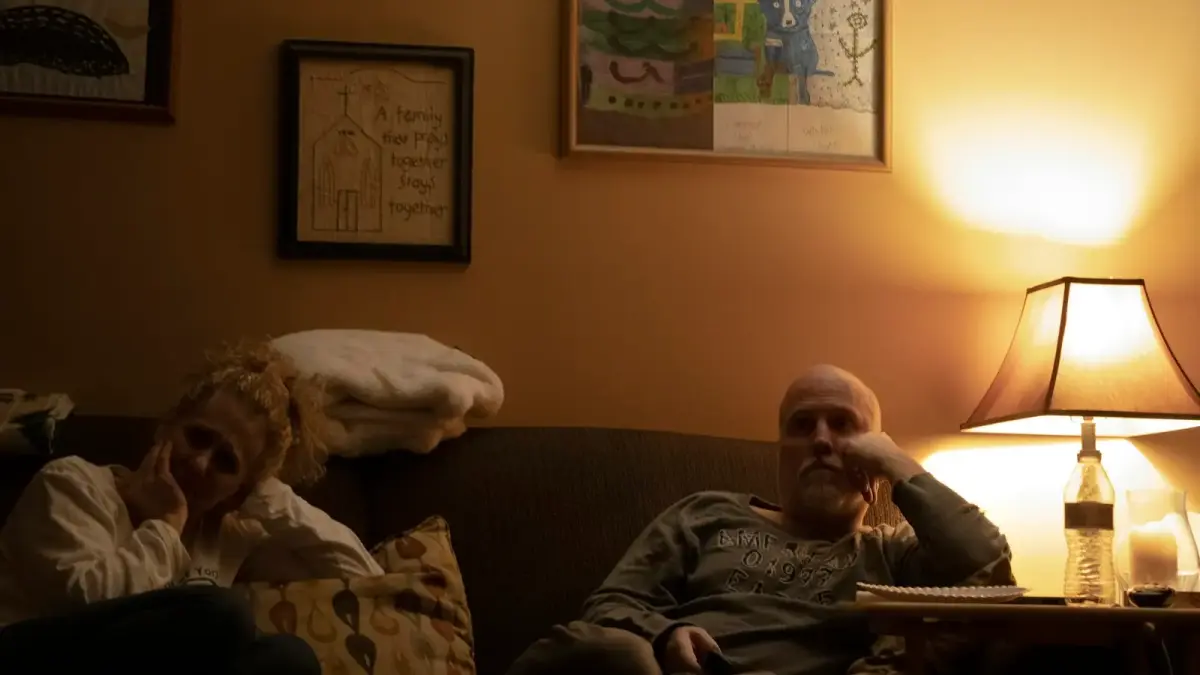
I sat with my daughter last Thanksgiving. After the dishes were done and everyone else had gone to bed, she curled up on the other end of the couch and started scrolling her phone, and I sat there in the quiet with my coffee, and neither of us said anything for twenty minutes.
Then she looked up and said, “I like this, Dad. Just sitting here.”
And I said, “Me too.”
That was all. Two words. But she heard them. She heard the whole thing inside those two words, because she is learning my language the same way I am learning hers. Slowly. With patience. With the willingness to believe that the person across from you is saying more than their words contain.
The thumbs-up at eleven-thirty at night is my entire heart, spelled in the only alphabet I was given. And the hearts she sends me at midnight are her entire heart, spelled in hers.
We are two people who love each other completely, speaking across a gap that neither of us built and neither of us chose. And the bridge is not fluency. The bridge is the willingness to keep trying to hear what the other person actually means.
I think that is enough. I think, at sixty, I have finally learned that it has always been enough.