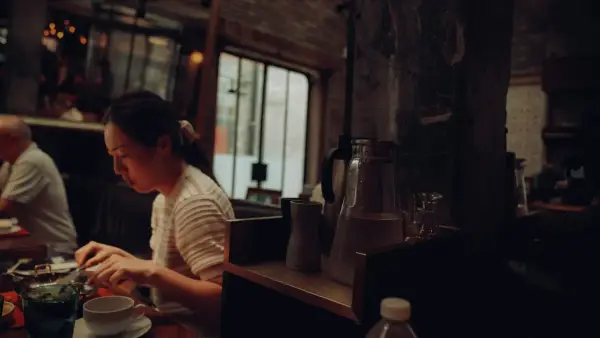
He is 60 and has just realized the reason he always volunteers to do the dishes after dinner is not helpfulness - it is that the sink faces the window and his back is to the room and for eleven minutes every night no one can make eye contact with him and the silence is not suspicious, because a boy who learned that wanting to be alone in a full house was selfish discovered that a man facing a wall is only invisible if he is useful
I am sixty years old, and last Tuesday I stood at the kitchen sink with my hands in water that had gone cold ten minutes earlier and I didn’t move.
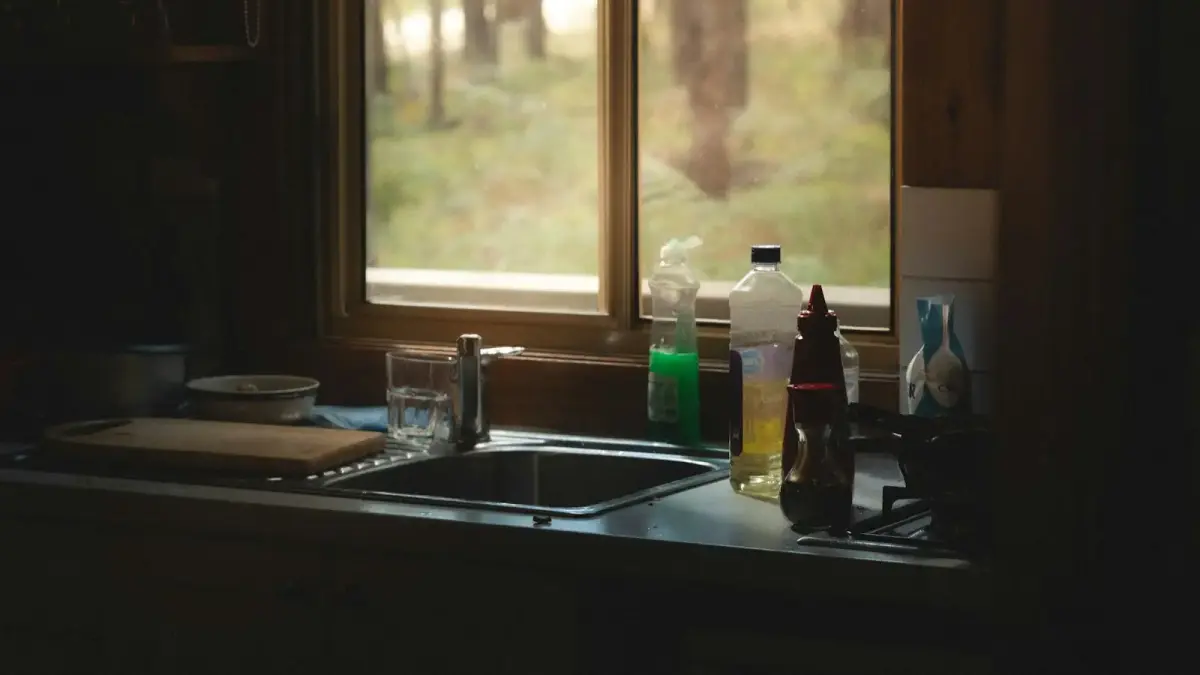
The dishes were done. The counters were wiped. The sponge was wrung out and folded on the edge of the basin the way I’ve folded it every night for thirty-three years. But I stayed there, my fingers pruning in gray water, looking at the backyard through glass that still had a smudge from where my grandson pressed his nose against it last weekend.
My wife called from the living room. “You okay in there?”
“Yeah,” I said. “Just finishing up.”
I wasn’t finishing anything. I was standing in the only position in our house where my back is to every other person and nobody finds it strange. I was buying myself another two minutes of not being looked at. And for the first time in my life, I understood that this is what I have been doing every single night since I was twenty-seven years old.
Not helping. Hiding.
The Architecture of the Kitchen Sink
Here is a fact about kitchen design that no one talks about: the sink almost always faces a wall or a window. The stove might face the room. The island might sit in the center, open to conversation on all sides. But the sink is tucked against the edge, oriented outward, away.
Which means the person standing at the sink has their back to everyone.
I did not choose to do the dishes because I am a generous man. I chose the dishes because the dishes chose the only geography in a family home where silence is not an absence but an expectation. You don’t talk while you scrub a pot. You don’t make eye contact while your hands are in suds. You stand, you face the window, you watch the yard go dark, and nobody walks up behind you and asks what you’re thinking about.
For a man like me - a man who has spent his entire adult life needing solitude the way other people need company - that position is not a chore. It is a room within a room. A door that doesn’t look like a door.
The Boy Who Took Up Too Much Space by Being Quiet
I grew up in a house with five people and two bathrooms and one television. My mother was loud and warm and always moving. My father was loud and tired and always reacting to my mother’s movement. My two sisters orbited between them like planets around twin suns, generating their own noise, their own gravity.
I was the quiet one.
Not shy. Not withdrawn. Not troubled. Just quiet. And in a house that loud, quiet was suspicious.
“What’s wrong?” my mother would ask, finding me reading on my bed on a Saturday afternoon. Nothing was wrong. I was reading. But a twelve-year-old boy alone in his room with a closed door registered as a problem to be solved, not a preference to be respected.
A 2014 study published in the Journal of Research in Personality found that people consistently judge those who seek solitude as less socially competent, less agreeable, and more likely to be experiencing psychological distress - even when the person is simply an introvert enjoying time alone. The researchers called it the “solitude stigma,” and I can tell you it was alive and well in my parents’ house in 1978.
I learned the lesson early. Wanting to be alone when other people were available meant something was wrong with you. Being alone when the house was full meant you were either angry, sad, or selfish. There was no fourth option. There was no version where a boy just needed twenty minutes without being perceived.
The Discovery at Twenty-Seven
I got married at twenty-five. By twenty-seven, I had a wife, a baby, and a two-bedroom apartment where the walls were thin enough to hear the neighbors’ microwave.
I loved my wife. I loved my daughter. I loved them with a fullness that sometimes made it hard to breathe. And I needed to be alone for at least fifteen minutes a day or I would start to feel like I was dissolving.
Not disappearing. Dissolving. Like the edges of me were bleeding into the air and I couldn’t tell where I ended and the apartment began.
I tried the bathroom. But a man in the bathroom for twenty minutes invites questions. I tried the car. But sitting in a parked car in your own driveway at eight in the evening looks wrong. I tried going for walks, but walks after dinner meant missing bedtime, and missing bedtime meant guilt that lasted longer than the walk.
Then one night, I just stood up from the table and said, “I’ll get the dishes.”
My wife smiled. My daughter banged her spoon on the high chair tray. And I walked to the sink, turned on the water, and felt something I hadn’t felt in two years of marriage.
My back was to the room. The water was warm. The window showed me the parking lot of our apartment complex, which was ugly, but it was outside, and outside was a place I could look at without anyone looking back. For eleven minutes, I scrubbed and rinsed and dried, and nobody interrupted me because I was doing something useful.
I had found it. The position where solitude and service are indistinguishable.
The Dish Towel as Exit Strategy
Here is what I need you to understand: I was not resentful. I was not suffering. I was solving a problem that men of my generation were never given language for.
We didn’t say “I need alone time.” We didn’t say “I’m overstimulated.” We didn’t say “I love you and I also need to not be perceived for a few minutes or I’ll lose my mind.” Those sentences didn’t exist for men born in the sixties. What existed was duty, presence, and the quiet expectation that a good man was always available to his family.
Dr. Marti Olsen Laney, in her research on introversion, described the introvert’s need for solitude not as withdrawal but as neurological regulation - a requirement as physical as sleep, as non-negotiable as food. The introvert’s brain processes stimulation through a longer neural pathway, she explained, which means social interaction is literally more taxing. Not emotionally. Chemically.
I didn’t know any of that at twenty-seven. I just knew that the dish towel over my shoulder gave me permission to face away.
And that facing away - for those eleven minutes between dinner and dessert, between the family table and the family couch - was the quietest exit strategy I ever built. Not an exit from my family. An exit from the relentless visibility of being someone’s husband, someone’s father, someone’s answer to every question.
The dish towel was not domestic virtue. It was camouflage.
Thirty-Three Years at the Same Window
We moved four times in our marriage. Different kitchens, different windows, different views. The apartment parking lot became a suburban backyard, which became a different suburban backyard, which became the house where we live now, with a view of a Japanese maple my wife planted when our youngest started kindergarten. That tree is thirty feet tall now.
Every night, I stood at a different sink and looked at a different version of outside and felt the same thing. Relief. Not from my family. From the performance of being always-on, always-warm, always-available.
A 2019 study in the journal Motivation and Emotion found that people who regularly experienced “unsociable solitude” - time alone chosen freely, without loneliness - reported higher levels of creativity, emotional regulation, and self-awareness. The researchers noted that this kind of solitude is one of the most undervalued human needs, particularly in cultures that equate constant togetherness with love.
I could have told them that. But I was probably at the sink.
My kids grew up thinking I was the most helpful man alive. “Dad always does the dishes,” my daughter told her college roommate once, like it was a character trait. She didn’t know that her father’s helpfulness was a shell around a small, necessary silence. She didn’t know that the man drying the cast iron skillet with a towel was not performing love but purchasing solitude in the only currency his generation accepted: usefulness.
The Window at Dusk
The best part is dusk.
When the sun is just below the tree line and the backyard goes that specific shade of blue-gray that only lasts about eight minutes. The kitchen light is on behind me, which means the window becomes half-mirror, half-glass. I can see the yard and I can see a faint reflection of myself, and for a moment both images are true at the same time.
A man at a sink. A man somewhere else entirely.
I watch the birds settle into the maple. I watch the neighbor’s cat walk the fence line. I watch absolutely nothing happen, and I let my thoughts go to whatever place they go when no one is watching them. Sometimes I think about my father, who I now realize was not cold but chronically overstimulated by a life that never offered him a sink to stand at. Sometimes I think about nothing at all, which is the most luxurious thought a sixty-year-old man can have.
The water gets cold. I don’t refill it. I just stand there with my hands in it, feeling the temperature drop, which is its own kind of timer. When the water is cold, the performance is over. Time to rejoin.
What I Want You to Know
If you are a man who volunteers for the dishes, or the grocery run, or walking the dog at night, or checking on the car in the driveway, or going to the hardware store for a single bolt that could wait until Saturday - I see you.
I see the architecture of your hiding. The way you have built small rooms inside your life where you can stand with your back to the world for a few minutes without anyone asking why. The way you turned solitude into service because no one ever told you that needing to be alone was just a fact about your nervous system, not a moral failing.
You are not selfish for needing those eleven minutes. You are not broken for wanting them. You are not a bad husband or a distant father or a man who loves his family less than the man who sits on the couch all evening making conversation.
You are a person who found a way to survive inside a life you chose and love without losing the small, quiet center of yourself that makes everything else possible.
The dishes are done. The towel is folded. The water is cold and going down the drain.
You can come back to the room now.
But you and I both know - you’ll be back at that sink tomorrow night. And the eleven minutes will be there, waiting for you, the way they always are. Warm water. A window. The particular mercy of being useful and invisible at the same time.
That’s not hiding. That’s knowing exactly what you need and building a life that includes it, even if you had to disguise it as a chore.
The boy who learned that wanting to be alone was selfish became a man who found a place where alone looks like love. And maybe that’s not the worst thing a man can build with sixty years and a kitchen sponge.