He's 60 and just realized the way he holds the steering wheel in traffic - one hand draped over the top of the wheel, elbow on the window frame, jaw set the same way his jaw always sets when the world is moving too slowly - is the exact posture his father held on every commute home from the plant for thirty years, and a boy who sat in the passenger seat watching a man drive home from a job that took everything from him except the thirty minutes behind the wheel learned that the one-handed hold at the top of the wheel was never about driving but about a man whose entire day belonged to someone else reclaiming the only sovereignty a working man ever had, one red light at a time
The arm on the window frame
I was sitting in traffic on a Tuesday - nothing special about the Tuesday, nothing urgent about wherever I was going - when I caught my own reflection in the side mirror.
Not my face. My arm.
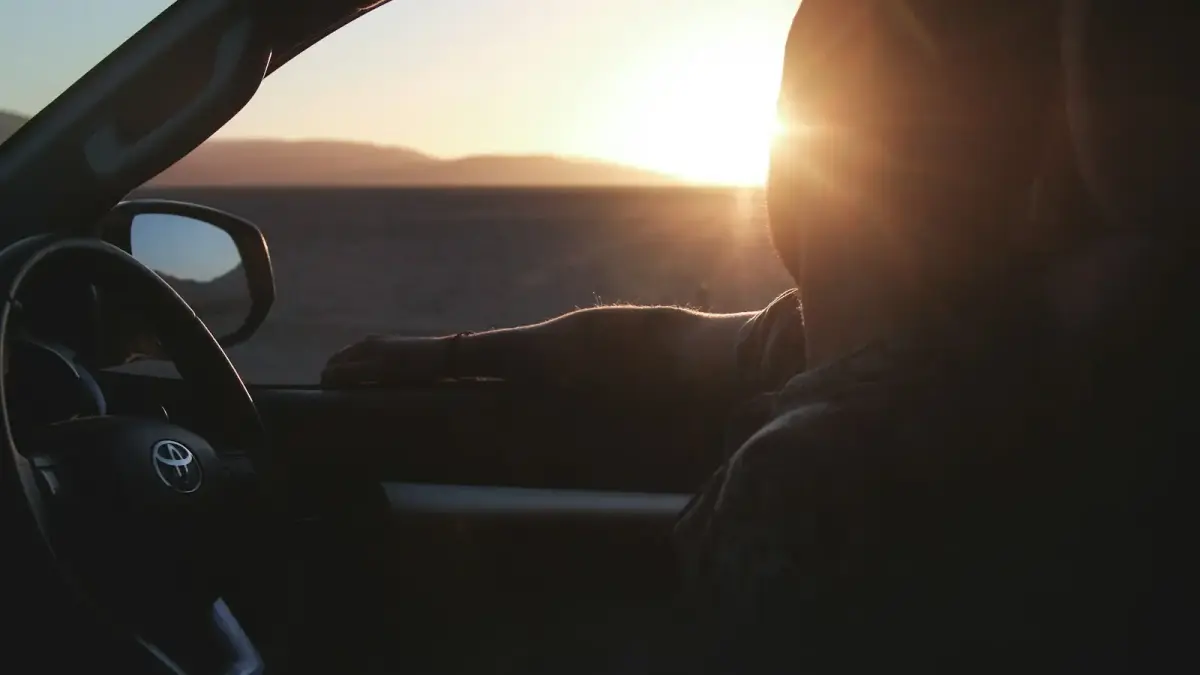
Left hand draped over the top of the steering wheel at twelve o’clock. Elbow resting on the open window frame even though the air conditioning was on. Right hand nowhere near the wheel. Jaw pushed slightly forward, the way it does when you’re not angry but you’re not relaxed either - when you’re somewhere between patience and the memory of needing patience.
I looked at that arm and I didn’t see mine. I saw my father’s.
The exact posture. The exact angle of the wrist. The same slight lean toward the driver’s side door like the car itself was something you leaned into rather than sat inside. I was sixty years old and I was sitting in the body of a man who’d been dead for eleven years, holding the wheel the same way he held it on every drive home from the stamping plant from 1971 to 2003.
Nobody taught me this. Nobody said hold it like that. But I hold it like that every single time.
Thirty minutes of sovereignty
My father worked the second shift at an automotive parts plant for most of my childhood. He left the house at two in the afternoon and came home sometime after eleven at night.
I didn’t see much of his working life. I saw him in the mornings, moving slowly through the kitchen with the particular heaviness of a man who sleeps during the hours the world is awake. And I saw him on Saturdays, when he’d take me along on errands.
That’s where I learned his driving posture.
One hand at the top of the wheel. Not ten and two, the way they taught in driver’s ed. Not the cautious grip of someone who read the manual. His left hand draped over the top with the kind of lazy authority that said this is the one machine in my life that goes where I tell it to go.
The elbow out the window even in February. The jaw set. The eyes reading the road three intersections ahead - not nervous, not scanning. Settled. The way a man looks when he’s in the only part of his day that isn’t supervised, timed, or owned by someone whose name is on a building he’ll never enter through the front door.
A 2019 study published in the Journal of Nonverbal Behavior found that habitual postures - the ones we return to without thinking - are more closely linked to emotional states than to physical comfort. We don’t hold our bodies the way that feels best. We hold them the way that feels true.
My father’s driving posture was true. It was the truest thing about his day.
What a boy learns in the passenger seat
You don’t learn your father’s gestures the way you learn math or manners. Nobody sits you down. There’s no lesson.
You absorb them the way a sponge absorbs water - through proximity, through repetition, through the quiet hunger a boy has to understand what it means to be a man by watching one move through space.
I sat in that passenger seat hundreds of times. I watched his left hand find the top of the wheel every single time without him ever looking at it. I watched his elbow settle onto the window frame like it was a desk he’d been assigned. I watched his jaw do that thing - that forward-set thing, not clenching, just positioning, the muscular equivalent of a man squaring his shoulders in a room where no one asked him to stand up.
Research on motor mimicry supports what any son already knows in his body. A 2016 study in Psychological Science demonstrated that children unconsciously replicate the postural habits of their primary caregivers, often retaining those physical patterns well into adulthood. The researchers called it “embodied inheritance” - the things we carry not in memory but in muscle.
I didn’t remember deciding to hold the wheel that way. I just held it that way. By the time I was seventeen and driving my own car, the posture was already installed. Left hand at twelve. Elbow out. Jaw set. Ready for a commute I hadn’t started yet, from a job I didn’t have, in a life that would look nothing like his.
Except for this. Except for the way I hold the wheel.
A man whose direction was given, not chosen
Here is what I understand now about my father’s driving posture that I couldn’t have understood at twelve.
His entire day was direction given to him. Stand here. Lift this. Move there. The foreman told him where. The line speed told him when. The whistle told him to start and stop. For eight and a half hours, his body was a tool that someone else operated.
Then the shift ended and he walked to the parking lot and sat down in a car that only moved when he decided it moved.
Left turn or right turn - his choice. Fast or slow - his choice. Windows up or down. Radio on or off. The route home was always the same, but the sameness was chosen, and that made it different from every other repetition in his day.
Gabor Mate has written about how the body stores the experiences that the mind doesn’t have language for. A working man in 1985 didn’t have the vocabulary for autonomy or agency or self-determination. He had a steering wheel and thirty minutes of road between the plant and his driveway.
That one-handed hold at the top of the wheel - I understand it now as something closer to a declaration than a habit. It said: this is the one direction I’m choosing. This is the one machine that answers to me.
The jaw set forward wasn’t tension. It was resolve. The resolve of a man who spent all day being moved and was now, for thirty minutes, the one doing the moving.
The reflection in the side mirror
I’m sixty. My commute, when I had one, was climate-controlled. Optional, some years. I worked in an office with my name on a door, not someone else’s name on a building. My hands were never raw. My back never seized the way his did on cold mornings.
And yet.
My arm in the side mirror is his arm. The drape of the wrist is his drape. The angle of the elbow on the frame - even when the window is up, even when there’s no frame to rest on because the glass is closed - I hold the elbow as if the frame is there. As if the open window is part of the posture and not just a detail.
A 2021 study in Frontiers in Psychology on intergenerational transmission of gesture found that sons replicate their fathers’ habitual physical behaviors with remarkable precision - not just the broad strokes but the specific angles, the micro-adjustments, the timing. The researchers noted that these inherited postures often outlast the conditions that created them. A man holds his body the way his father held his even when the world those gestures were built for no longer exists.
That’s me at a red light in 2026. Holding the posture of a man who drove home from a stamping plant. In a car with lane assist and a backup camera and seat warmers. With nowhere in particular to be. Holding the wheel like it’s the last piece of territory I have to defend.
I don’t work in a plant. I was never supervised the way he was supervised. But my body doesn’t know that. My body learned its lessons in the passenger seat of a 1979 Ford LTD and never unlearned them.
The physical vocabulary of fathers
We talk about what fathers teach their sons. How to throw a ball. How to shake a hand. How to look someone in the eye.
We don’t talk about the things they teach without teaching. The muscular vocabulary. The way a man sits in a chair. The way he stands in a doorway. The way he holds a steering wheel on a road he’s driven ten thousand times.
These are the lessons that bypass language entirely. They go straight from his body to yours through years of watching, and they settle into your muscles like sediment at the bottom of a river. You don’t know they’re there until one afternoon in traffic you catch your own arm in the side mirror and your breath catches because for one second you think he’s driving.
Daniel Goleman wrote about how emotional learning happens fastest through observation, not instruction. A child doesn’t learn what composure looks like from being told to calm down. He learns it from watching a man hold a steering wheel with one hand while the world moves too slowly around him and deciding, without deciding, that this is what it looks like to be in control of the only thing you’re allowed to control.
The sovereignty of the steering wheel
My father never called it sovereignty. He never called it anything.
He just drove home. Left hand over the top of the wheel. Elbow on the frame. Jaw set. Eyes forward. Thirty minutes between the last place that owned him and the first place that needed him, and in that thirty minutes he was neither owned nor needed. He was just a man driving.
I think about that now when I’m sitting in traffic and I feel my hand drift to the top of the wheel. I think about how the steering wheel might be the last honest object in a working man’s life - the one thing that actually goes where you point it, that responds to the pressure of your hand with movement in the direction you chose.
And I think about a boy in the passenger seat who didn’t know he was memorizing anything. Who was just sitting there, watching his father drive, learning with his muscles what his father couldn’t say with his mouth.
You’re allowed to keep the posture even though the conditions that created it are gone. You’re allowed to hold the wheel the way he held it. You’re allowed to set your jaw at a red light and lean toward the door and rest your elbow on a window frame that exists only in your body’s memory.
It’s not a habit. It’s an inheritance. And some inheritances don’t come through paperwork or bank accounts or the division of property after a funeral.
Some inheritances come through the angle of a wrist on a steering wheel, passed from a man who needed thirty minutes of his own direction to a boy who didn’t know he was receiving the most honest thing his father ever gave him.