He's 61 and has finally understood that the reason he takes the dog for a walk every evening at exactly the same time is not discipline and it is not health - it is that the walk became the only thirty minutes in his day where no one asks him anything, where the leash in his hand is the only obligation his body is carrying, and the dog is the only companion who has never once needed him to perform a version of himself
I watched my father do it for years and never understood what I was seeing.
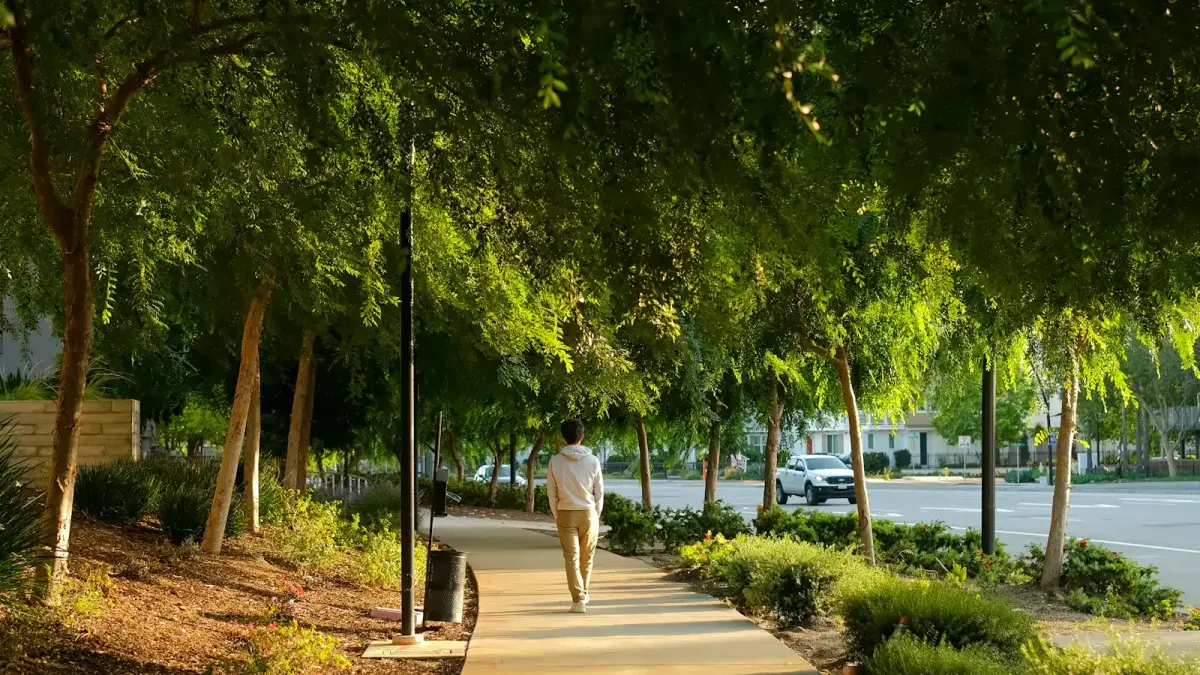
Every evening at 6:45, he’d clip the leash onto our old lab’s collar, pocket his keys, and disappear out the front door. He never invited anyone. He never varied the route. If dinner was almost ready, he’d go anyway. If it was raining, he’d go anyway. My mother would sometimes shake her head at the back door and say, “Your father and that dog,” like it was a mild character flaw she’d made peace with.
I thought it was discipline. I thought he was one of those men who simply needed structure, the way some men need their coffee at exactly the same temperature every morning.
I was wrong about all of it.
I know because I am sixty-one years old now, and I have become my father at the front door. Same keys in the pocket. Same thirty-minute loop through the neighborhood. Same dog who doesn’t care whether I had a good day or a terrible one.
And I have finally stopped pretending this is about exercise.
The role that never clocks out
Here is something no one tells you about being a man for six decades: you are never off duty.
Not when you’re sleeping, because your wife’s breathing changes and you’re already calculating whether she’s anxious about something you should have noticed. Not when you’re on vacation, because someone still needs you to navigate, to decide where to eat, to carry the thing that doesn’t fit in anyone else’s bag.
You are the provider at breakfast. The problem-solver at work. The steady one at dinner. The one who doesn’t get to fall apart at funerals because someone has to drive home.
A 2021 study published in the Journal of Research in Personality found that men who score high on what researchers call “role rigidity” - the inability to step outside their established social identities - report significantly higher levels of chronic stress and emotional exhaustion. Not because the roles themselves are harmful, but because there is no exit. The performance never ends.
I read that and thought about how I have been some version of “the capable one” since I was nineteen. Capable at work. Capable at home. Capable in a crisis. Capable when I didn’t want to be capable. Capable when I was breaking.
The dog does not need me to be capable. The dog needs me to open the door.
What men of my generation were never given language for
My father never said the words “I need alone time.” Men of his generation - and honestly, men of mine - didn’t have that vocabulary. We didn’t read articles about boundaries. We didn’t tell our wives we were “overstimulated.” We didn’t announce that we needed to regulate our nervous systems.
We just walked the dog.
And that was the genius of it, if you think about it. The dog walk is the only form of solitude a man can take without anyone questioning his motives. No one worries when a man walks the dog. No one asks, “Are you okay?” or “Are you mad at me?” or “What’s wrong?”
If I sat alone in the bedroom for thirty minutes, my wife would knock. Not because she’s controlling - she’s wonderful. But because a man sitting alone in a room is a problem to be solved. A man walking a dog is just a man walking a dog.
Brene Brown has written extensively about how men experience shame around vulnerability - how the expectation to be stoic, dependable, and emotionally contained creates a kind of invisible cage. She’s right. But what she doesn’t always say is that men build escape hatches. Quiet ones. Ones that look like hobbies or habits or routines.
The garage. The fishing trip. The long drive to the hardware store for one bolt.
The evening walk.
The dog knows something your family doesn’t
My dog’s name is Walter. He’s a nine-year-old beagle with a gray muzzle and a hip that clicks when it’s cold. He is not a therapy animal. He has no training. He ate a shoe last month.
But Walter has done something for me that no human in my life has ever done, and I don’t say that to diminish the humans. I say it because it’s true.
Walter has never needed me to perform.
He doesn’t need me to be funny. He doesn’t need me to have answers. He doesn’t care whether I got the promotion or lost the account or said the wrong thing at the dinner party. He doesn’t need me to be the version of Marcus that holds it together.
He needs me to walk. That’s it. Forward motion, at whatever pace my legs feel like going.
A 2019 study published in the journal Frontiers in Psychology found that human-animal interactions reduce cortisol levels and activate the parasympathetic nervous system - the branch responsible for rest and recovery. But here’s the part that struck me: the researchers noted that the effect was strongest when the interaction was unstructured. Not training. Not performing tricks. Just being together, without agenda.
Without agenda.
I have not done anything without an agenda in forty years. Every conversation has a subtext. Every dinner has logistics. Every phone call from my adult children has a question nested inside a question.
Walter and I walk, and the agenda is the sidewalk.
The leash is the lightest thing I carry
I want to tell you something about the weight of a leash in your hand.
It weighs almost nothing. A few ounces of nylon and a metal clip. And yet, when I pick it up at 6:45, something in my shoulders drops. Something in my jaw unclenches. My breathing changes before I even reach the door.
It took me years to understand why.
The leash is the only obligation my body carries lightly. Everything else I hold - the mortgage, the marriage, the aging parents, the kids who still need guidance even though they’re grown, the reputation I’ve spent decades maintaining - all of it sits in my shoulders like concrete.
The leash asks nothing of me except that I hold it. And even then, not tightly.
Daniel Goleman wrote about emotional labor - the constant expenditure of energy required to manage other people’s feelings while suppressing your own. He was talking about the workplace, but he could have been talking about my living room. About the effort it takes to walk through your own front door and immediately become the person everyone needs you to be.
On the walk, I am no one. I am just a man with a beagle, passing houses where other men are being needed.
The route never changes, and that is the point
People have asked me why I always walk the same route. Same left turn at the end of the driveway. Same loop past the elementary school. Same pause at the corner where Walter investigates the same patch of grass with the same intensity, every single evening, as though something might have changed in the last twenty-four hours.
The answer is that the sameness is the gift.
My days are full of decisions. Dozens of them before lunch. Hundreds by dinner. What to say. What not to say. How to respond to the email that’s really about something else entirely. How to be supportive without being patronizing. How to show up without showing off.
The walk requires zero decisions. Left turn, straight, right, right, home. Walter leads. I follow. My brain, for the first time all day, does not have to choose.
And in that absence of choosing, something happens that I can only describe as becoming myself again. Not the husband. Not the father. Not the employee or the neighbor or the man who remembers to bring in the trash cans. Just the person underneath all of that.
I didn’t know he was still in there until the walk showed me.
The thing a man cannot admit
Here is the confession at the center of all of this, the one I couldn’t have articulated ten years ago and can barely write now.
I need to be nobody for thirty minutes a day.
Not someone’s husband. Not someone’s father. Not someone’s manager or friend or dependable one. Just a body moving through the evening air, holding a leash, listening to nothing in particular.
And I couldn’t say that. Not to my wife, not to my friends, not to myself. Because men of my generation don’t admit they need disappearing. We don’t confess that the weight of being needed has become the heaviest thing we carry. We don’t say, “I love you all, and also I need thirty minutes where none of you exist.”
So we walk the dog.
A 2022 study in Psychological Science found that individuals who regularly engage in what researchers call “identity rest” - brief, recurring periods of disengagement from social roles - showed lower levels of burnout, higher relationship satisfaction, and better emotional regulation. The study noted that men were significantly less likely than women to name these periods as intentional self-care, instead framing them as chores or routines.
That’s it. That’s the whole thing. We frame our healing as chores because we were never given permission to call it what it is.
He just needs you to walk
If there is a man in your life who disappears for thirty minutes every evening with a leash in his hand, I want you to know something.
He is not avoiding you. He is not unhappy. He is not pulling away.
He is putting himself back together so he can return to you whole.
The walk is not discipline. It is not fitness. It is not a habit. It is the closest thing to freedom his nervous system has ever known - a half hour where the only expectation is forward motion, where the only companion is one who has never once asked him to explain himself.
Walter is slowing down these days. His muzzle is almost entirely white. The hip clicks louder in the cold. Some evenings we barely make it past the school before he wants to turn around.
That’s okay. We’ll walk shorter. We’ll walk slower. We’ll still go at 6:45.
Because the walk was never about the distance. It was about the thirty minutes where I got to remember that underneath all the roles and responsibilities and decades of performing competence, there is still a man who just wants to move through the evening air without anyone needing anything from him.
And a dog who understood that long before I did.