He's 61 and has just realized that the way he taps a watermelon at the grocery store - three knocks with the flat of his knuckles, head tilted, listening for the deep hollow sound that means it's ready - is the exact same test his father performed every August at the roadside stand on Route 9, and the son who learned to listen for ripeness through a rind was never learning about fruit but about the kind of man who could tell what was good by the sound it made when you asked
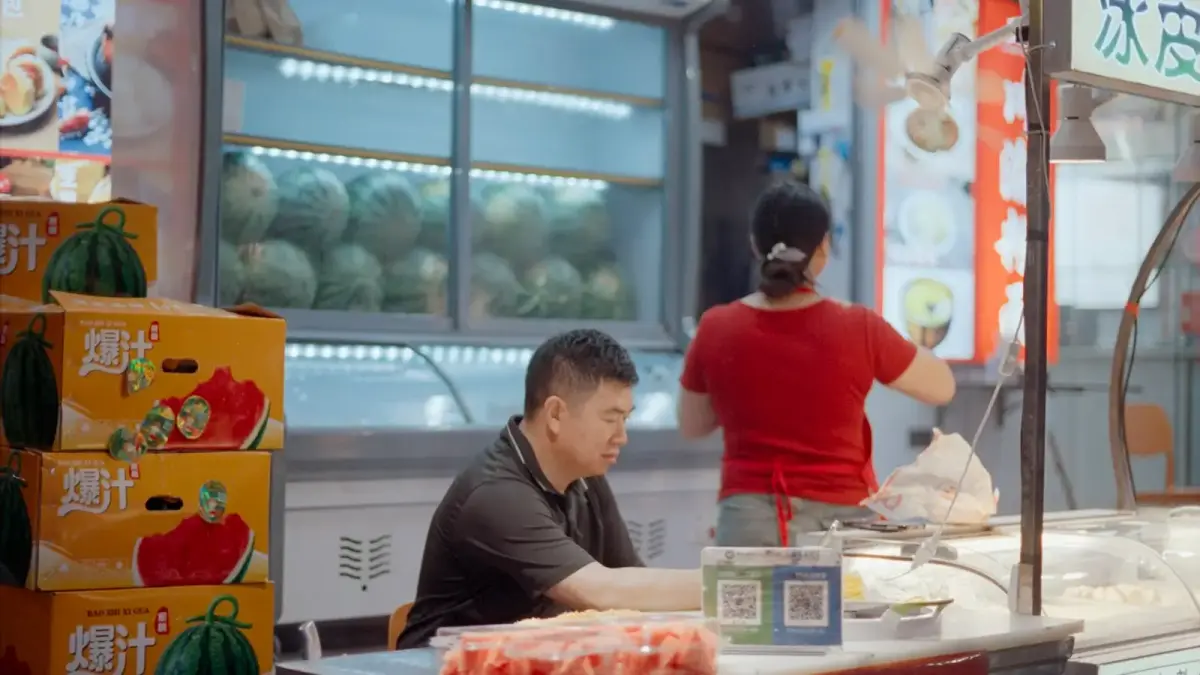
I was standing in the produce section of a grocery store last Tuesday, holding a watermelon with both hands, when my body did something my mind hadn’t asked it to do.
Three knocks. Flat of the knuckles. Head tilted slightly to the right, ear angled toward the rind. Listening for the deep, hollow sound that means the fruit is ready.
I’ve done this a thousand times. Maybe two thousand. I’ve done it at Kroger, at Safeway, at farmers’ markets in towns whose names I’ve already forgotten. I’ve done it in front of my wife, my kids, strangers who glance over and then look away because a grown man communing with a melon doesn’t warrant much attention.
But last Tuesday, something cracked open. I heard the knock come back - that low, promising thud - and for one disorienting second, I wasn’t in a fluorescent-lit supermarket. I was eight years old, standing next to my father at a roadside stand on Route 9 in late August, watching him do the exact same thing.
Three knocks. Flat of the knuckles. Head tilted.
I put the watermelon in my cart and walked to the parking lot and sat in my car for a while. I’m sixty-one years old, and I just realized I’ve been performing my father’s hands for most of my life without knowing it.
The Test He Never Explained
My father was not a man who explained things. He demonstrated them.
He’d pull the truck over when he saw a hand-painted sign - WATERMELONS $3 - and walk up to a folding table covered in green rinds still warm from the field. He never asked the seller which one was good. He never looked for a sticker or a label or anyone else’s opinion.
He picked one up. He held it the way you’d hold something you respected - firm but not aggressive, like he was greeting it. Then the knocks came.
Three of them, always. Not two, not four. The flat of his knuckles against the belly of the melon, each knock spaced evenly, each one a question. And he’d tilt his head and listen for the answer.
If the sound came back thin and tight, he’d set it down without a word. If it came back deep and round - hollow the way a drum is hollow, full of potential - he’d nod once and carry it to the truck.
I never asked him what he was listening for. He never told me. But somehow, decades later, I knock the same way. Three times. Same spot on my knuckles. Same tilt of the head.
A 2019 study published in the Journal of Family Psychology found that behavioral rituals are transmitted between generations with remarkable fidelity - not through instruction but through repeated observation during formative years. Children don’t learn what their parents teach. They learn what their parents do when they think no one is paying attention.
My father thought I was just tagging along. I was memorizing him.
A Man Who Trusted His Hands
The watermelon was only one chapter in a much longer story about how my father moved through the physical world.
He squeezed avocados with his thumb - one gentle press, right at the stem end. He could tell you if it was ready today or tomorrow, and he was almost never wrong. He smelled cantaloupes the way some people smell wine, inhaling slowly through his nose with his eyes half-closed, searching for the faint sweetness that meant the fruit had sugar in it.
He held tomatoes in his palm like he was weighing a small heart. Not squeezing. Just feeling. Letting gravity tell him whether the flesh was dense and alive or hollow and disappointing.
He never read labels. He didn’t trust ingredient lists or nutritional panels or sell-by dates stamped in ink that smudged if you rubbed it. He trusted contact. He believed the world would tell you what it was if you touched it the right way and paid attention to what came back.
This wasn’t limited to produce. He could run his hand along a board and tell you if it was warped before you held a level to it. He could listen to an engine and know which cylinder was misfiring. He’d press his palm flat against a wall to check if the heat was coming through before he looked at the thermostat.
His entire epistemology - though he would have never used that word, would have probably told me to stop showing off if I said it - was built on direct sensory contact. The world was not an abstraction to him. It was a series of textures, temperatures, sounds, and weights that would answer you honestly if you asked with your hands.
The Dialect of Fatherhood No One Records
Here is what nobody tells you about losing a parent: you don’t just lose the person. You lose an entire language.
My father’s language was physical. It was the way he tested things before he trusted them. The way he shook a man’s hand - firm, one pump, eye contact, release. The way he turned a wrench. The way he dried dishes, always starting with the glasses because they spotted if you left them too long.
These gestures were his dialect. Not English, not words at all, but a complete system of meaning expressed through touch and rhythm and physical attention.
And the strange, aching thing is that I speak it now.
I catch myself drying the glasses first. I catch myself pressing my palm against walls. I catch myself shaking hands the way he did - firm, one pump, eye contact - and I never decided to do any of this. It just happened. The way an accent happens. The way you pick up the cadence of someone you lived beside for eighteen years.
Daniel Goleman has written extensively about what he calls “social inheritance” - the ways we absorb the emotional and behavioral patterns of our caregivers not through instruction but through mirror neurons and implicit memory. We don’t choose to become our parents. Our nervous systems record them and play them back when we’re not looking.
The watermelon knock is the one that finally woke me up. But it’s not the only track on the record.
What Ripeness Really Sounded Like
My father wasn’t listening for ripeness. Not really.
He was listening for honesty. He wanted to know if the fruit was what it appeared to be - full, ready, worth the money and the effort of carrying it home. The knock was a question, and the sound was the answer, and the whole exchange lasted less than three seconds, but it contained a philosophy.
Can this thing be trusted?
He asked that question of everything. Watermelons, used cars, weather forecasts, people. He had a way of sizing up a situation that wasn’t intellectual or analytical. It was sensory. He’d walk into a room and know something was off before anyone spoke. He’d meet someone and decide, within a handshake, whether they were solid.
A 2021 study published in Psychological Science found that people who rely on somatic markers - gut-level physical signals - for decision-making often demonstrate higher accuracy in social judgments than those who rely on purely rational analysis. The researchers called it “embodied cognition.” My father would have called it common sense.
He could tell what was good by the sound it made when you asked.
That sentence has been sitting in my chest for a week now, and I still can’t say it out loud without my voice doing something I wasn’t planning.
Because he could. He really could. And what I’ve slowly come to understand is that he wasn’t just selecting fruit. He was modeling a way of being in the world - a way that said: pay attention. Get close. Don’t take someone else’s word for it. Touch it yourself. Listen to what comes back.
The Things Sons Carry Without Knowing
I have his tools in my garage. His watch in a drawer. A photograph of him holding me on his lap at a picnic table, both of us squinting into the sun, neither of us smiling exactly but both of us perfectly content.
Those are the inheritance you’d expect. The physical objects. The documented memories.
But the deeper inheritance is the one that lives in my muscles. In my knuckle memory. In the automatic tilt of my head when I’m trying to decide if something is ready.
I tap watermelons the way he tapped watermelons. I dry glasses first. I judge firmness with my palm instead of my eyes. I shake hands like the handshake matters - because he taught me, without words, that it does.
A 2023 study in Frontiers in Psychology described what researchers call “embodied legacy” - the physical habits, gestures, and somatic patterns that children inherit from parents through years of unconscious observation. These patterns, the study found, persist long after the conscious memories of learning them have faded. The body remembers what the mind forgets.
My son is thirty-four. Last summer, I watched him pick up a watermelon at a Fourth of July cookout. He held it with both hands. He knocked three times - flat of his knuckles - and tilted his head to listen.
He has never seen a photograph of his grandfather doing this. I never sat him down and taught him. But there it was. Three generations of men, listening for the same hollow sound, trusting the same test, speaking the same physical dialect that none of us ever put into words.
The Kind of Man Who Listened
My father died eleven years ago. Prostate cancer, caught late, because he was also the kind of man who didn’t go to doctors until his body forced the issue.
I think about him most in grocery stores. Which is a strange place to grieve, surrounded by bright packaging and background music and the soft mist that sprays over the lettuce every ninety seconds. But grief doesn’t care about setting. It shows up where the body remembers, and my body remembers him most when my hands are doing what his hands taught them to do.
He never said “I love you.” Not once that I can recall. He wasn’t cruel about it - he wasn’t withholding affection to make a point. He just didn’t have that particular word in his vocabulary. Love, for him, was not a declaration. It was a demonstration.
It was driving forty minutes to a roadside stand because the watermelons were better there. It was teaching his son to listen for ripeness without ever saying a word about it. It was showing up, every single time, with his hands ready to do the work.
I used to wish he’d said it. Just once. I carried that wish around for decades like a stone in my coat pocket - always there, always heavy, never quite painful enough to put down.
But last Tuesday, standing in the produce section, performing his ritual with his knuckles and his tilt, I heard something I hadn’t heard before.
The knock came back hollow and deep and ready, and I realized that I’ve been hearing my father say it my whole life. Not with words. With the sound a watermelon makes when a man who loves you shows you how to listen.
If you’ve ever caught yourself performing a gesture that belongs to someone you’ve lost - a way of folding, stirring, checking, holding - you already know what I’m talking about. That gesture is not a habit. It’s a conversation that’s still happening. It’s love in its most durable form - not a sentence that fades, but a motion that passes from hand to hand to hand, surviving every silence, answering every knock.
You learned it without trying. You carry it without thinking. And every time your body performs it, the person who taught you is still right there, standing beside you, listening for the same sound.