He's 62 and still keeps a box of photographs in the hall closet that took two weeks to come back from the drugstore - twenty-four exposures on a roll, each one a decision, and the reason he cannot explain to his daughter why he still prints the ones that matter even though her phone holds ten thousand images is that a boy who waited fourteen days to find out whether he captured Christmas morning learned that a photograph was not a picture but a promise you made to a moment that it would not be forgotten
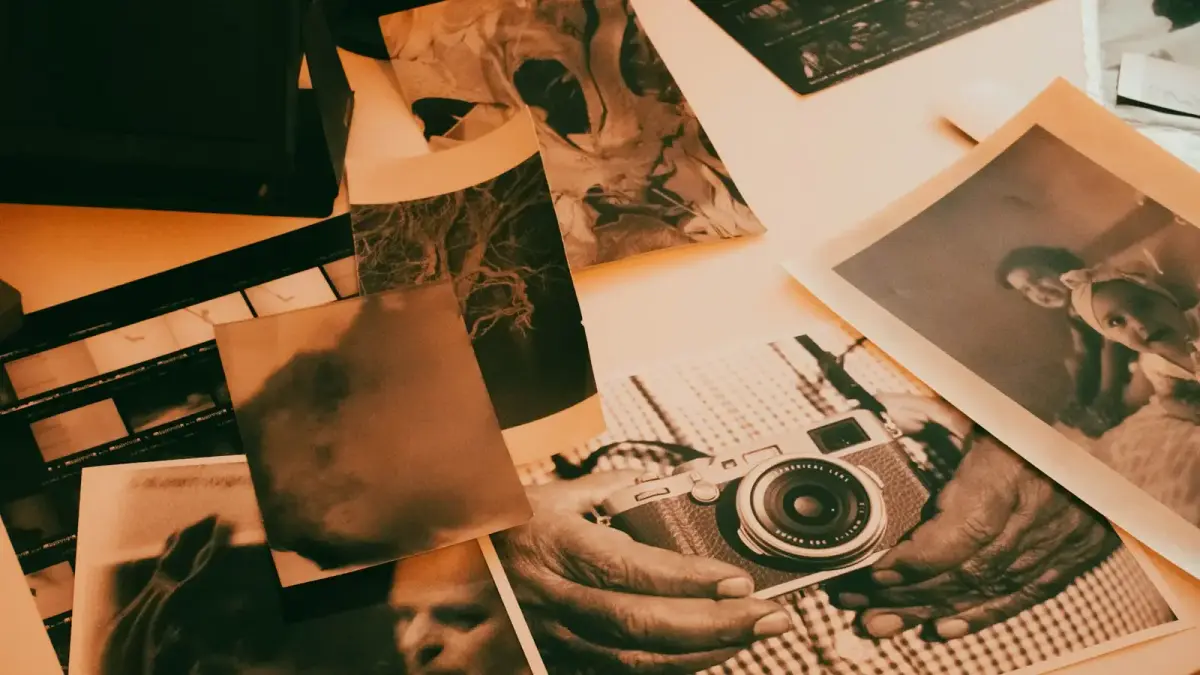
The Box Weighs Almost Nothing and Almost Everything
I found it again last weekend. Top shelf of the hall closet, behind the Christmas ornaments we never hang anymore and a wool scarf nobody claims.
A shoebox. Not even a proper storage container - just a Florsheim box from a pair of dress shoes I bought for my brother’s wedding in 1989. Inside it, maybe three hundred photographs, loose, no album, no order. Some of them have bent corners. A few have that orange-yellow cast that happens when the light was wrong and nobody knew it for two weeks.
I sat on the hallway floor and opened it. The smell hit first - that particular chemistry of drugstore photo paper that has no equivalent in the modern world. Part chemical, part dust, part the faint ghost of whatever was in the envelope with them. Then the weight. Not physical weight. The weight of knowing every single one of these images was a choice someone made with a finite resource.
Twenty-four exposures. Sometimes thirty-six if you splurged. Each one a tiny contract between you and a moment.
My daughter walked past and glanced down. “You know I can scan all of those in like twenty minutes, right?”
She meant well. She always means well. But she was offering to solve a problem I wasn’t having.
Loading the Film Was the First Act of Commitment
You have to understand the ceremony of it if you grew up with it.
You bought the roll at the drugstore or the grocery store. Kodak Gold 200 if you were practical. Kodak 400 if you wanted to shoot indoors. Fuji if you were feeling adventurous or it was on sale.
You opened the canister. That satisfying pop of the plastic lid. You pulled the film leader out, threaded it into the camera’s take-up spool, and closed the back. Then you advanced it - two or three blank shots to get past the exposed section - and the counter on top of the camera clicked to number one.
Number one. You had twenty-four ahead of you, and every single one cost something. Not just money, though there was that too. Each click of the shutter was an act of selection. You were saying, out of everything happening in front of me right now, this is the thing I choose to record.
There was math involved, and I don’t mean arithmetic. It was a kind of emotional calculus. Birthday party, and the cake is coming out, and you’ve already shot eight frames this morning, and the counter says you have sixteen left, and tomorrow is the school play. Do you take the wide shot of the whole table? The close-up of your kid’s face? Both? Can you afford both?
A 2014 study published in the Journal of Consumer Research found that scarcity doesn’t just limit choice - it deepens engagement with the choices we make. When resources are constrained, people invest more attention, more care, and more meaning in each decision. The researchers called it the “focus effect” of scarcity.
We didn’t call it anything. We just called it taking pictures.
The Two-Week Wait Was Where Memory Did Its Quiet Work
Here’s something my daughter will never experience: not knowing whether you got the shot.
You dropped the canister off at the drugstore counter. Sometimes a dedicated photo counter, sometimes just the regular register where they also sold cough drops and birthday cards. You filled out the little envelope. Name, phone number, single prints or doubles. Glossy or matte.
Then you waited. Seven to fourteen days depending on where you lived and which service they used. Two weeks of not knowing whether Christmas morning turned out, whether the birthday candles were blown out too fast, whether your thumb was over the lens for the only shot you took of your grandmother that year.
That wait did something to you. It created a gap between the moment and the image, and in that gap, your memory had to do its own work. You remembered the morning by what it felt like, not by a screen you could check thirty seconds later. The photograph, when it finally arrived, became a negotiation between what you remembered and what actually happened.
Sometimes the photo was better than the memory. Sometimes worse. But it was never redundant. It was never one of ten thousand.
Dr. Daniela Palombo, a memory researcher at the University of British Columbia, has written extensively about how physical objects serve as what she calls “memory anchors” - external cues that stabilize autobiographical memory in ways that digital records often don’t. A printed photograph, held in your hand, activates spatial and tactile memory systems that a screen image simply cannot.
I think about this when I see my daughter scrolling through her camera roll. Thousands of images, each one taken without cost, without pause, without the quiet negotiation of “is this worth it?” She’s not doing anything wrong. But she’s doing something different. Something that comes from a completely different relationship with time.
Twenty-Four Chances Taught You What Mattered
Here’s what nobody tells you about growing up with film: the limitation was the lesson.
When you only had twenty-four exposures, you developed - no pun intended - a kind of internal radar for significance. You learned to feel the moments that mattered before they happened. The way the light hit your mother’s face while she was reading the Sunday paper and didn’t know anyone was watching. The way your kid held a baseball for the first time with both hands, studying the seams.
You learned to see before you shot. Not compose, not frame - those are technical words for something that was actually emotional. You learned to feel when a moment crossed the line from ordinary to worth remembering.
And you missed things. Of course you missed things. You were out of film at the fireworks. You forgot to bring the camera to the beach. You took twenty-three perfect shots and the twenty-fourth was your own foot because the roll advanced wrong.
But the missing was part of it. The gaps in the record were honest. They said: I was there, but I was living it, not documenting it.
Barry Schwartz, the psychologist who wrote The Paradox of Choice, has argued that more options don’t always produce more satisfaction. In fact, an abundance of choice often leads to what he calls “satisficing” - settling rather than savoring. When you had twenty-four shots, every one you took was an act of conviction. When you have unlimited storage, every shot is provisional. You’ll sort through them later. You’ll delete the bad ones eventually. You’ll organize them someday.
Someday is doing a lot of heavy lifting in the digital age.
The Envelope You Opened in the Car
I haven’t talked about the best part yet.
The drugstore called, or you just stopped by on a hunch, and the envelope was there. Your name on it in someone else’s handwriting. The weight of it told you something - a thick envelope meant the prints were big, the pictures numerous, the doubles you ordered worth the extra dollar fifty.
You opened it in the car. Every single time, in the car, before you even turned the key. You flipped through them right there in the parking lot of Walgreens or CVS or Eckerd, and every image was simultaneously a surprise and a confirmation. You saw what you already remembered, but slightly different. Slightly more real.
The bad ones disappointed you. The good ones stopped you. And there was always one - always - that you didn’t remember taking. A background detail you didn’t notice. Someone’s expression in the corner of the frame. A shadow on the wall that accidentally made the whole image look like a painting.
Those accidental photographs were the closest thing to magic I knew as a young man. They proved that the camera saw something I didn’t. That the moment was richer than my perception of it.
My daughter’s phone never surprises her. It shows her exactly what she saw, processed through an algorithm designed to make it look slightly better than reality. There is no gap between the shot and the seeing. There is no room for the accident.
She Takes Fifty Photos of the Same Sunset
I want to be clear about something: my daughter’s way of recording her life is not wrong.
She photographs everything. The meal, the sunset, the dog from seven angles, the outfit before she leaves the house, the coffee with the foam art that lasts about forty-five seconds before it dissolves into beige. Her phone holds over ten thousand images and she can find any one of them in seconds with a search.
She will have a more complete record of her life than I will ever have of mine. That’s not nothing. When she’s sixty-two, she’ll be able to reconstruct entire days, entire trips, entire years with a detail I can only envy.
But I wonder sometimes whether she’ll ever sit on a hallway floor and hold a picture that surprises her. Whether she’ll feel the particular weight of an image she chose when choosing cost something. Whether any single photograph will ever carry the density that scarcity gave to mine.
This is not a complaint. It’s an observation from the other side of a line that history drew, and that neither of us asked for.
A Photograph Was a Promise
I’ve been thinking about why I still print the ones that matter.
When my granddaughter was born, I took exactly one photograph with my phone, then I asked my son to send me his favorite from the day, and I drove to the drugstore - yes, they still do it - and I ordered a single 4x6 glossy print.
It cost thirty-nine cents. It took four days. When I picked it up, I opened the envelope in the car.
It’s in the Florsheim box now, with the others. Resting against a picture of my own daughter at three days old, shot on Kodak Gold 200, exposure number seventeen out of twenty-four.
The boy who loaded that roll of film in 1988 made a promise every time he pressed the shutter. Not to the camera. Not to the technology. To the moment itself. He was saying: I see you. You are worth one of my twenty-four. I will wait two weeks to find out whether I did you justice, and if I didn’t, I will remember you anyway, because the decision to try was the real photograph.
That’s what I can’t explain to my daughter. Not because she wouldn’t understand, but because understanding it requires having lived inside the constraint. Requires knowing what it feels like to run out of film at your sister’s wedding and realize that the seven shots you did take will have to hold the whole day.
They did hold it. They still hold it.
The box in the closet weighs almost nothing. A few hundred prints, some bent corners, some faded colors, the faint chemical smell of a process the world has mostly forgotten.
But every picture in that box was a promise someone made to a moment. And every moment kept.