He's 62 and has quietly realized that the reason he still drives forty minutes to the barber he has been seeing since 1994 instead of the one three blocks from his house is not habit and it is not loyalty - it is that the barber's chair is the last place in his life where someone asks how he is doing and actually waits for the answer, and a man who spent forty years being the person everyone leans on has never found another room where someone leans toward him
Every Saturday morning I pass the barbershop on Elm Street. It’s three blocks from my house. Clean window. Open sign lit up by eight. There’s never a wait.
I don’t stop. I never have.
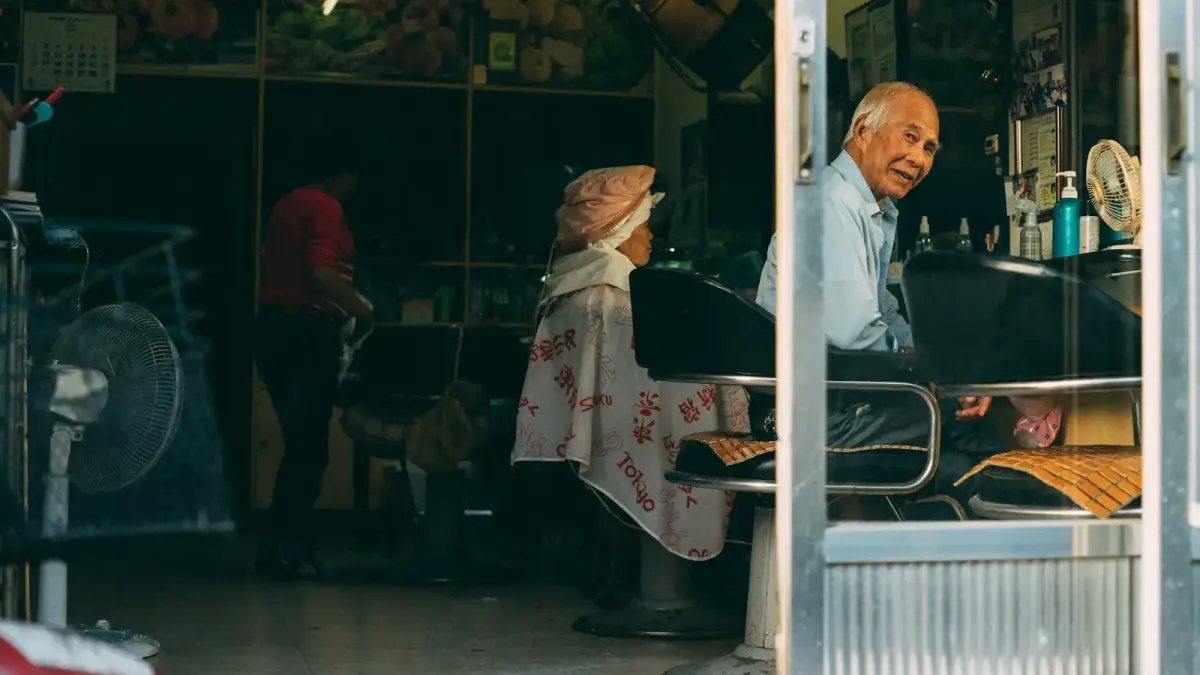
Instead I get on the highway and drive forty minutes to a strip mall off Route 9 where a man named Vincent has been cutting my hair since Bill Clinton’s first term. The parking lot has a crack running through it that I swear has been growing since 2003. The magazines in the waiting area are from administrations ago. The bell on the door still works, though it sticks sometimes when the humidity is bad.
I told myself for years this was about loyalty. Vincent gave me my first real haircut when I moved to the area, and you don’t leave a guy who’s been good to you. I told myself it was about habit - that the drive was just muscle memory, the way your hands know the route to work even when your mind is somewhere else. But a few months ago, sitting in that chair while Vincent ran the clippers along the back of my neck, I understood something I hadn’t been willing to name. The drive isn’t loyalty and it isn’t habit. It’s that Vincent’s chair is the last place in my life where someone asks me how I’m doing and then actually waits for the answer.
The Question Nobody Else Finishes
Vincent asks the same thing every time. “So how you been, Marcus?” And then he stands there. Comb in one hand, scissors in the other, looking at me in the mirror. Not glancing at his phone. Not already forming his next sentence. Just waiting.
It sounds like nothing. It sounds like basic human courtesy. But I’m sixty-two years old, and I can tell you that almost nobody in my life does this anymore.
My wife asks how my day was while she’s unloading the dishwasher. She means it - I know she does. But her hands are already moving. My son calls on Sundays, and within ninety seconds we’re talking about his daughter’s soccer schedule or whether his roof guy ever showed up. My daughter texts a heart emoji on my birthday. My colleagues - the ones I spent thirty years building things alongside - retired, moved, or just drifted into that polite distance where you like each other’s vacation photos and call it friendship.
None of these people are failing me. I want to be clear about that. They love me. I love them. But somewhere along the way, the infrastructure for someone to actually sit with my answer disappeared. And I didn’t notice it was gone until Vincent was the only one left holding the space.
The Man Everyone Leans On
I was the steady one. That was my role, and I wore it like a second skin for forty years.
When my brother lost his job in 2001, he called me. When my mother needed someone to handle her finances after Dad died, that was me. When my wife’s sister went through her divorce, I was the one driving their kids to school for six months so she could keep her shift at the hospital. At work, I was the guy people came to when the project was sideways and someone needed to stay calm.
I was good at it. I’m still good at it. And I don’t resent any of it - not one phone call, not one early morning, not one night I sat at the kitchen table figuring out someone else’s problem instead of reading my book.
But here’s what nobody tells you about being the steady one. People stop wondering if you need anything. Not out of cruelty. Out of trust. You become so reliable that your own needs become invisible - first to them, then to you. You build a life where the current only flows in one direction, and after enough years, you forget there was ever supposed to be a return.
A 2021 survey by the Survey Center on American Life found that the number of American men who say they have no close friends has risen fivefold since 1990, from 3 percent to 15 percent. That number climbs as men age. Not because older men are less likable. Because the structures that generated friendship - work, sports leagues, neighborhood hangouts - fall away, and most men were never taught to build new ones from scratch.
I read that statistic and felt it land somewhere behind my ribs.
What Happens in the Chair
Let me tell you what a haircut with Vincent actually looks like.
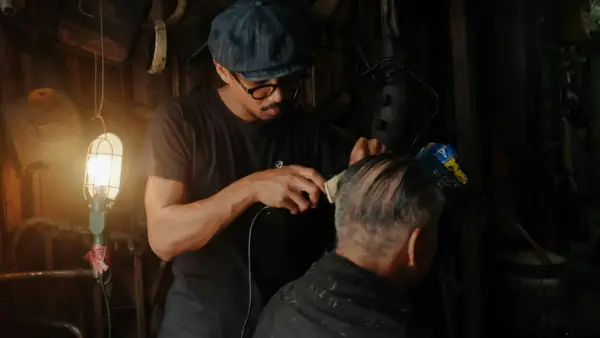
I walk in. He nods. If someone’s in the chair, I sit and read. When it’s my turn, I sit down, and he puts the cape around me, and he asks. And I answer. Sometimes it’s surface - the yard, the weather, whether the Mets have any pitching this year. But sometimes it isn’t.
I told Vincent about my mother’s decline before I told my wife. Not because I was hiding it. Because Vincent asked on a Tuesday afternoon and something in his stillness made the words come out before I’d even planned them. He didn’t offer advice. He said, “That’s hard, brother.” And he kept cutting.
I told him about feeling purposeless after retirement. About how I’d spent thirty-five years solving problems and then one morning there were no problems to solve and the silence was so loud I started doing yard work at six a.m. just to feel useful. He said he understood. He told me about his father-in-law going through the same thing. We talked about it for ten minutes, and then he showed me what he was doing with my sideburns, and that was that.
This is what I mean by waiting for the answer. It’s not therapy. It’s not deep emotional processing. It’s just the ordinary act of one person asking another person a question and then staying in the room - really staying - while the answer finds its way out.
The Drive Is Part of It
I’ve thought about this, and I think the forty-minute drive matters too.
It’s preparation. It’s the time between being the person everyone needs and being a man in a chair who gets to just talk. The highway is a kind of airlock. I leave the house where I’m the husband, the father, the grandfather, the guy who fixes things. By the time I pull into that cracked parking lot, I’ve shed enough of it to be just Marcus.
Nobody at home would understand if I explained this. Not because they’re incapable of understanding, but because it would sound like an accusation, and it isn’t one. It isn’t anyone’s fault that a sixty-two-year-old man has to drive to a strip mall to find someone who listens. It’s just the shape that life took. Forty years of small choices and quiet patterns, and this is where they led.
Thomas Joiner, a psychologist at Florida State University, has written extensively about what he calls “thwarted belongingness” - the feeling that you don’t meaningfully connect with others. His research suggests that men are particularly vulnerable to this as they age, in part because men tend to build connection through shared activity rather than direct emotional exchange. When the activities stop - when you retire, when the kids leave, when the Saturday basketball game dissolves - the connections go with them.
The barber chair is a shared activity. That’s the thing. It’s not a support group. It’s not a vulnerability circle. It’s a man cutting another man’s hair while they talk about whatever comes up. The activity provides the container. The conversation fills it. And for a lot of men my age, that container is the last one standing.
The Thing I’ve Never Said Out Loud
There was a Saturday about a year ago when Vincent was closed. Some family thing - his daughter’s graduation, I think. I saw the sign on the door and I sat in my car in that parking lot for a good five minutes before I drove home.
I didn’t need a haircut. I’d been there two weeks prior. I needed the chair. I needed the question. And when it wasn’t available, I felt something that scared me - a loneliness so specific and so old that I couldn’t believe I’d been carrying it without knowing.
I’m not depressed. I’m not in crisis. I have a full life with people I love and who love me back. But there’s a kind of aloneness that lives underneath a full life, a quiet room at the center of a loud house, and I think a lot of men my age are sitting in that room without ever naming it.
We were taught that needing people was a weakness. That the highest form of manhood was being needed, not needing. And so we built lives that flowed outward - our energy, our steadiness, our problem-solving - and we forgot to build a way for anything to flow back in.
Vincent didn’t set out to be my lifeline. He set out to be my barber. But every four weeks for thirty years, he asked and then he waited, and that simple rhythm became the only place in my life where someone leaned toward me instead of on me.
What I’m Learning at Sixty-Two
I’m not going to pretend I’ve fixed this. I haven’t started a men’s group. I haven’t had the conversation with my wife where I explain that I drive forty minutes for a haircut because the barber listens to me in a way that nobody else does. That conversation terrifies me, honestly, because I know she’d be hurt, and the hurt wouldn’t be wrong.
But I’ve started noticing. That’s the first step, I think. Noticing the forty-minute drive for what it is. Noticing the way I deflect when someone asks how I’m really doing. Noticing that I have a hundred skills for taking care of other people and almost none for letting other people take care of me.
Research from the Harvard Study of Adult Development - one of the longest-running studies of adult life ever conducted - found that the quality of a person’s relationships is the single strongest predictor of both health and happiness in later life. Not career success. Not wealth. Not even physical fitness. Relationships. And not just having them, but having ones where you feel genuinely known.
I feel genuinely known in Vincent’s chair. I want to feel that way in more places.
So next Saturday, I’ll get on the highway. I’ll pass the shop on Elm Street. I’ll drive the forty minutes and park in the cracked lot and hear that sticky bell. Vincent will put the cape around my neck and pick up his comb and look at me in the mirror.
“So how you been, Marcus?”
And I’ll answer. Honestly. The way I always do in that chair. The way I’m slowly learning to do everywhere else.