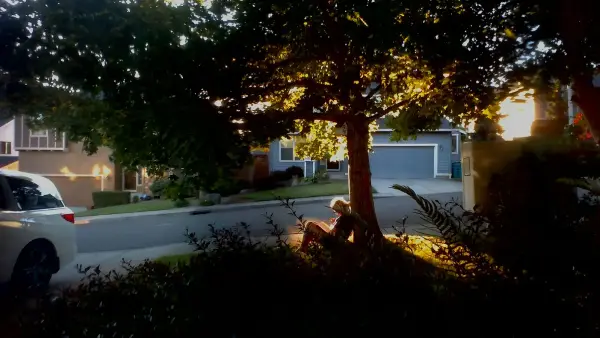
He's 62 and has just realized that in thirty-five years of marriage he has never once been the first to say 'I love you' at the end of a phone call - she says it and he says it back, every time - because a boy who never heard his father initiate tenderness learned that love is something you confirm, never something you announce
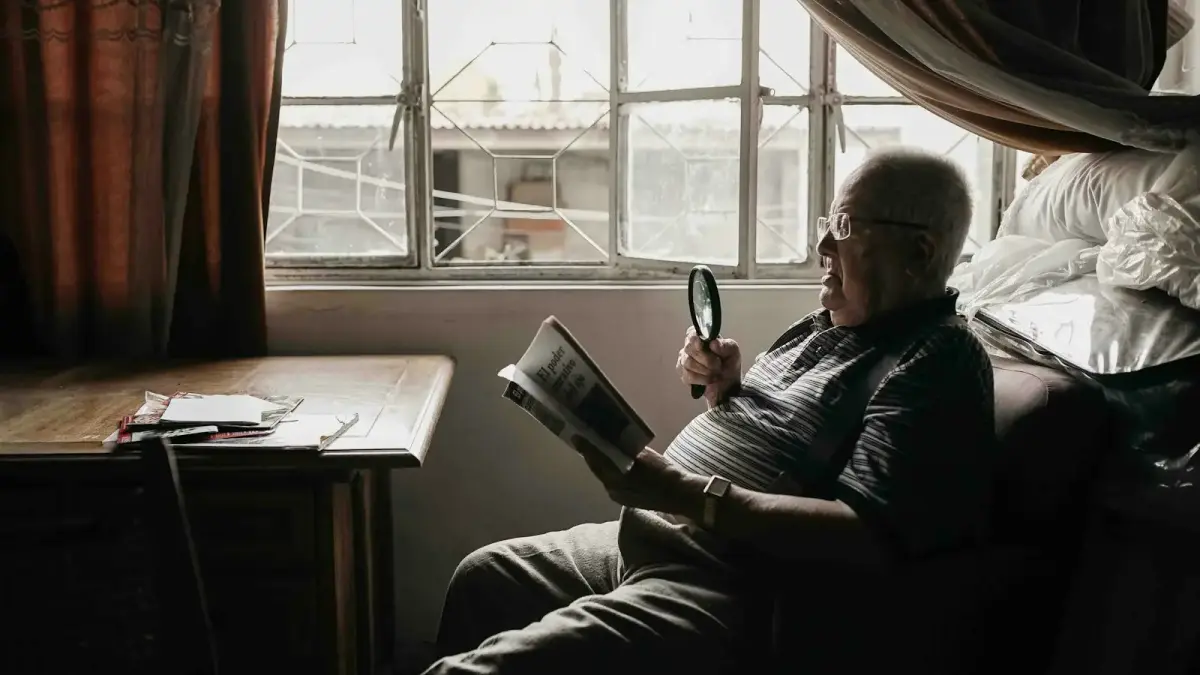
The call was ending the way it always does. My wife said, “Love you,” and I said, “Love you too,” and I hung up and stood in the kitchen for a moment longer than I needed to.
I don’t know why that particular Tuesday was the one that did it. We’ve had thousands of these calls. Maybe tens of thousands - thirty-five years of phone calls ending the same way, her voice lifting into that soft declaration, mine following behind it like a shadow that only appears when the light comes first.
But something shifted that afternoon. I heard the word “too” differently. I heard it for what it actually was - not a word of love, but a word of confirmation.
A receipt. An acknowledgment that love had been offered and I was willing to accept it.
I stood in my kitchen at sixty-two years old and realized I had never once - not once, in thirty-five years of marriage - been the first to say it.
The word that carried everything
When I sat with that realization, my first instinct was shame. Thirty-five years and I couldn’t lead with three words. What kind of husband does that make me?
But then I started paying attention. Not just to phone calls, but to everything.
She says “I’m proud of you” and I say “That means a lot.” She says “I missed you today” and I say “I missed you too.” She reaches for my hand in the car and I hold it. She moves toward me and I receive her. Every single time, without hesitation, without reluctance.
I am not withholding. I have never been withholding. I mean every word I say back to her, and she knows that. The love between us is real and deep and has weathered things that would have broken something less honest.
But the pattern is undeniable. She initiates. I respond. She speaks love into silence. I confirm it once it’s already there.
The word “too” has been doing all the emotional heavy lifting in this marriage for three and a half decades.
What my father never did
Here’s what I keep coming back to. I can close my eyes and see my father clearly - standing at the stove on Saturday mornings, driving us to church, reading the paper in his armchair with his glasses sliding down his nose. I can see him in a thousand ordinary moments.
But I cannot find a single memory of him initiating tenderness.
My mother would say, “I love you, Frank,” and he would say, “Love you too, hon.” She would hug him when he came home and he would wrap his arms around her. She would tell him she was glad he was there and he would nod and say, “Me too.”
He was not a cold man. That’s the part people get wrong about men like my father. He was steady. He was present. He showed up every single day of my childhood, and I never once doubted that he loved us.
But he never said it first. He never walked into a room and offered it without being prompted. Love, in our house, was a call-and-response - and my father was always the response.
I don’t think he ever decided to be that way. I don’t think he woke up one morning and chose not to initiate affection. I think his father never did it either. And his father before that. This is how it moves through families - not as a decision, but as an absence that gets inherited like the color of your eyes.
The rules nobody wrote down
A 2016 study published in the Journal of Family Psychology found that sons develop their emotional expression patterns primarily through observational learning from their fathers, often adopting not just the emotions their fathers expressed but the specific contexts in which they expressed them. Boys don’t learn “don’t feel.” They learn “feel here, not there. Respond, don’t initiate. Confirm, don’t announce.”
That’s exactly right. Nobody sat me down and said, “Marcus, you are not allowed to say ‘I love you’ first.” There was no rule. There was no instruction.
There was just an absence that I filled with my own interpretation.
What I learned watching my father was that love is something you hold quietly until someone asks for it. That tenderness is a response, not an offering. That the safest way to be emotional is to wait for someone else to go first, so you know it’s wanted before you risk it.
I learned that being the first to say “I love you” is a kind of exposure - a moment when you are standing in the open with nothing between you and the possibility that silence might follow.
And I learned, without anyone ever saying so, that men don’t stand in the open like that.
A language with no send button
Psychologist Terrence Real has written extensively about what he calls “covert depression” in men - an emotional constriction that doesn’t look like sadness but shows up as distance, control, and the inability to initiate vulnerability. Real argues that this isn’t a failure of feeling. It’s a failure of permission.
That distinction matters more than almost anything I’ve read about men and emotion.
I feel everything. I feel it deeply, constantly, sometimes overwhelmingly. When my daughter graduated college, I sat in the audience with tears running down my face. When my wife was sick three years ago, I could barely breathe for the weight of how much I needed her to be okay.
The feelings are all there. Every single one. What’s missing is the send button.
I have a full vocabulary of love and tenderness and vulnerability - but it only activates in reply mode. Someone has to prompt me. Someone has to go first. Someone has to create the opening, and then I will pour everything I have into it.
It’s like being fluent in a language that has no way to start a conversation. You can respond with extraordinary eloquence, but you cannot speak first. You can feel the words inside you, perfectly formed and achingly sincere, but they will not leave your mouth until someone else’s words arrive to call them forward.
A 2019 study in Psychological Science found that men report equivalent emotional intensity to women in self-report measures, but demonstrate significantly lower rates of spontaneous emotional disclosure - meaning they feel just as much but are far less likely to express those feelings without external prompting.
That is the gap. Not between feeling and not feeling. Between feeling and saying it first.
Thirty-five years of “too”
My wife knows this about me. She has always known it.
I asked her once, recently, if it bothered her - being the one who always says it first. She looked at me for a long time and said, “I never thought of it as going first. I just thought of it as making sure you heard it.”
That almost broke me.
Because what she was really saying is that she understood - long before I did - that the word “too” wasn’t evidence of lesser love. It was the only door I knew how to use. And she had spent thirty-five years keeping that door propped open, not because she needed to hear it back, but because she knew it was the only way I could say it at all.
She wasn’t compensating for my failure. She was accommodating my inheritance.
I think about how many men my age are carrying this exact same pattern and don’t even know it. Men who love their wives desperately and have never once said so without being prompted. Men who adore their children and have never called just to say, “I was thinking about you and I wanted you to know how proud I am.” Not because they don’t feel it. But because feeling it and initiating it are two entirely different skills, and they were only ever taught one.
What the boy at the kitchen table learned
I have a grandson now. He’s four. And I watch him with his father - my son - and I see the same pattern starting.
My son loves that boy with a ferocity that changes the air in the room. But he waits. He waits for the hug to come to him. He waits for the “I love you, Daddy” before he says it back. He holds all that tenderness behind his teeth and lets it out only when it’s been requested.
He learned that from me. I learned it from my father. My father learned it from his.
And here’s what I want to say to every man reading this who just recognized himself: you are not broken. You are not emotionally stunted. You are not failing the people you love because you can’t seem to go first.
You are operating inside a system you didn’t build, following rules nobody ever said out loud, fluent in a version of love that only has a reply function.
But the thing about being sixty-two is that you finally have enough distance to see the pattern for what it is. And once you see it, you can do something your father never could.
You can pick up the phone. You can listen to the silence on the other end before she’s said anything. And you can speak into it.
Not “I love you too.”
Just “I love you.”
No prompt. No confirmation. No safety net. Just the raw, terrifying, beautiful act of saying it first.
I called my wife that evening. She answered the way she always does - “Hey, hon.”
And before she could finish, before she could say it first, before the familiar rhythm could take over, I said it.
“I love you.”
There was a pause. A real one. And then she laughed - soft and surprised and warm - and said, “Well. I love you too.”
It was the first time in thirty-five years that the “too” was hers.