He's 62 and just realized that the reason he still walks through hardware stores touching everything - running his palm along a sheet of plywood, testing the weight of a wrench, squeezing a pair of pliers open and shut - is because his father never read labels or compared prices but judged everything by how it felt in his hand, and the son inherited not a preference but a prayer: that the world is still a place where a man can tell what's real by holding it
The Aisle Where It Hit Me
I was standing in the lumber section of a hardware store last Saturday, running my open palm along a sheet of birch plywood, when something shifted inside my chest. Not pain. Recognition.
I wasn’t shopping for anything. I didn’t have a project. I didn’t even have a list. I was just doing what I’ve always done - walking the aisles slowly, picking things up, putting them back, touching surfaces I had no intention of buying.
I’d been doing this for forty years without once asking myself why.
My wife has teased me about it for decades. She’ll wait in the car or wander off to the garden section while I disappear into tools and fasteners and lumber for an hour. She thinks I’m browsing. But I’m not browsing. I’m doing something I didn’t have a name for until that moment in the lumber aisle when I felt the grain of the plywood catch slightly under my fingertips and heard my father’s voice say, clear as a bell: That one’s good. You can feel it.
He’s been dead for fourteen years. But his hands are still teaching mine what to trust.
His Hands Knew Things His Mouth Never Said
My father was not an articulate man. He didn’t give speeches at dinner. He didn’t explain his thinking. He didn’t narrate his reasoning when he made a decision.
But his hands were fluent.
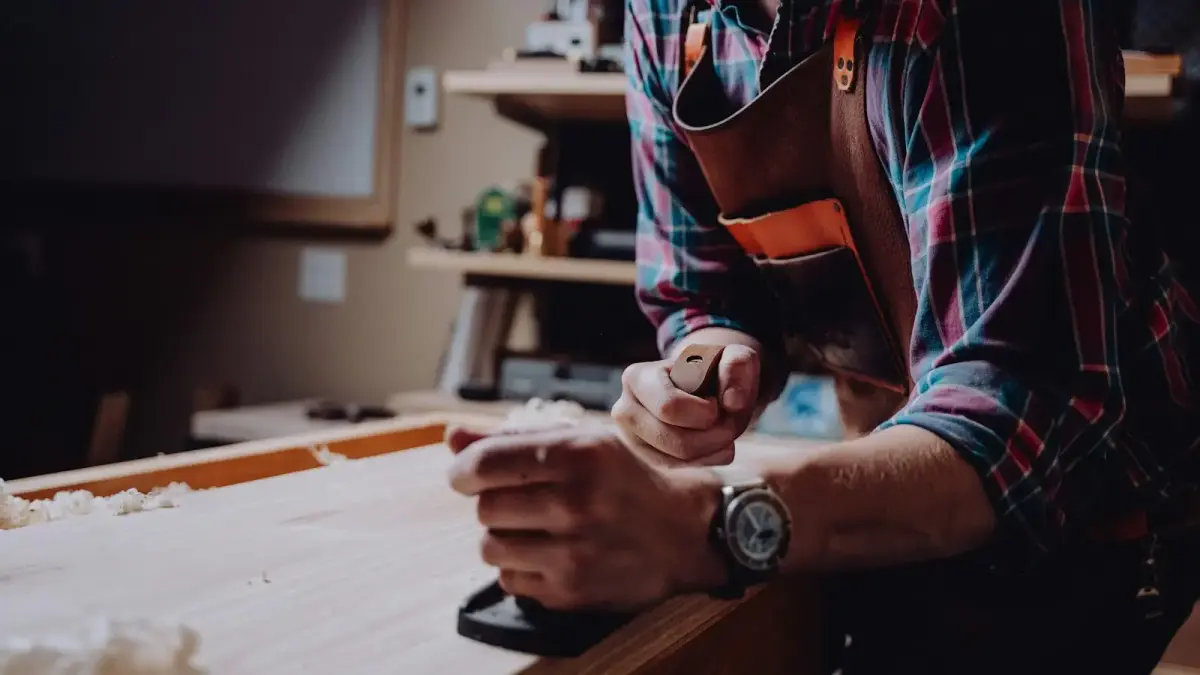
I grew up watching those hands evaluate the world. He’d pick up a wrench and bounce it once in his grip - not to test it, exactly, but to listen to what the weight told him. He’d squeeze a pair of pliers open and shut three or four times, feeling the resistance in the spring, the alignment of the jaws. He’d run his thumb along the edge of a board and know things about it that the label couldn’t tell you.
He never read packaging. Never compared specs. Never pulled out a calculator to figure out price per unit. He held things, and then he decided.
I thought this was just a quirk. A personality trait. Maybe even stubbornness - the kind of man who refused to trust what he couldn’t physically confirm. But standing in that lumber aisle at sixty-two, I realized it was something much larger than preference.
It was a way of knowing the world. And he’d given it to me without either of us noticing.
The Church of the Hardware Store
There’s a particular smell in a good hardware store that I’ve never been able to describe properly. It’s sawdust and machine oil and the cold metallic tang of fresh-cut keys and something else underneath - something mineral, like concrete dust or the inside of a pipe fitting.
That smell is the closest thing I have to incense.
I know that sounds dramatic, but I mean it seriously. The hardware store is the last place in American life where you’re allowed - even expected - to pick things up. To hold them. To feel their weight and texture and mechanical action before deciding if they’re any good.
You can’t do that at a clothing store without someone watching you. You can’t do it at a grocery store without looking strange. But in a hardware store, a man can stand at a pegboard wall of hammers and pick up six of them, one at a time, swinging each gently by his hip, feeling for the one that sits right in his hand.
Nobody asks what you’re doing. Nobody thinks it’s odd. Because everyone in that aisle is doing the same thing.
A 2019 study published in the Journal of Consumer Psychology found that physical touch activates what researchers call a “sense of ownership” - holding an object literally makes your brain begin to treat it as yours, increasing both attachment and trust. My father didn’t know the science. He just knew that a thing you’ve held tells you more than a thing you’ve only looked at.
What Gets Lost When Everything Becomes a Screen
I bought a drill last year. Not from a hardware store. From my phone.
I read fourteen reviews. I watched two comparison videos. I studied the torque specifications and battery life and chuck size. I compared three models side by side using a spreadsheet my daughter helped me set up.
The drill arrived two days later. I pulled it out of the box and held it, and within three seconds I knew it was wrong. Not defective. Just wrong. The grip was too narrow. The balance was off - it felt nose-heavy, like it would tip forward out of your hand if you relaxed. The trigger had a mushy, imprecise pull that told me nothing about the speed it was producing.
Everything the screen had told me about this drill was accurate. The specs were correct. The reviews were honest. The comparison was fair.
But my hands rejected it instantly. Because my hands have a different system of evaluation, one that can’t be translated into stars or specifications or torque numbers. My hands wanted to know: does this feel like a tool that was made by someone who has used tools?
I returned it. Drove to the hardware store. Picked up four drills. Chose one in about ninety seconds. It’s been perfect.
This is what my father knew. Not that technology is bad or that specifications are useless. But that there’s a layer of information that only your body can access. And if you stop trusting that layer, you lose something you can’t get back.
Tactile Inheritance
I’ve been thinking about what to call this thing my father gave me. It’s not a skill, exactly. He didn’t teach me woodworking or plumbing or mechanics - I’m mediocre at all three. It’s not knowledge. He didn’t explain grain patterns or metallurgy or the physics of leverage.
What he gave me was a posture toward the world. A belief that the world is fundamentally physical - that reality has texture and weight and temperature - and that a man who pays attention with his hands can know things that a man who only reads and watches cannot.
Psychologist James Gibson called this “haptic perception” - the way humans gather information through touch, pressure, temperature, and resistance. A 2021 study in Frontiers in Psychology found that haptic perception plays a critical role in how we assess quality, authenticity, and trustworthiness of objects - and that this capacity diminishes with disuse.
Diminishes with disuse. That phrase sat with me for a long time.
Because the world is actively discouraging this kind of knowing. Everything is sealed in packaging. Everything is ordered from a screen. We evaluate mattresses based on ratings and cars based on reviews and food based on photographs. We’ve built a civilization that asks you to trust things you’ve never held.
My father would have found this unbearable. Not because he was old-fashioned, but because his hands were his primary instrument of judgment. Asking him to buy something he couldn’t touch was like asking a musician to choose a guitar by reading about it.
The Weight of a Good Wrench
My father had a wrench - a twelve-inch Craftsman adjustable - that he carried in his truck for thirty years. The chrome had worn to bare steel in the places where his hand gripped it. The worm gear was smooth from decades of adjustment. The jaw had tiny marks from every bolt it had ever turned.
When he died, my mother asked me what I wanted from his toolbox. I took the wrench.
I didn’t take it because it was valuable. I took it because when I pick it up, I can feel where his hand was. The wear pattern in the steel is a record of his grip. The places where the metal is warm and smooth are the places where his thumb and forefinger held on, thousands of times, applying exactly the right pressure.
Holding that wrench is the closest I come to holding his hand.
Adam Grant has written about how identity is often transmitted not through explicit instruction but through observed behavior - what he calls “absorbed values.” Children don’t learn what their parents teach. They learn what their parents do. And what my father did, every Saturday, was walk through a hardware store touching things.
So that’s what I do. Every Saturday. Without a list. Without a project. Without a reason I could have named until last week.
The Prayer
I called it a prayer earlier, and I want to stay with that word.
Because when I run my palm along a piece of plywood and feel the grain - tight and smooth, or rough and likely to splinter - I am performing an act of faith. I am saying: I believe the world can still be known this way. I believe my hands are still reliable instruments. I believe that in a civilization that has moved almost entirely into abstraction, there is still something sacred about the physical.
My father believed this without ever articulating it. He believed it in the way he squeezed a pliers to test the spring. In the way he bounced a hammer to feel its balance. In the way he rubbed his thumb across a bolt to check the threading.
He was not a religious man. But he had a religion. It was the conviction that real things feel different from cheap things. That quality has a texture. That the world - the actual, physical, holdable world - will tell you the truth if you ask it with your hands.
I’m sixty-two years old. I have a phone that can tell me more about a sheet of plywood than my fingers ever could - its species, grade, moisture content, the mill it came from. But I still touch it. I still need to touch it.
Not because the information is better. But because the touching is how I stay connected to a man who’s been gone for fourteen years and a way of being in the world that’s quietly disappearing.
Some inheritances come through documents. Some come through stories. Mine came through the wear pattern on a wrench and the instinct to never trust anything I haven’t held.
I didn’t know that until last Saturday. But my hands have known it all along.