He's 63 and every time his wife says 'we need to talk,' his body prepares as if he's being called to the principal's office - because a boy who grew up where serious conversations only meant trouble never learned those words could mean 'I miss you'
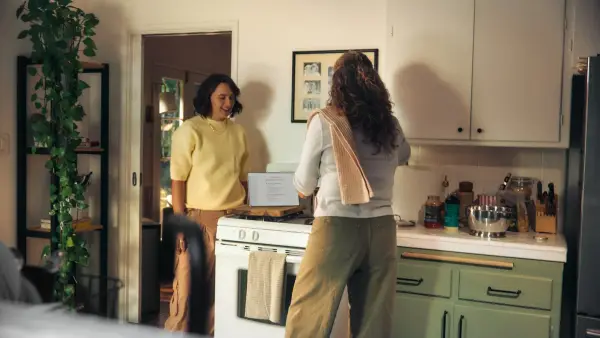
I was sitting at the kitchen table last Tuesday when my wife walked in and said four words that made my chest tighten like I was sixteen again.
“We need to talk.”
She was smiling. She had two mugs of coffee. She wanted to tell me about a trip she’d been thinking about for our anniversary. But for about three full seconds before she got to any of that, my body did what it has always done when someone I love says those words. It got ready for the worst.
My shoulders went up. My jaw locked. My hands found something to hold onto - a pen, the edge of the table, anything solid. And somewhere in the back of my brain, a voice that hasn’t aged since 1974 whispered the same thing it always whispers: figure out what you did wrong.
I’m 63 years old. I’ve been married for thirty-one years to a woman who has never once used that phrase to ambush me. And still, every single time, my body prepares like I’m about to be called to the principal’s office.
For most of my life, I thought that reaction was just who I was. Anxious. Overly cautious. Bad at intimacy. It took me an embarrassingly long time to understand that it wasn’t a personality trait at all. It was a memory. One my body never stopped rehearsing.
The kitchen table where everything went wrong
In my house growing up, the kitchen table wasn’t where you ate dinner together and talked about your day. It was a courtroom.
“Sit down” meant you were in trouble. “We need to have a conversation” meant someone was angry and you were about to find out exactly how angry. My father used the kitchen table the way other parents used a raised voice - as a signal that the normal rules of the household had been suspended and something serious was about to happen.
I can still feel the vinyl of those chairs. The way the overhead light buzzed. The way my mother would stand at the counter drying the same dish over and over while my father spoke in that low, measured tone that was somehow worse than yelling.
The topics varied. My grades. Something I’d broken. A neighbor who’d called to complain. But the architecture was always the same. You were summoned. You sat. You waited to learn what you’d done. And then you absorbed whatever came next.
There was never a conversation at that table that began with “I want to understand you” or “I’ve been worried about you” or “I miss spending time with you.” Those words weren’t in the vocabulary. Serious conversations had one purpose: correction. And the child sitting in that chair had one job: take it.
A 2021 study published in the journal Psychological Science found that children raised in households where direct address from a parent consistently predicted conflict developed what researchers describe as “anticipatory threat encoding” - the nervous system begins treating the cue itself as the danger, not what follows it. The words become the wound before any wound is delivered.
That’s what happened to me. By the time I was ten, I didn’t need to hear the content of the conversation. The phrase “we need to talk” was the content. Everything after was just confirmation of what my body already knew.
The woman who reaches for him, and the boy who flinches
My wife is not my father. I know this intellectually the way I know the earth is round - with complete certainty and absolutely no confusion. And yet.
When she says, “Can we sit down for a minute?” something in me goes cold. When she gets quiet in the car and then takes a breath like she’s about to say something, I grip the steering wheel a little harder. When she texts “call me when you get a chance,” I spend the entire drive home running through a list of things I might have done wrong.
She noticed it years ago. She once told me, “I can see the moment you leave. Your eyes go flat. You’re sitting right there but you’re already somewhere else.” She was right. I was somewhere else. I was at the kitchen table in 1973, waiting for the verdict.
The cruelest part isn’t the reaction itself. It’s what it costs the person on the other side of it. My wife reaches toward me emotionally - she tries to open a door - and my entire nervous system reads it as a threat. She’s saying “I want to be closer” and my body hears “something is wrong and it’s your fault.”
Dr. Sue Johnson, the psychologist who developed Emotionally Focused Therapy, has written extensively about this pattern. She describes it as a core tension in long-term relationships: one partner reaches, the other withdraws. Not because he doesn’t love her. But because the reaching itself feels like the beginning of something painful. The bid for connection gets filtered through decades of conditioning, and by the time it arrives, it doesn’t feel like love. It feels like danger.
I’ve done this to my wife a thousand times. She walks toward me with tenderness, and I brace like she’s carrying something heavy she’s about to drop on me. The flinch has nothing to do with her. It never did.
What no one tells you about growing up in a house without emotional safety
There’s a specific kind of childhood that doesn’t show up in case studies or trauma memoirs. Nobody hit you. Nobody abandoned you. Your parents were present, responsible, sometimes even affectionate. But somewhere in the architecture of daily life, you learned a rule that settled into your bones: when someone important wants to talk to you, it’s because you’ve failed.
You learned that seriousness was a weapon. That a closed door and a lowered voice were not invitations to connect but signals that you were about to be exposed. And you carried that lesson so far into adulthood that you can’t tell the difference between a woman who wants to plan a vacation and a father who wanted to tell you how disappointed he was.
A 2018 study in the Journal of Research in Personality examined adults who reported no overt childhood trauma but scored high on what the researchers called “relational vigilance” - a chronic readiness for interpersonal threat. The common thread wasn’t abuse or neglect. It was predictability. These adults grew up in homes where emotional tone was unstable, where a parent’s mood could shift without warning, and where direct address from an authority figure was reliably paired with criticism or conflict.
The study found that relational vigilance persisted well into the participants’ fifties and sixties - long after the original environment had any power over them. The body doesn’t update its files just because the context changes. It learned the pattern once and decided that was enough.
This is the part that’s hardest to explain to someone who didn’t grow up this way. It’s not that you think your wife is going to yell at you. It’s that your body remembers a time when the person you depended on most used closeness as a delivery system for pain. And now every form of closeness carries that echo.
He’s not emotionally unavailable - he’s emotionally bracing
I spent my thirties and forties believing I was bad at relationships. I read that narrative everywhere - in magazine articles, in therapy waiting rooms, in the way my wife’s friends talked about their husbands. Men are closed off. Men don’t want to go deep. Men treat emotional conversations like root canals.
And I thought, yeah. That’s me. I’m the guy who’d rather reorganize the garage than sit on the couch and talk about feelings. I’m the guy who answers “I’m fine” forty times a day even when I’m not, because the alternative - being honest about what’s happening inside me - feels like walking into traffic.
But here’s what I didn’t understand until embarrassingly recently: I was never emotionally unavailable. I was emotionally bracing. There’s a difference the size of a childhood.
Unavailability suggests the feelings aren’t there. Bracing means the feelings are there, all of them, piled up behind a door that you’re holding shut with your entire body because the last time you opened it, you were a boy standing in a kitchen being told that you were a disappointment.
Brene Brown has talked about this distinction in her research on vulnerability. She describes how some people don’t avoid vulnerability because they lack emotional depth - they avoid it because they have too much. The emotional bandwidth is enormous, but it was never safe to use. So it sits there, behind the wall, generating a kind of pressure that looks from the outside like indifference but feels from the inside like drowning.
That’s what my wife sees when my eyes go flat. Not absence. Overflow. A man who has so many feelings about the conversation she’s trying to start that his only option is to shut down the entire system before it overwhelms him.
The phrase that rewrites the pattern
My wife figured something out about five years ago that changed everything. She stopped saying “we need to talk.”
She didn’t do it because I asked her to. She did it because she’s the kind of person who pays attention - who notices what a phrase does to someone’s body before the conversation even begins. She started saying other things instead.
“I’ve been thinking about something nice.”
“I want to run an idea by you - it’s a good one.”
“Hey, come sit with me. Nothing’s wrong.”
That last one - “nothing’s wrong” - might be the most important sentence anyone has ever said to me. Because it does something that no amount of rational understanding can do on its own. It interrupts the pattern at the source. It tells the boy at the kitchen table, before he has time to brace, that this is not that.
I know how small that sounds. Three words. But for a man whose entire nervous system was calibrated to hear “sit down” and translate it to “you’re in trouble,” those three words are a complete rewiring of what it means to be approached by someone you love.
I’m not fixed. I want to be honest about that. My wife said “hey, can I ask you something?” last week and I still felt the flicker - the chest tightening, the jaw setting, the split-second scan for what I might have done. The pattern is old. It lives in a part of my brain that doesn’t respond to logic or time or the fact that I’m a grown man who hasn’t sat at that kitchen table in over forty years.
But the flicker is shorter now. The recovery is faster. And sometimes - not always, but sometimes - when she says “come sit with me,” I actually feel something I never felt as a child sitting in that chair.
I feel safe.
What this is really about
If you’re a man who stiffens when your partner says “we need to talk,” I want you to hear something that might take a while to land.
You are not broken. You are not emotionally stunted. You are not the closed-off, feelings-avoidant man that pop culture has convinced you that you are.
You are a boy who learned, in the most formative years of your life, that the people who loved you most used direct conversation as a weapon. You learned that being approached meant being corrected. That seriousness meant danger. That the safest thing you could do when someone important wanted your full attention was to disappear inside yourself and wait for it to be over.
And you carried that lesson into every relationship you’ve ever had. Into your marriage. Into your friendships. Into the way you parent your own children - because some part of you knows exactly how it feels to be that kid at the table, and you would rather lose your own voice entirely than make your child feel the way you felt.
The flinch isn’t a flaw. It’s a memory that your body refuses to let go of because, for a long time, it kept you safe. Honoring that - not fighting it, not being ashamed of it, but understanding it - is the beginning of something that looks a lot less like being fixed and a lot more like being free.
Your wife is not your father. The kitchen table is not a courtroom. And “we need to talk” can mean “I love you and I want more of you.”
It just takes a while for the boy in the chair to believe it.