He's 63 and just realized the scorched potholder by the stove - the one his wife made in a craft class twenty years ago, the one he reaches for every time even though newer ones sit in the drawer - was never a kitchen tool but the last place in the house where his hand still touches something her hands made
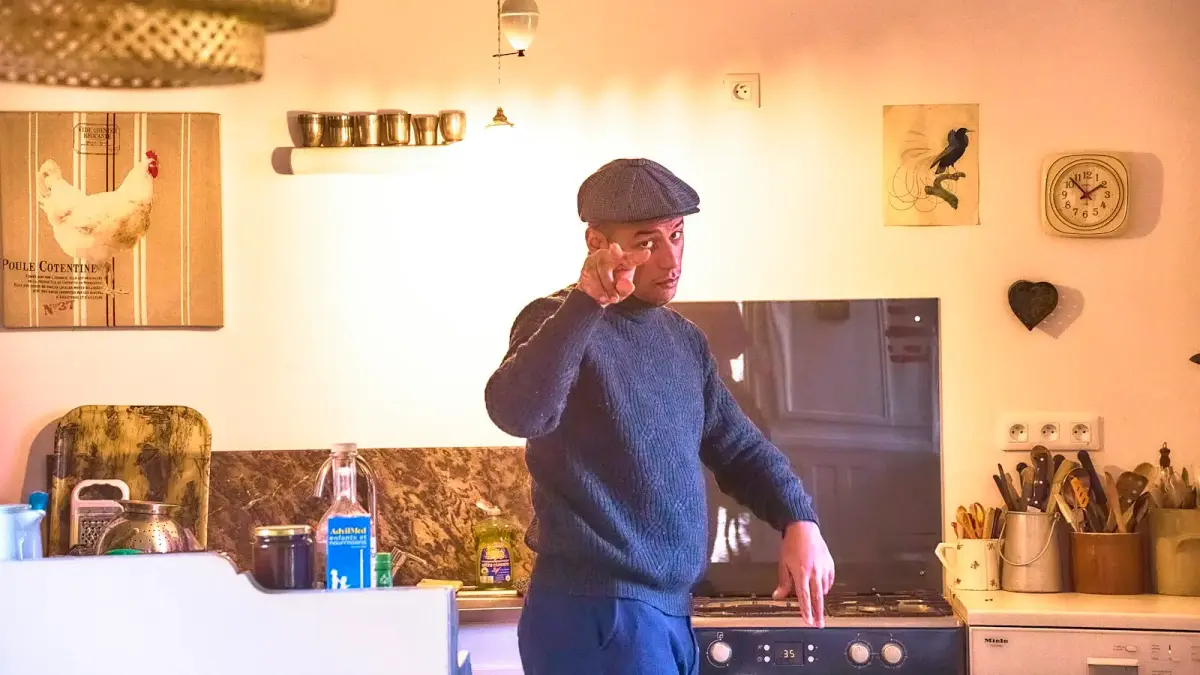
The hook by the stove
There’s a potholder hanging from the hook next to our stove. It’s scorched along one edge from a casserole dish I pulled out too fast maybe ten years ago. The fabric is thinning in the middle, and the corner where you grip it has frayed into a small tangle of loose threads I keep meaning to trim but never do.
My wife made it in a community craft class back in 2006. Maybe 2007. One of those Saturday morning things she used to do at the community center before the kids’ schedules swallowed every weekend whole.
I could replace it for two dollars. There are three perfectly good potholders sitting in the drawer six inches away.
I reach for this one every time. Every single time.
I’m 63 years old, and I only just understood why.
The reach
It wasn’t a conscious decision. Nobody decides to prefer a burned potholder over a clean one. My hand just goes there - the hook, the grab, the fold, the lift.
It’s muscle memory at this point, woven so deep into how I move through that kitchen that it doesn’t register as a choice anymore.
My daughter noticed it last Thanksgiving. She was standing beside me while I pulled a roasting pan from the oven, and she laughed and said, “Dad, that thing is disgusting. Just use one of the new ones.”
I told her I would. Then the next morning I reached for it again without thinking.
That’s when something shifted. Not a revelation exactly. More like a slow focusing, the way your eyes adjust when you walk into a dim room and realize there’s been something right there the whole time that you couldn’t see until the light caught it differently.
What his hands remember
I started paying attention to the moment my hand closed around it. The texture is different from the store-bought ones. It’s uneven.
There’s a slightly raised ridge where the stitching bunches on one side, and the fabric has a particular softness that comes from being washed hundreds of times over two decades.
My wife’s hands made that unevenness. Her fingers pushed thread through that fabric on a Saturday morning when she had nowhere to be and nothing she had to do.
She was sitting at a long table with other women, and she was making something small and unnecessary and entirely her own. She came home and held it up and said, “Look what I made,” and I probably said something like “Nice” while half watching the game.
I want to go back to that moment and hold it longer.
The Saturday mornings that disappeared
She didn’t stop all at once. It happened the way most things happen in a long marriage - gradually, without announcement, without anyone marking the date.
First it was our son’s travel soccer schedule. Then our daughter’s Saturday tutoring sessions. Then the errands that multiplied as the kids got older - the grocery runs and the drop-offs and the birthday party logistics that somehow always landed on Saturday morning.
By the time the kids left, the Saturday mornings had been absorbed into a different kind of busyness. Doctor’s appointments, her mother’s care needs, the house projects we’d been deferring for fifteen years.
She never said she missed the craft class. I never asked.
A 2021 study published in the Journal of Marriage and Family found that women in long-term marriages often experience what researchers call “identity contraction” - a gradual narrowing of personal pursuits as caregiving responsibilities expand across decades. The study noted that the loss is frequently invisible to both partners because it happens so incrementally that neither person registers the accumulation.
I think about that word. Accumulation. Twenty years of Saturday mornings traded away so quietly that neither of us heard them go.
Objects that hold what we can’t say
I’m not good with words. I know that about myself. I’ve known it for forty years of marriage.
My wife will ask me what I’m feeling, and I’ll say “fine” or “tired” or “I don’t know,” and I’ll mean all three at once and none of them exactly. She’s learned not to press too hard. I’ve learned to feel guilty about the asking.
But my hands know things my mouth doesn’t.
My hands know to reach for the potholder she made instead of the ones from Target. My hands know to keep her old gardening gloves on the shelf in the garage even though she hasn’t gardened in three years. My hands know to leave the coffee mug she painted at one of those paint-your-own-pottery places in the front of the cabinet, where I’ll see it first every morning.
Psychologist Dacher Keltner at UC Berkeley has written extensively about the way physical touch - even with objects - can carry emotional meaning that verbal language can’t fully capture. The body, he argues, has its own vocabulary for connection and love, and some of us speak that language more fluently than we speak any other.
I never would have put it that way. But I recognize it completely.
The keeping is the language. The reaching is the sentence.
The fossil
My wife is alive. She’s right here. She’s in the next room right now, reading on her tablet, and if I walked in there she’d look up and smile and ask if I wanted tea.
This isn’t a grief story. This is something stranger and quieter than grief.
It’s the recognition that the potholder isn’t a potholder anymore. It’s a fossil. A preserved impression of a time that existed and then stopped existing without either of us quite noticing when the line was crossed.
When I hold it, my hand is touching something her hands made during a period of our life that had a particular quality - a spaciousness, a lightness, an ease - that I didn’t appreciate until it was behind us. She had time and she made things.
She drove to a community center on a Saturday because she wanted to, not because she had to.
A 2019 study published in Psychological Science found that people form significantly stronger emotional attachments to objects that were handmade by someone they love compared to identical factory-produced items. The researchers described it as the knowledge that someone’s time and effort and choice went into creating something, and how that knowledge transforms the object from functional to irreplaceable.
Irreplaceable. That’s the word for what hangs on that hook by our stove.
The men who keep things
I know I’m not alone in this. I’ve talked to exactly zero other men about it, but I know.
I know because my father kept a broken watch in his dresser drawer for thirty years and would not explain why. I know because my neighbor Dave keeps his late mother’s wooden spoon in a jar with the other utensils and uses it to stir pasta every Sunday night. I know because men everywhere have drawers and shelves and hooks holding objects that serve no practical purpose and will never be thrown away.
A 2020 study published in the Journal of Consumer Psychology found that men are more likely than women to form deep emotional attachments to physical objects while being significantly less likely to articulate the emotional reasoning behind keeping them. The researchers described it as silent preservation - the act of maintaining an emotional bond through object retention rather than verbal expression.
We keep things because keeping is the only verb some of us learned. Because nobody taught us to say “I miss the version of you that had time,” so instead we hold onto a scorched piece of fabric and let our hands do the remembering.
What he never named
I’ve been sitting with this for weeks now, ever since the moment in the kitchen when my daughter pointed out the obvious and the question finally surfaced: why do you keep reaching for that one?
And the answer, the one I couldn’t have spoken out loud until I sat down and wrote it here, is this.
That potholder is the only place in my house where my hand touches something she made with hers. Not something she bought or organized or cleaned or arranged or scheduled.
Something she created on a free Saturday morning because she wanted to, because she had time, because she was still the woman who signed up for craft classes on a whim and came home holding up her work like a kid proud of a school project.
I reach for it because my hand is reaching for her. Not the her who is in the next room - I love that woman, deeply, and I’ll love her until I’m done - but the her who had Saturday mornings. The her who made things with her hands and held them up for me to see.
I miss that version of us. I don’t quite know how to say that to her face, so I say it every morning with a potholder she forgot she made.
If you’re reading this and you have your own version of the potholder - something worn and impractical that you reach for without thinking, something you keep without being able to fully explain - I want you to know something.
You’re not sentimental. You’re not foolish. You’re not holding onto clutter.
You’re holding a piece of time that mattered. Your hands know what your words haven’t caught up to yet. And the fact that you keep reaching for it, that you refuse to replace it with something newer and cleaner and more efficient, says more about your capacity for love than any anniversary speech ever could.
The potholder is hanging on the hook right now. I can see it from where I’m sitting. Tomorrow morning, when I make breakfast, I’ll reach for it again.
I’ll know why this time. But honestly, knowing doesn’t change the reach. My hand was already there.