He's 64 and has quietly realized that the reason he cannot sit through a family dinner without clearing the plates before anyone has finished is not helpfulness - it is a boy who learned at eight that the fastest way to prevent the argument that always came after the second glass of wine was to end the meal before the conversation got too honest
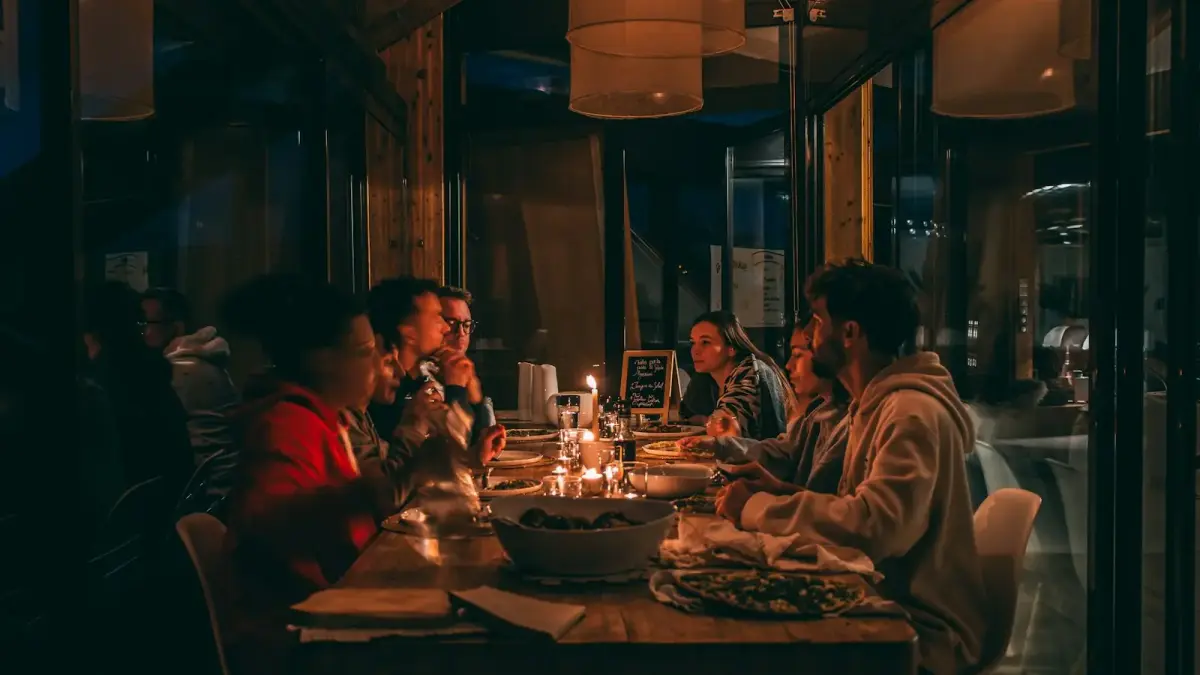
I watched a man at a holiday dinner last year do something I’ve done my entire life.
The turkey was still warm. His daughter was mid-sentence, telling some story about her kids, and he was already up. Plates in hand. Scraping. Rinsing. Loading the dishwasher before anyone had taken a second helping.
His wife said what wives always say: “Sit down, Tom, we’re not done yet.”
He smiled the way I’ve smiled a thousand times. The polite deflection. The “I’m just being helpful” shrug. And then he kept clearing.
I recognized him immediately. Not because I know him. Because I am him. I have been him since I was eight years old, standing at a kitchen sink in a house where dinner was not a meal. It was a countdown.
The Table Was Never Safe
Here’s what people who grew up in calm homes don’t understand about people who grew up in loud ones.
The table is not neutral ground. It’s a stage. And every dinner is a performance where you know the third act, because the third act was always the same.
In my house, the first glass of wine meant dinner was fine. Conversation was normal. My mother would ask about school. My father would talk about work. For twenty minutes, we were a family you’d see in a catalog.
The second glass changed the air. Not immediately. But if you’d been watching as long as I had, you could feel it. A slight edge in the voice. A comment that wasn’t quite a joke. A silence that lasted one beat too long.
By the time I was eight, I had the timing down to a science. Somewhere between the second pour and the moment my father’s jaw tightened, I had a window. Maybe four minutes. Maybe six.
If I could get the plates off the table in that window, the meal was over. And if the meal was over, the argument had no stage.
The Boy Who Became the Busboy
I didn’t know I was doing it at first. Kids don’t narrate their survival strategies. They just survive.
I’d finish my food fast - not because I was hungry, but because an empty plate was a reason to stand up. Then I’d reach for my sister’s plate. Then my mother’s. I’d be at the sink before anyone questioned it.
“What a helpful boy,” my grandmother said once. She meant it as a compliment. It landed like a medal pinned to the wrong uniform.
I wasn’t being helpful. I was defusing a bomb. Every plate I removed was one less prop on the stage. Every dish I washed was one more minute of noise from the faucet drowning out whatever was building between my parents.
A 2019 study published in the Journal of Family Psychology found that children in high-conflict homes develop what researchers call “hypervigilant monitoring” - a constant scanning of emotional cues that allows them to predict and attempt to prevent conflict before it escalates. The study noted that these children often develop elaborate behavioral routines that appear prosocial but are fundamentally self-protective.
That language - “behavioral routines that appear prosocial” - is the most clinical way I’ve ever heard someone describe a boy washing dishes so fast his hands shook.
Fifty-Six Years of Clearing Tables
The thing about survival strategies is that they don’t retire when the danger does.
My father has been dead for nineteen years. My mother lives in a care facility where she drinks tea, not wine. The kitchen I grew up in belongs to a family I’ve never met.
And I still can’t sit through a dinner.
My wife noticed it first, maybe thirty years ago. “You never finish a meal with us,” she said. Not angry. Curious. Like she was studying something she’d seen a hundred times but never named.
She was right. I don’t finish meals. I finish eating, and then I become a man in motion. Clearing, wiping, organizing the leftovers into containers nobody asked for. I once wrapped the butter dish while my son was still buttering his bread.
At Thanksgiving, I’m legendary. The family jokes about it. “Don’t put your fork down or Dad will take your plate.” Everyone laughs. I laugh too.
But here’s what the laughter covers: the moment everyone is sitting around the table, full and relaxed, talking freely - that is the exact moment my body tells me something terrible is about to happen.
Gabor Mate has written extensively about how the body stores unresolved childhood experiences as physiological responses that persist long after the original threat is gone. The nervous system doesn’t check the calendar. It doesn’t know that the man at the head of the table is you now, not your father. It only knows the pattern. Full bellies. Lingering conversation. Wine. Danger.
What the Dishwasher Really Sounds Like
I want to tell you something embarrassing.
The sound of running water calms me. Not ocean waves on a meditation app. Actual water from an actual faucet hitting actual dishes. That specific frequency of domestic noise is the closest thing I have to a lullaby.
Because that was the sound of safety. The meal was over. The dishes were being done. The argument didn’t happen tonight. My sister could go to her room. My mother’s mascara would stay intact. My father would fall asleep in his chair watching the news instead of standing in the kitchen with that voice.
I built an entire emotional regulation system out of dishwater and urgency. And I carried it into a marriage, a family, a life where no one is fighting. Where the second glass of wine means my wife is relaxed, not loading a weapon.
But my hands don’t know that. My hands still reach.
The Dinner You Never Let Happen
Research published in Psychological Science in 2021 found that adults who experienced chronic household tension in childhood often struggle with what the researchers called “sustained social presence” - the ability to simply remain in a group setting without feeling compelled to manage, redirect, or end the interaction.
I read that and sat with it for a long time.
Sustained social presence. The ability to just be there. To sit at a table where people you love are talking and laughing and not do anything about it.
That’s what I’ve been avoiding for fifty-six years. Not the argument. The argument stopped happening decades ago. What I’ve been avoiding is the dinner itself. The unscripted part. The part where people say what they actually feel and nobody controls what happens next.
Because in my house, the conversation getting honest was always the beginning of the end. Honesty was the match. The table was the kindling. And I was the boy who learned to blow it out before anyone got burned.
So I never learned what happens when you let dinner just be dinner. When the conversation wanders into vulnerable territory and nobody yells. When someone says something real and the response is warmth instead of wreckage.
I’ve been so busy preventing the catastrophe that I’ve also been preventing the connection.
Learning to Stay Seated
I’m sixty-four years old. I’ve spent more years clearing tables than I spent at the one that taught me to.
Last month, my daughter had us over for Sunday dinner. The food was good. The wine was better. My granddaughter was telling a story about a bird she saw at school, and it was going on forever the way five-year-old stories do, and I felt it.
The pull. The itch in my legs. The scan - how many plates could I grab on my way up? Could I get to the kitchen without interrupting?
And I stayed.
Not comfortably. My hands gripped the edge of my chair like I was keeping myself from floating away. But I stayed. I listened to the bird story. I watched my daughter pour her husband a second glass of wine and I let it be just wine.
Nothing happened. The conversation got honest. My son-in-law talked about struggling at work. My daughter’s eyes went soft in a way that reminded me of my wife. And the table held.
It just held.
I don’t want to make this sound like a breakthrough. I’ve read enough to know that a single dinner doesn’t undo a lifetime of wiring. But I will tell you this - that five-year-old’s bird story is the first full after-dinner conversation I’ve sat through in fifty-six years.
I didn’t clear a single plate.
The Plates Can Wait
If you recognized yourself in this - the early riser from the table, the one who’s always cleaning, always moving, always finding a task the moment the meal slows down - I want you to know something.
You weren’t being helpful. You were being brave. You were a child doing the only thing you knew to keep your world from splitting open.
And the fact that you’re still doing it doesn’t mean you’re broken. It means you were so good at protecting the people you loved that your body never stopped.
The plates can wait. They’ve always been able to wait. You just never lived in a house where that was true.
But you do now.