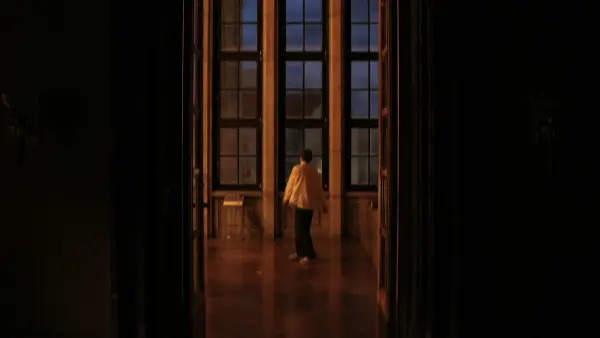
He's 64 and just realized he still introduces himself by his old job title three years after retiring - 'I'm in engineering' instead of 'I was in engineering' - because a man who spent forty years answering the question 'what do you do' never once practiced answering the question 'who are you' without the work providing the first sentence, and the silence that follows retirement is not peace but the sound of an identity that was never built to survive the thing that held it up

A friend of mine retired three years ago. Good pension, healthy marriage, grandkids nearby. Everything he was supposed to want.
Last month we were at a neighborhood barbecue, and someone new asked him the question. You know the one. The inevitable opener that every adult conversation defaults to within thirty seconds.
“So, what do you do?”
He said, “I’m in engineering.” Present tense. No hesitation. No correction.
I watched his wife glance at him. She didn’t say anything. She’s seen this before. He caught himself a few seconds later and added, “Well, retired now,” like it was a footnote to the real answer. Like the retirement was the thing that needed explaining, not the fact that he still carries a job title around like a name tag he forgot to take off at the end of a very long conference.
He told me later, quietly, that he doesn’t know what else to say. That without the work providing the first sentence, the rest of the paragraph doesn’t exist yet.
He’s not depressed. He’s not ungrateful. He’s just standing in a room where the walls used to be, trying to remember what shape he is without them.
The question nobody teaches you to answer differently
Here’s something strange about the way we raise men in this country. We spend decades teaching them how to answer “what do you do” and zero hours teaching them how to answer “who are you” without the job doing the talking.
Think about it. From the time a boy is old enough to understand the question, the answer is being built for him. What do you want to be when you grow up? Not who. What.
A fireman. A doctor. An engineer. A businessman.
The identity gets constructed around a function. A role. A thing that produces, earns, solves, builds. And for forty years, that answer works beautifully. It fills the blank on every form. It gives you something to say at every party. It provides a complete, socially acceptable response to the most common question adults ask each other.
Then retirement comes, and the question doesn’t stop. But the practiced answer does.
A 2013 study published in The Journal of Vocational Behavior found that the strength of a person’s identification with their career role was one of the strongest predictors of psychological difficulty during retirement. The more completely someone had merged their sense of self with their professional role, the more disorienting the transition became.
Not because retirement is bad. But because the self that remains after the role is removed was never given its own vocabulary.
The places where the gap shows up
It’s not one big moment. It’s a hundred small ones.
It’s the form at the new doctor’s office that asks for your occupation, and you don’t know whether to write “retired” or the thing you actually did, because “retired” feels like writing “nothing” in a box that’s asking what you’re made of.
It’s your neighbor asking how your week was, and realizing that without the structure of work, you don’t have a narrative for your days. Monday felt like Thursday. You did things, but none of them had the weight that a meeting or a deadline or a project review used to carry.
It’s your adult son calling to chat and asking, “What’s new?” And the honest answer is that you reorganized the garage. Again.
These moments don’t hurt the way grief hurts. They hurt the way a phantom limb hurts - you keep reaching for something that should be there, something you can still feel, but when you look down, there’s nothing to grab.
Sociologist Helen Rose Ebaugh wrote about this in her work on “role exit” - the process of disengaging from a role that has been central to your identity. She found that people leaving major life roles don’t just lose a job or a function. They lose the social script that told them how to be a person in public. The role provided not just a title but a way of moving through the world - how to dress, how to talk, what to care about, what your days meant.
When the role exits, the script exits with it. And what’s left is not a clean slate. It’s a silence that feels uncomfortably close to emptiness.
Why this hits men of a certain generation differently
I want to be careful here, because this isn’t about saying men have it harder than anyone else. Women face their own brutal identity reckonings - around motherhood, around aging, around a dozen things the culture refuses to let them outgrow.
But there’s something specific about the way men who are now in their sixties and seventies were raised to build a self.
They were taught, implicitly and explicitly, that their value lived in what they produced. That love was earned through providing. That a man’s worth was measured not by his emotional depth or his relationships or his inner life, but by his ability to show up, do the work, bring home the result.
This wasn’t cruelty. It was the water they swam in. Their fathers modeled it. Their culture rewarded it. Their marriages often depended on it.
And so they built accordingly. They poured concrete into the professional identity because that was the foundation they were told would hold everything else up. The marriage, the family, the respect, the sense of purpose - it all sat on top of the work.
A 2018 study in The Journals of Gerontology found that men were significantly more likely than women to experience a decline in life satisfaction after retirement, and that this gap was most pronounced among men who reported that their career had been central to their sense of identity.
Not because these men were shallow. Because they were obedient. They built exactly the identity they were told to build. And nobody mentioned that it had an expiration date.
The present tense that refuses to become past
There’s a reason my friend still says “I’m in engineering” and not “I was in engineering.”
It’s not confusion. It’s not habit, exactly. It’s that the past tense feels like a small death every time you say it.
“I was” means that’s over. “I was” means the thing that defined you for four decades is now a historical fact, not a living reality. And every time you say it, you feel the gap between who you are and who you were get a little wider.
So the present tense persists. Not as denial, but as a kind of loyalty to a self that hasn’t been replaced yet.
This is what people don’t understand about the retirement identity crisis. They think it’s about missing the work. Sometimes it is. But more often, it’s about missing the person the work let you be.
The decisive one. The knowledgeable one. The one who got called when things broke. The one who walked into a room and knew his function in it.
Without the role, you’re just a person in a room. And for a man who spent forty years being defined by his function, “just a person” can feel terrifyingly undefined.
The dinner party problem
I’ve started noticing how conversations shift when someone reveals they’re retired.
There’s a brief, almost imperceptible pause. The social energy changes direction. The questions that follow are softer, gentler, slightly patronizing - “So what do you do to keep busy?” As if the primary concern is that you might be bored. As if the real risk of retirement is having too much time and not enough hobby.
But the real risk isn’t boredom. It’s invisibility.
In a culture that equates productivity with personhood, stepping out of productive life can feel like stepping out of relevance. You’re still invited to the dinner party. But the conversation moves around you differently now. You’re no longer someone who does. You’re someone who did.
And that shift - from present to past, from active to former - is one of the most psychologically underestimated transitions in adult life.
Psychologist Kenneth Gergen wrote about the “relational self” - the idea that our identities are not contained inside us but constructed between us, in the way others see and respond to us. When the relational context shifts, the self shifts with it. When people stop asking about your work, stop looking to you for expertise, stop seeing you as someone in the middle of something - the version of you that lived in those interactions starts to fade.
Not because you’re less. But because the mirrors that reflected that particular version of you have been quietly removed from the room.
What the silence is actually made of
Here’s what I want my friend to know, even though I’m not sure he’s ready to hear it yet.
The silence that follows retirement is not emptiness. It’s space.
It might be the first real space he’s had in forty years. The first morning that belongs entirely to him, unscripted by someone else’s agenda. The first year without a performance review telling him whether he mattered enough.
That space is disorienting precisely because it’s new. Not because it’s wrong.
The men I know who’ve navigated this transition most gracefully didn’t do it by filling the silence immediately. They didn’t rush into volunteer work or part-time consulting or a hobby aggressive enough to qualify as a second career. They sat in the discomfort for a while. They let the old identity loosen its grip before trying to build a new one.
They discovered, slowly, that the question “who are you” has more interesting answers than “what do you do” ever allowed. That a man is also his friendships, his curiosity, the way he listens, the things he notices when he’s not looking at a screen, the kind of grandfather he’s becoming, the parts of himself he shelved at twenty-five because they didn’t fit the professional mold.
The first sentence that’s actually yours
My friend will figure this out. I believe that not because I’m optimistic by nature, but because I’ve watched it happen before.
There’s a moment - it doesn’t come on a schedule, and you can’t force it - where a man who has been introducing himself by his old job title suddenly tries something different. Not because the old title stopped being true, but because something newer, quieter, more honest wants to be said first.
Maybe it’s “I’m a grandfather who’s learning to cook.” Maybe it’s “I’m figuring that out, actually.” Maybe it’s just “I’m retired, and I’m still getting used to the sound of that.”
Any of those is a beginning. A real one. The first sentence that isn’t borrowed from a business card or a LinkedIn profile or a lifetime of performing usefulness.
It might feel small. It might feel insufficient compared to the forty-year answer it’s replacing.
But it’s the first sentence that’s actually his. And that matters more than he knows. Because the silence after work ends was never the sound of something missing. It was the sound of a room finally quiet enough for a man to hear his own voice - maybe for the first time - without the job answering for him.