There is a kind of honesty that only happens when the room is dark enough and the fire is close enough and nobody can quite see anyone else's face - a backyard firepit, a campfire on a trip someone organized because they needed an excuse to sit in a circle, even a candle on a porch after the party has thinned - and if you have ever watched a man who cannot finish a sentence about his feelings at a well-lit dinner table tell a story around a fire that makes the whole circle go quiet, you have seen what happens when a boy who was taught that feelings require an audience finally finds a room dark enough to stop performing
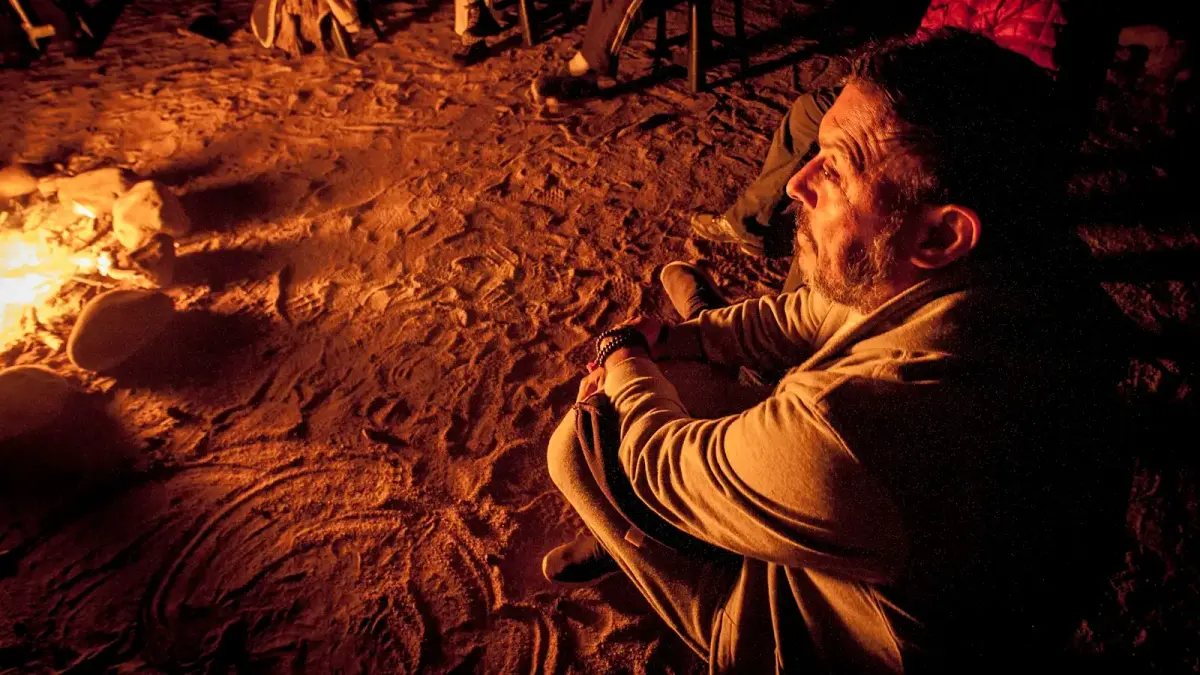
My friend David told me about his father on a Thursday night in October, around a firepit his wife had bought from Costco and he’d assembled wrong twice before giving up and calling his neighbor.
The coals were low. The kids were asleep. Three of us sat in lawn chairs with beer cans balanced on armrests, and the conversation had done that thing where it drifted from fantasy football to work complaints to a silence that wasn’t uncomfortable yet. The kind of silence that’s waiting for someone to either say goodnight or say something real.
David chose real.
He said his dad had never once told him he loved him. That the closest he’d ever gotten was a hand on his shoulder after his wedding, held there for maybe three seconds, and that he’d replayed those three seconds more times than he’d admit to anyone. Then he said he’d become that same man with his own son, and he didn’t know how to stop.
Nobody said anything for a long time. The fire cracked. Someone shifted in their chair. And I remember thinking - David has never said anything like this at a restaurant, at a party, at a dinner table, in any room with overhead lighting. I’ve known him for fifteen years. This was the first time I’d ever heard his voice shake.
The fire made it possible. I’m almost certain of that now.
The oldest therapy room on earth
There’s a reason humans have been sitting in circles around fire for hundreds of thousands of years, and it isn’t just warmth.
Anthropologist Polly Wiessner published a landmark study in 2014, analyzing conversations among the Ju/’hoansi Bushmen of the Kalahari. She found that during the day, roughly 60 percent of conversation focused on practical matters - economic complaints, logistics, social judgments. But at night, around the fire, the content shifted dramatically. Eighty-one percent of firelight conversation was storytelling, emotional sharing, and what Wiessner called “social imagination” - people talking about feelings, relationships, meaning.
The fire didn’t just change the mood. It changed the category of what people were willing to say out loud.
And what struck me about that research wasn’t the Bushmen. It was how precisely it described every backyard firepit conversation I’ve ever been part of. The way the night and the flames conspire to create a space that daytime conversation can’t touch. There’s something ancient in it. Something the body recognizes before the mind catches up.
You don’t decide to be more honest around a fire. You just are.
What the darkness actually does
In 1973, psychologist Kenneth Gergen ran an experiment that should be more famous than it is. He placed groups of strangers together in a room - some in normal lighting, others in complete darkness. The people in lit rooms kept their conversations polite and surface-level. The people in the dark became startlingly intimate within an hour. They disclosed fears, regrets, longings. Some touched each other. Some wept. When the lights came on, most of them couldn’t make eye contact.
Gergen’s conclusion was deceptively simple: reduced visual feedback lowers the cost of vulnerability. When you can’t see the other person’s face react to what you’re saying, the social evaluation machinery in your brain relaxes. You stop editing. You stop performing.
This is the mechanism that operates around every campfire, every firepit, every candle-lit porch. The flickering light creates a halfway space between visibility and shadow. You can see enough to feel connected but not enough to feel watched. Your face is there and then it isn’t. The darkness gives you somewhere to hide inside the honesty.
For women, this is often a pleasant loosening. For men, it can be a revelation. Because many men have never experienced a social environment where their emotional performance wasn’t being graded.
The architecture of how boys learn to feel
I want to be careful here because I don’t want to make this about blame. It’s about architecture.
Most boys are not taught that feelings are wrong. They’re taught something more subtle and more damaging - that feelings require a specific kind of audience, and that audience is almost never available.
A boy cries at school and he’s told to tough it out. He cries at home and his father leaves the room or his mother says something loving but worried, and what he absorbs isn’t “don’t cry” but “crying creates a situation.” It makes the adults uncomfortable. It changes the energy. It becomes an event.
So he learns that if he’s going to feel something, he needs to do it somewhere where the feeling won’t ripple outward. Somewhere private. Somewhere with no witnesses. Or at least - somewhere where the witnesses can’t quite see his face.
The fire provides exactly that room.
A 2015 study published in the Journal of Research in Personality explored what researchers called “contextual emotional expression” in adult men. They found that men didn’t lack emotional depth or even the desire to express it. What they lacked were environments they perceived as safe enough for disclosure. The study identified several key features of perceived safety: low lighting, absence of direct eye contact, small group size, and the presence of a shared focal point that allowed attention to be directed away from the speaker.
Read that list again. Low lighting. No direct eye contact. Small group. Shared focal point.
That’s a campfire. That’s literally a campfire.
The shared focal point
This is the part people underestimate. The fire gives everyone something to stare at.
When a man starts talking about his divorce at a dinner table, everyone has to look somewhere. They look at him, or they look at their plates, and both feel wrong. The attention becomes a spotlight. The vulnerability becomes a spectacle.
But around a fire, when a man starts talking about his divorce, everyone is already looking at the flames. The fire holds the gaze so the speaker doesn’t have to. He can say what he needs to say without feeling like a specimen. The other men can listen without the pressure of performing the right facial expression of concern.
It sounds small. It changes everything.
I’ve watched it happen dozens of times. The man who starts a sentence staring into the fire and finishes it staring into the fire and by the time he’s done talking, nobody has moved, and the silence afterward isn’t awkward because the fire fills it with sound and light and the conversation can continue or it can sit there and both options feel natural.
There is no equivalent to this at a brunch table.
The stories men tell in the dark
If you’ve been around enough campfires with the right people, you know the pattern.
The first hour is logistics. Who wants another beer. Whether the wood is too green. Some half-hearted argument about a sports trade. This is the runway. Nobody takes off without taxiing first.
The second hour is when the lighting shifts. Not just the fire - the internal lighting. Someone makes a joke that’s a little too specific, a little too revealing, and the group either leans in or pulls back. Usually they lean in.
By the third hour, if the fire is still going and nobody has checked their phone, you’re in the space. This is where a man will say something he hasn’t said in thirty years. Where someone will talk about the kid they lost, or the marriage they almost didn’t survive, or the father they never understood until they became one and suddenly understood everything.
I’ve heard men say things around fires that they haven’t told their wives. Not because they’re hiding something - because the fire created a container that their marriages never did. And that’s not an indictment of their marriages. It’s an indictment of a culture that gives men almost no containers at all.
Psychologist Niobe Way, whose research on boys’ friendships spans decades, has documented how adolescent boys describe their friendships in language that is strikingly intimate - deep, emotional, vulnerable - until around age fifteen or sixteen, when they begin to self-censor. The emotional capacity doesn’t disappear. It goes underground. It waits for a room dark enough to resurface.
The campfire is that room.
What the fire is really offering
I don’t think it’s the fire itself. I think it’s the permission structure the fire creates.
Permission to sit still. Permission to not fill silence. Permission to speak without being looked at directly. Permission to say something that matters and then stare into the flames while the words settle, instead of watching someone’s face decide how to react.
Men are often accused of being emotionally unavailable, and sometimes that’s true. But more often, what I’ve seen is that men are emotionally available in very specific conditions - conditions that modern life rarely provides. The well-lit open-plan living room doesn’t provide them. The restaurant with its attentive server checking in every ten minutes doesn’t provide them. The couples therapy office with its fluorescent overheads and the clock on the wall doesn’t always provide them either.
The fire provides them. The darkness provides them. The circle of faces that are half-visible and half-shadow provides them.
Building the fire
My friend David never brought up his father again. Not in the daylight. Not at the next barbecue or the next dinner party. He didn’t send a follow-up text clarifying what he’d said or apologizing for going deep.
But something changed after that night. He hugged his son differently at school drop-off - not longer, just less stiff. He started asking his friends questions that he wouldn’t have asked before. Small questions. “How are you really doing” kind of questions. Daylight questions that carried a trace of firelight in them.
I think that’s what the fire does. It doesn’t just let you speak. It teaches you that the world doesn’t end when you do. That the people sitting around you didn’t flinch. That your voice shaking wasn’t a catastrophe. And sometimes, just sometimes, that’s enough to start carrying a little bit of the fire’s permission into rooms where the lights are on.
If you’re a man who has ever surprised himself by what came out of his mouth after midnight, in the dark, with the embers low and the right people quiet around you - your emotional architecture isn’t broken. It’s just been waiting for the right room.
The fire was always the room.
You just needed someone to light it.