There are men who have been married for thirty years and still knock before entering their own bedroom, not out of courtesy but out of something much older - a boy who grew up in a house where closed doors meant someone was angry, and the safest thing you could do was announce yourself before walking into whatever was waiting on the other side
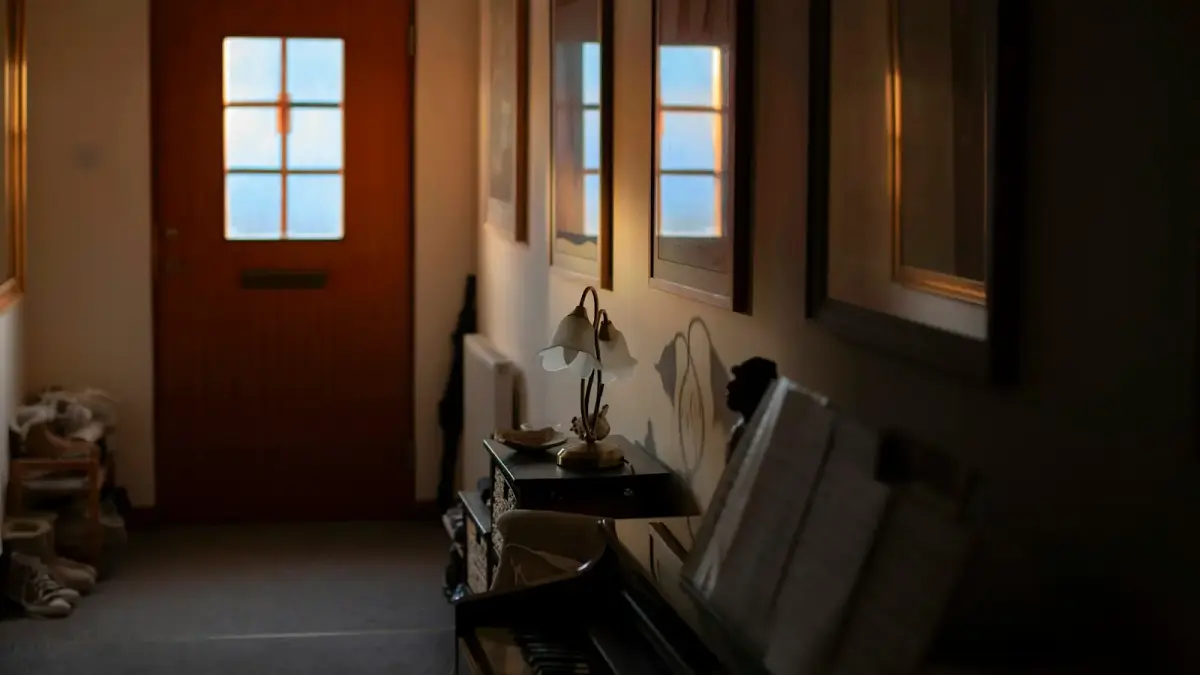
He knocked twice. Soft. Knuckles barely touching wood.
His wife looked up from her book, glasses halfway down her nose. “You know you live here, right?”
He laughed. She laughed. It became one of those small married jokes that gets repeated at dinner parties - my husband knocks on his own bedroom door, can you believe it? And everyone chuckles because it sounds like a man being considerate. Respectful. Maybe a little old-fashioned in a way people find charming.
But standing in that hallway, hand still raised, he felt something he couldn’t name. Not embarrassment. Something lower than that. Something in the architecture of his body that had nothing to do with courtesy and everything to do with a house he grew up in thirty-five years ago, where a closed door was never just a closed door. It was a weather report. It was a warning system. And the boy who lived in that house learned - not through words but through consequence - that you never, ever walk into a room without first finding out what’s happening on the other side.
If you are a man who does this, or if you love a man who does this, what I’m about to describe is probably going to feel uncomfortably familiar.
The door was never about the door
In certain households, a closed door carried information. Not the simple, neutral information of someone getting dressed or wanting quiet. The charged kind. The kind a child learns to read the way sailors read clouds.
Door closed in the afternoon meant mom was crying again. Door closed after dinner meant dad was drinking and you should stay downstairs. Door closed with voices behind it meant an argument, and the argument might spill out if you were standing too close when it opened.
A boy in this house doesn’t learn that doors are boundaries. He learns that doors are barricades. And the space between the hallway and whatever is behind that door becomes a kind of no man’s land where you gather intelligence before you commit to entering.
You knock. You listen. You read the tone of the voice that says “come in” - or you read the silence that says nothing at all, which was often the most dangerous answer.
A 2019 study published in the Journal of Family Psychology examined what researchers called “ambient household threat” - the chronic low-level vigilance that children develop in emotionally volatile homes. They found that children in these environments didn’t just respond to conflict. They developed anticipatory scanning behaviors, constantly monitoring for the next disruption before it arrived. The study noted that these behaviors often persisted well into adulthood, long after the original threat had disappeared.
That scanning is what the knock is. It isn’t politeness. It’s reconnaissance.
Living in your own house like a guest
There’s a particular way some men move through their own homes that, if you’re paying attention, looks almost careful. They close cabinets quietly. They enter rooms at the edges. They take up less space than a person their size should take up, as if they’re trying to pass through without disturbing the air.
Their partners notice, sometimes. “You’re so quiet, I didn’t even know you were home.” And the man smiles because it sounds like a compliment. But it isn’t a skill he chose to develop. It’s a skill that was built into his nervous system by a childhood where being noticeable was dangerous.
These are men who learned, very young, that the volume of your footsteps could determine how a night unfolded. That the way you closed a door - too hard and you’ve started something, too soft and someone asks what you’re sneaking around for - was a test you could fail in either direction.
So they became experts at the middle distance. Not too present, not too absent. Visible enough to not seem suspicious. Invisible enough to not become a target.
Dr. Gabor Mate has written extensively about how children in unpredictable homes develop what he describes as a finely tuned radar for the emotional states of others. The child becomes hyperattuned not because they’re naturally empathic, but because reading the room correctly was a survival strategy. The empathy came from necessity. The gentleness came from fear.
And now, decades later, that man is fifty-three years old and still checking the emotional weather before he walks into his own kitchen.
What his wife sees and what is actually happening
She sees a considerate husband. A man who respects her space. Who never barges in, never startles her, never assumes he has the right to just appear. And she isn’t wrong - he is all of those things. But the mechanism underneath the behavior is something she may have never been told about, and something he may never have examined himself.
Because here’s the part that’s hard to say out loud: he doesn’t knock because he respects her privacy. He knocks because some part of him still doesn’t fully believe the room is safe.
Not safe from her. She’s the safest person he’s ever known. That’s probably why he married her. But the reflex isn’t about her. The reflex is about all the doors that came before her - the ones that opened onto shouting, or silence so thick it felt like a wall, or a parent whose face told you everything before a single word was spoken.
A 2021 study in Psychological Science explored how early relational experiences shape what the researchers called “domestic spatial behavior” - the way adults physically navigate shared living spaces. They found that adults who grew up in high-conflict homes were significantly more likely to exhibit what the study described as “threshold hesitation” - pausing at doorways, knocking unnecessarily, avoiding rooms where another person was present. These weren’t conscious choices. They were body-level habits carved by years of practice.
His wife might say, “You don’t have to knock.” And he’ll say, “I know.” And he does know. Intellectually, he knows. But his body hasn’t caught up to what his mind already understands. His hand still rises. His knuckles still find the wood. And for a half second, he is nine years old again, standing outside his parents’ bedroom, listening for information that will tell him who he’s about to meet on the other side.
The quiet math of making yourself small
This isn’t only about doors. The knock is just the most visible version of a much larger pattern.
These are often men who ask permission for things that don’t require permission. “Is it okay if I watch the game?” “Do you mind if I go to the garage for a bit?” “Would it bother you if I had the guys over Saturday?” Not because their wives are controlling - most of their wives are baffled by the asking - but because the man never fully internalized the idea that his presence and his preferences are allowed to exist without approval.
He was a boy who learned that wanting things was risky. That having needs made you a burden. That the safest version of yourself was the one that took up the least amount of room, asked for the least amount of anything, and made sure that everyone else was settled before you even thought about what you might want.
And the thing about this kind of boy is that he often becomes a very good man. Considerate. Attentive. The kind of partner people describe as “one of the good ones.” But underneath all of that goodness is a question he’s been carrying since childhood, and the question is this: is it okay that I’m here?
Not in the existential sense. In the literal, daily, room-by-room sense. Is it okay that I’m in this kitchen right now. Is it okay that I’m sitting in this chair. Is it okay that I exist in this house at this volume, with these needs, taking up this much space.
He has been doing this math for so long that he doesn’t even notice it anymore. It just runs in the background, like software he never installed but can’t seem to uninstall either.
The moment it becomes visible
Sometimes there’s a moment - and it usually catches him off guard - when the pattern becomes visible. Maybe his wife points it out gently. “You know you don’t have to ask to use the television in your own living room.” Maybe a therapist names it. Maybe he watches his son walk through the house freely, carelessly, leaving doors open and making noise without thinking, and something in his chest tightens because he realizes his son feels safe in a way he never did.
That tightness isn’t jealousy. It’s grief. Grief for the boy who couldn’t do that. Who walked softly and knocked first and listened at doors and learned to read the weather in a room before he allowed himself to enter it.
And this is the part I want to be careful with, because I’m not interested in telling anyone they’re broken. You are not broken. A man who knocks on his own bedroom door is not damaged. He is someone whose body learned a set of rules a long time ago, and those rules kept him safe when he needed them, and now they’re still running even though the danger has passed.
The knock was a brilliant adaptation. It was a child solving an impossible problem - how do I move through a house where any room might contain something that hurts? - and the solution he came up with was elegant. Announce yourself. Test the air. Enter only when you’ve confirmed it’s safe. That’s not a flaw. That’s intelligence operating under pressure.
But it is also worth noticing. Not to fix, necessarily. Just to see. Because when you finally see the pattern, when you finally understand why your hand rises before you enter your own bedroom, something shifts. The knock doesn’t have to stop. But it can become a choice instead of a reflex. And there is a world of difference between the two.
You were never being polite
If you’re reading this and you feel that slow, quiet recognition settling in your chest, I want you to hear something clearly.
You were never being polite. You were being safe. And the fact that your survival strategy looked like good manners is one of the quieter tragedies of growing up in a house where you had to earn the right to walk into a room.
You deserved a home where you could slam a door and nothing terrible happened. Where you could walk into the kitchen without scanning for mood. Where your footsteps didn’t need to be calibrated to someone else’s emotional state. You deserved a childhood where a closed door was just a closed door.
You didn’t get that. And instead of collapsing under the weight of that, you adapted. You became careful. You became watchful. You became the kind of man who notices everything and says very little about what he sees.
That’s not weakness. That’s a kind of strength that most people will never have to develop, and will never fully understand.
But your wife’s bedroom is safe. Your kitchen is safe. Your hallway is yours. The doors in this house don’t carry warnings. You can walk through them.
You can walk through them without knocking.
And if you still knock - if your hand still rises out of habit, if your knuckles still find the wood before you even think about it - that’s okay too. Just know that the boy who taught you to do that was doing his best. He was trying to keep you alive. He succeeded.
You’re here. You’re safe. You’re home.