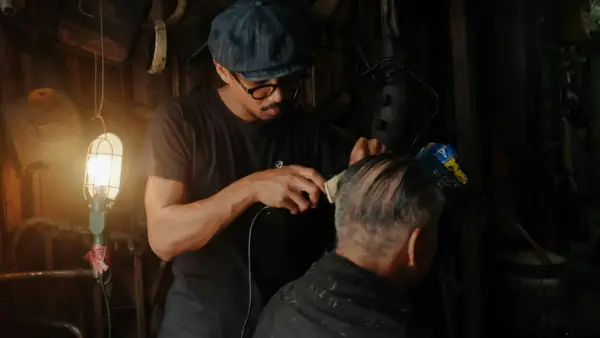
There are men who sit in the same barber's chair every three weeks not because they need a haircut but because the barber is the only person in their life who asks how they're doing and genuinely waits for the answer, and the twenty minutes of someone else's hands on their head is the closest thing to being cared for that a man who forgot how to ask for tenderness will allow himself to receive
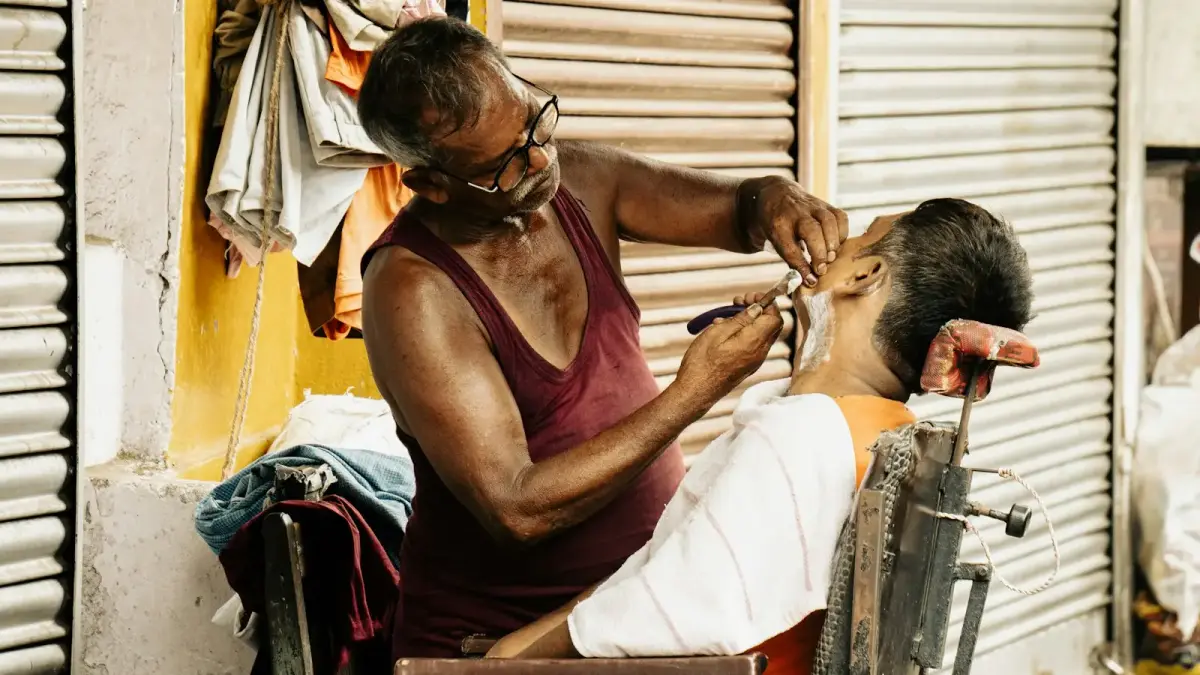
I have a barber named Ray. He’s been cutting my hair for almost nine years. I could not tell you what his last name is. I could not tell you whether he has children or what kind of car he drives. But I can tell you that he is the only person in my life who puts both hands on my head and says, “How you been, man?” - and then doesn’t move until I answer.
I go every three weeks. My hair doesn’t need it every three weeks. I know that. Ray probably knows that too.
But I sit in that chair and something in me exhales - something that has been holding its shape for twenty-one days without anyone noticing. And for twenty minutes, someone touches me gently and talks to me like I matter outside of what I provide.
I never told anyone that until now. I suspect a lot of men never will.
The chair that asks nothing of you
There is a kind of space that only exists in certain barbershops - not the trendy ones with espresso machines and playlists curated by algorithm, but the old ones, the small ones, the ones where the same guy has been cutting hair in the same spot for fifteen years and the TV on the wall is always playing something nobody watches.
The chair reclines. The cape goes on. And something shifts.
You are no longer the provider, the problem-solver, the one who holds it together. You are just a man sitting still while someone else’s hands move around your head with care.
That word matters - care. Not efficiency. Not transaction. Care.
A 2021 study published in the journal Psychosomatic Medicine found that non-sexual physical touch activates the parasympathetic nervous system, lowering cortisol and blood pressure within minutes. The researchers noted something that won’t surprise any man who keeps his barber appointment like clockwork - touch doesn’t just feel good. It tells the nervous system that it is safe enough to stop performing.
Most men I know don’t have that signal anywhere else in their lives.
The conversation that sneaks past the guard
Ray knows about my father’s diagnosis before my closest friend did. He knew about the trouble in my marriage during the stretch when I was telling everyone things were fine. He knew I was thinking about leaving my job three months before I actually did it.
I didn’t plan any of those confessions. They happened because of the architecture of the interaction.
You’re not facing each other. There’s no eye contact. The mirror is there but you’re both looking at the work, not at each other’s faces. The hum of the clippers fills the silence so there’s no pressure to keep talking.
It’s the safest confessional a man who doesn’t go to therapy will ever find.
A barber doesn’t react the way a wife does. He doesn’t worry. He doesn’t try to fix it. He says, “That’s rough, brother,” or “Yeah, I hear you,” and then he blends your neckline. The conversation moves. The weight stays behind in the chair.
Men have been socialized out of the language of emotional need, but the need didn’t go anywhere. It just learned to dress up as something else - a standing appointment, a loyalty to a particular barber, a preference that looks like habit but is actually hunger.
What touch means when you’ve stopped asking for it
I want to talk about touch specifically because I think this is where the real ache lives.
Think about the last time another human being touched you without wanting something. Not a handshake. Not a pat on the back at work. Not the functional touch of passing a child between arms in a doorway. Touch that was slow, deliberate, and meant to tend to you.
For a lot of men over forty, the answer is the barber’s chair. And they don’t even realize it.
The psychologist Tiffany Field, who founded the Touch Research Institute at the University of Miami, has spent decades documenting what she calls “touch hunger” - a condition where the body, deprived of regular meaningful physical contact, begins to show stress responses that mirror loneliness and grief. Her research, published across multiple studies in journals including Developmental Review, has shown that American men are the most touch-deprived demographic in the Western world.
Not because no one would touch them. But because they stopped making themselves available for it.
The barber’s chair bypasses all of that. Nobody has to ask. Nobody has to be vulnerable. You sit down, and someone puts their hands on you. It’s built into the service. And the relief of that - the sheer relief of being touched without having to initiate or explain - is something I don’t think most men have language for.
So they just keep coming back every three weeks.
The barber who knows more than anyone
There’s a quiet phenomenon that happens in long-term barber relationships, and it operates on a different frequency than friendship.
A friend expects reciprocity. A therapist operates inside a structure with rules and goals. A partner carries the weight of shared history, shared finances, shared futures. Every one of those relationships requires the man to show up as something - a good friend, a cooperative patient, a reliable husband.
The barber requires nothing. You show up. You sit. He cuts.
And inside that absence of expectation, men say things they can’t say anywhere else.
A barber in Detroit named Jerome once told a reporter that he knew about divorces, cancer diagnoses, layoffs, and bankruptcies months before anyone else in his clients’ lives. “They don’t come here to talk,” he said. “They come here to not have to perform. The talking just happens.”
That distinction matters. It’s not that the barbershop is a place where men open up. It’s that the barbershop is a place where the performance of composure was never required - and in the absence of that requirement, something honest leaks through.
I think about my father’s generation, men who worked with their hands and came home tired and sat in their chairs and were never asked a single question about their interior lives. Those men had barbers too. And I wonder now how much of what we lost when those men died was actually sitting in a barber’s chair somewhere, spoken once to someone who listened, never recorded, never repeated.
The ritual of being tended to
There is a word I keep circling back to, and the word is tended.
Not cared for in the way a doctor cares for you - diagnostically, with purpose. Not loved the way a partner loves you - with expectation and history. Tended, the way a gardener tends something. Quietly. Regularly. Without making a big deal of it.
The hot towel on your face. The careful line along the edge of your ear. The way a good barber tilts your head with two fingers instead of grabbing. These are acts of tenderness dressed up as craft, and I believe men recognize them on a level they’ve been taught to ignore.
Research from 2019 published in the journal Psychology of Men and Masculinities found that men who adhered to traditional masculine norms were significantly less likely to seek emotional support but showed no reduction in the actual need for that support. The need was identical. The behavior was suppressed.
The barbershop is where suppressed need and acceptable behavior overlap perfectly. You can be tended to without admitting you wanted it. You can be touched without asking. You can be asked how you are by someone who isn’t keeping score.
That is not a haircut. That is emotional infrastructure, built in twenty-minute increments by men who couldn’t build it anywhere else.
The drive across town
I know men who pass four barbershops to get to theirs. Men who could get a cut around the corner but instead drive thirty minutes to a strip mall off the highway where a particular person in a particular chair is waiting.
That’s not brand loyalty. That’s not convenience. That’s a man who found the one place in his week where he is touched and spoken to and seen without having to earn it - and he will protect that place with the same ferocity he protects everything he loves but can’t name.
The appointment isn’t about hair. The drive isn’t about the drive. The tip that’s always a little too generous isn’t about the service.
It’s about the fact that for twenty minutes, someone else is in charge of him. Someone else is paying attention to the details of his body. Someone else is asking questions and shaping the answers with patience instead of panic.
And when it’s done, he looks in the mirror. He looks sharper. He looks handled. And he walks out carrying something he didn’t walk in with - something warm and unnamed that will last about three weeks before it needs replenishing.
What I wish someone had told us
I wish someone had told us that needing to be touched isn’t weakness. That wanting someone to ask how you are - and actually wait for the answer - isn’t neediness. That the ache you feel when nobody has put their hands on you in weeks is not a character flaw. It is your body telling you the truth your pride won’t.
I wish someone had told us that tenderness is not a feminine need dressed up in gendered language. It is a human need. And the fact that so many men have to find it in a barber’s chair - disguised as grooming, justified by routine, made acceptable by commerce - says something about how badly we failed each other.
Not the barbers. The barbers did their part. They showed up. They asked. They waited. They touched with care.
The rest of us just forgot to do the same.
I’ll be back in Ray’s chair in about two and a half weeks. My hair will be fine. I’ll go anyway. And when he puts the cape around my shoulders and says, “How you been, man?” - I’ll tell him. Because he’s the one who always asks.
And he’s the one who always stays to hear the answer.