There is a reason some men whistle the same shapeless melody their fathers whistled - while mowing the lawn, while standing at the grill, while tinkering under the hood of something that didn't need fixing - and the reason is that a boy who grew up hearing that sound from down the hallway learned that whistling meant the house was safe, that the man making the noise was calm, and the melody was never music but the sound a nervous system makes when it is finally at rest
My father whistled a melody that wasn’t a melody.
It had no beginning. No chorus. No resolution. It wandered up a few notes, paused where a real song would have committed to something, and then drifted sideways into a different key entirely.
If you’d asked him what song it was, he would have looked at you like you’d asked what color Thursday is. It wasn’t a song. It was just something his mouth did when his hands were busy and his mind was quiet.
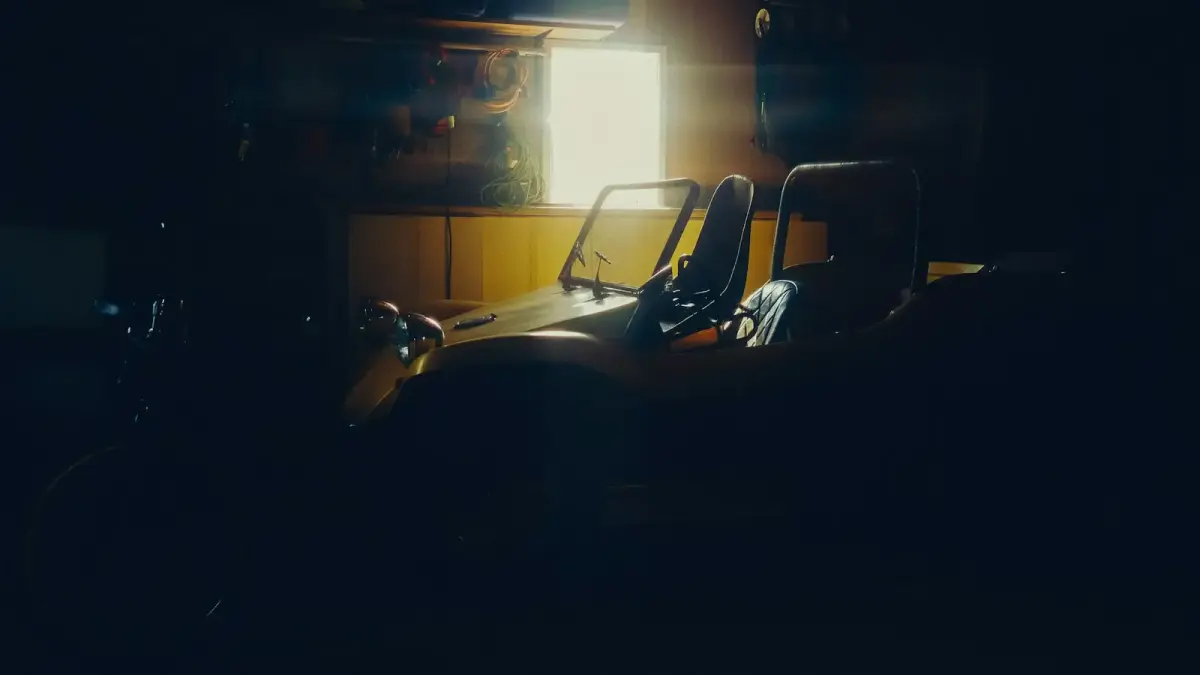
He whistled it while edging the lawn. He whistled it while rinsing the grill grate with the hose. He whistled it in the garage, standing over some small mechanical problem that didn’t urgently need solving but gave him a reason to be out there, alone, in the cool of the concrete, doing something with his hands that asked nothing of him emotionally.
I didn’t know I’d memorized it until I was fifty-three years old, standing in my own garage, sanding the edge of a shelf I was building for no real reason, and I heard it. Coming from me. The same shapeless, wandering, unfinished tune.
And something in my chest opened that I didn’t have a name for.
The sound a house makes when nothing terrible is about to happen
If you grew up in a home where tension had a sound - and most of us did - then you know that silence is not the same as peace. Silence in a volatile house is the worst sound there is.
Silence means someone is deciding. Silence means the next thing that happens might be a door slamming, a voice rising, a conversation you’ll have to pretend you didn’t hear.
But whistling. Whistling was different.
You couldn’t whistle while you were angry. You couldn’t whistle while you were planning how to deliver bad news. You couldn’t whistle while clenching your jaw or rehearsing an argument in your head.
The physics of it wouldn’t allow it. Whistling requires a relaxed mouth, a steady breath, a kind of purposeless ease that is physically incompatible with agitation.
A child doesn’t know any of this consciously. But a child’s nervous system knows it completely.
Stephen Porges, the neuroscientist who developed polyvagal theory, has spent decades studying how the human autonomic nervous system reads vocal signals for cues of safety or danger. His research, published across multiple papers in journals including Psychophysiology and Biological Psychology, demonstrates that the human ear is uniquely tuned to detect prosodic qualities in sound - rhythm, pitch variation, melodic contour - and that these qualities activate what Porges calls the “social engagement system.”
When the nervous system detects vocal patterns associated with calm - soft, melodic, rhythmic, unhurried - it downregulates the body’s threat response. The vagus nerve signals safety. The muscles of the face and middle ear relax.
A father’s whistle, formless as it was, carried every one of those prosodic markers.
And a boy lying in bed at night, hearing that whistle drift up from the kitchen or the back porch, didn’t think “my father is calm.” He didn’t think anything. His body simply registered: we are safe.
The man downstairs is making the sound that means nothing bad is coming. I can sleep.
Why the melody is never a real song
This is the part that gets me. The whistle is never a recognizable tune.
It’s never “Yesterday” by the Beatles or the theme from a TV show or anything you could look up and play back. It’s a formless, meandering, half-musical sound that goes nowhere and resolves into nothing.
And that’s precisely why it works.
A real song has structure. It has intent. If your father were whistling a specific melody, it would mean he was performing something - remembering a song, entertaining himself, making music on purpose.
That performance would carry a different neurological signature. It would suggest attention directed outward. A degree of self-consciousness.
The formless whistle carries none of that. It is sub-intentional. It is the sound a body produces when it has nothing to process, nothing to brace for, nothing to perform.
It is as involuntary as humming in the shower. And that involuntariness is what makes it so profoundly trustworthy to a child’s nervous system.
You can fake a smile. You can fake a calm voice. You can say “everything’s fine” while your jaw is locked and your shoulders are up around your ears, and a child will know you’re lying without being able to explain how.
But you cannot fake a whistle. The body won’t let you.
Research on embodied cognition - the branch of cognitive science that studies how the body shapes thought and emotion - has shown that certain physical behaviors serve as what psychologists call “somatic markers.” These are bodily signals that communicate internal states more reliably than language ever could.
A 2018 study in Frontiers in Psychology found that observers could accurately detect emotional states in others based on nonverbal auditory cues - breathing patterns, vocal quality, involuntary sounds - even when linguistic content was removed entirely.
Your father’s whistle was a somatic marker. It was his body’s way of broadcasting, to anyone within earshot, that the internal weather was fair.
The inheritance no one talks about
Here is what no one tells you about growing up with a whistling father: you will become him. Not in the ways you expect - not in his opinions or his career or his taste in cars.
You will become him in the smallest, most involuntary way possible. You will inherit the whistle.
You’ll be standing at the sink doing dishes on a Saturday, or pushing a cart through the hardware store, or walking the dog through the neighborhood after dinner, and you’ll hear it. That same tuneless, purposeless, shapeless melody coming from your own mouth.
And for a second, you won’t know if you’re hearing yourself or remembering him.
This is not nostalgia. This is behavioral transmission - the way human beings pass patterns from one generation to the next through means that have nothing to do with language, instruction, or conscious intent.
Developmental psychologists have studied this kind of transmission extensively. Children don’t just learn what their parents teach them. They absorb how their parents breathe, stand, move, sigh, and - yes - whistle.
A 2020 paper in Developmental Psychology examined what researchers called “affective behavioral echoes” - the unconscious replication of a caregiver’s regulatory behaviors in their adult children. The study found that adults whose primary caregivers displayed consistent self-soothing behaviors were significantly more likely to develop their own somatic regulation habits, often replicating the exact motor patterns they’d observed in childhood.
You weren’t taught to whistle that melody. You absorbed it the way you absorbed the cadence of your father’s walk, the particular way he cleared his throat before saying something important, the exact angle at which he tilted his head when he was thinking.
These are the smallest, most intimate inheritances a person can receive. And they are the ones that survive the longest.
What you’re actually doing when you whistle
When I caught myself in the garage that afternoon, whistling my father’s melody, my first thought was that I was being sentimental. That I’d picked up a habit from him the way you pick up a regional accent or a preference for a certain brand of coffee.
Something environmental. Something minor.
But it wasn’t minor. And it wasn’t sentimental.
What I was doing - what you are doing, if you are one of these men - is regulating your nervous system using the only lullaby it ever learned. You are reproducing the frequency of safety that your body cataloged decades ago, in a kitchen that no longer exists, from a man who may no longer be alive, and you are using it to tell yourself what he told you without ever saying a word: I am here. I am calm. Nothing terrible is about to happen.
Porges calls this “self-administered neuroception” - the use of self-generated vocal patterns to activate the same neural pathways that were originally activated by a caregiver’s voice. Your whistle isn’t a song and it isn’t a memory. It is a physiological event.
Your vagus nerve responds to the sound of your own formless melody the same way it responded to your father’s, because it doesn’t distinguish between the source. It only recognizes the pattern. And the pattern says: safe.
You are your own lullaby now. You have been for years. You just didn’t know it until you heard it from outside yourself and recognized whose voice it really was.
The boys who are listening
There is a version of this that breaks my heart a little, and it’s the part about your own children.
If you are a man who whistles - in the kitchen, in the yard, in the car with the windows down - your children are doing exactly what you did. They are not listening to the melody. They are calibrating to the frequency.
Their nervous systems are filing that sound under the category of “this is what safety sounds like,” and they will carry that file for the rest of their lives.
They won’t remember it consciously. They won’t be able to tell you when it started. But thirty years from now, one of them will be standing in a garage or a kitchen or a backyard, and they’ll hear themselves producing a formless, purposeless, wandering melody, and something in their chest will open that they don’t have a name for.
And they’ll think of you. Not because they decided to. Because their body decided for them.
This is the quietest form of love that exists between fathers and children. It requires no words. No grand gestures.
No conversations about feelings that neither of you knows how to have. It is simply the sound of a man’s body at rest, transmitted across decades, arriving intact in the muscles of his son’s mouth and the memory of his daughter’s ears.
The lullaby that was never sung
My father never sang to me. I don’t think his father sang to him, either. There is a whole lineage of men in my family who would have rather changed a tire in the rain than sit on the edge of a bed and sing a child to sleep.
But they whistled.
And the whistling did everything a lullaby was supposed to do. It said: the world is not ending tonight. It said: the man in this house is at ease, which means you can be at ease, too. It said: I may not have the words for what I feel about you, but listen - listen to this sound I’m making without thinking about it - this is what it sounds like when I’m not worried about anything, and right now, the thing I’m not worried about is you, because you are safe, and I am here.
I don’t know if my kids will remember my whistle. I don’t know if they hear it the way I heard my father’s - as the low, reliable hum underneath the household noise, the frequency that meant everything was fine.
But I know I can’t stop doing it. And I know it isn’t music.
It’s the sound my body makes when it remembers what safety felt like before I had language for it. A nervous system’s lullaby, passed down from a man who never knew he was singing.