There are men who keep their father's old toolbox in the garage - the rusted wrenches, the hand drill with the cracked handle, the carpenter's level that hasn't been true in twenty years - not because the tools are useful but because a son who never learned how to say I miss you learned instead to keep the objects that still carry the weight of his father's hands
The toolbox that nobody opens
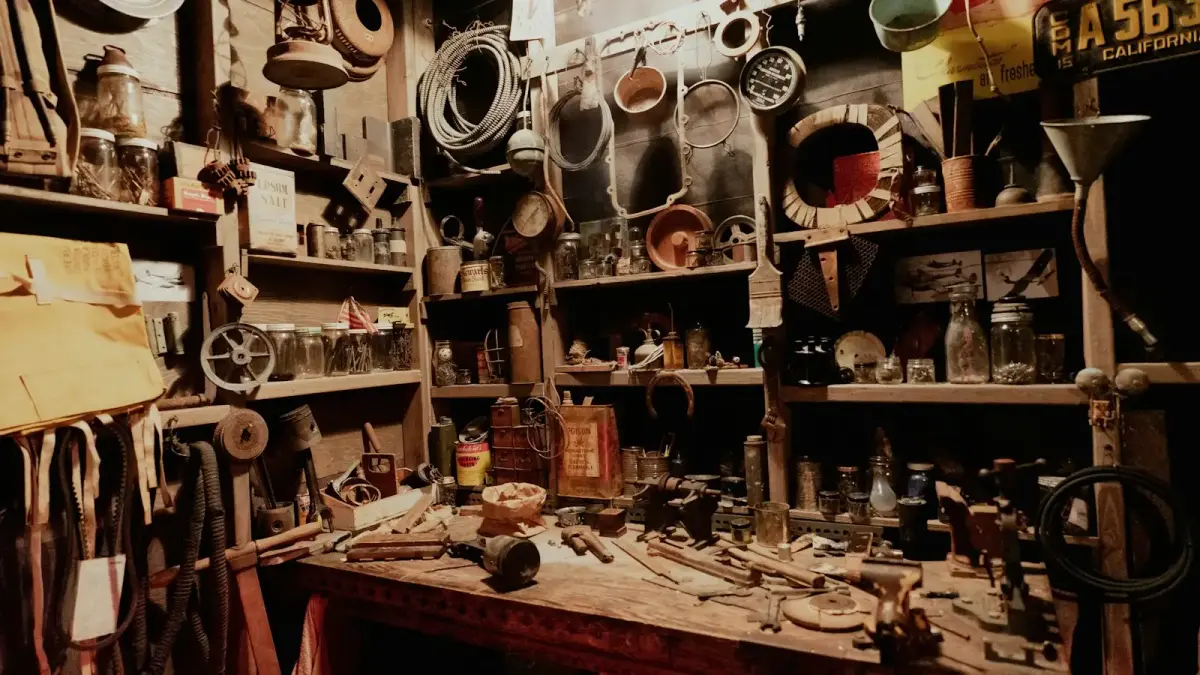
I found it last spring when I was reorganizing the garage. Pushed behind a stack of paint cans I’ll never use and a folding chair with a torn seat. My father’s toolbox. Green metal, dented at the corners, the latch so corroded it barely clicks anymore.
I opened it. Inside, everything was exactly as he’d left it. The Phillips head screwdriver with the electrical tape wrapped around the handle. A handful of mismatched nails in a baby food jar. The carpenter’s pencil, flat and wide, still marked with a faint line he’d drawn on some piece of wood I’ll never identify.
I stood there in the garage for a long time. Not doing anything. Just holding a pencil that my father once held.
I am fifty-three years old, and I have never once used anything from that toolbox. But I will carry it with me into every house I ever live in.
Love expressed in lumber
My father was not a man who talked about feelings. He was a man who fixed things.
When my mother was upset, he’d find something in the house that needed repair. A squeaky hinge. A loose cabinet door. He’d disappear into his project and emerge an hour later, hands dusty, and the house would be slightly more functional than before. That was his apology. That was his tenderness.
A 2014 study published in the Journal of Family Psychology found that men of the boomer generation were significantly more likely to express care through instrumental acts - fixing, building, providing - than through verbal affirmation. The researchers called it “practical love.” My father would have called it Tuesday.
He built me a bookshelf when I was twelve. Didn’t ask if I wanted one. Just noticed my books were stacked on the floor and showed up one Saturday with lumber in the back of his truck. We didn’t talk while he worked. I handed him things when he pointed. The bookshelf was crooked, slightly. I kept it until I was thirty-four.
That shelf was a sentence he couldn’t say. I understood that even then, in some wordless way a boy understands his father.
The shrine we never call a shrine
There is a particular kind of man - and I know him because I am him - who keeps his father’s tools not on a shelf of honor but shoved in the back of the garage, behind things, half-hidden. As though we’re embarrassed by what we’re doing.
Because what we’re doing is keeping a shrine. And men like us don’t keep shrines. Men like us don’t light candles or press flowers in books or save locks of hair. We save socket wrench sets. We save hand drills with cords so frayed they’d be a fire hazard if we ever plugged them in.
We save the things that still smell like his garage. That still have sawdust in the crevices. That still carry the oil from his hands.
Nobody taught us a ritual for this. Nobody gave us a language for what it means to lose a man who never spoke and to realize, only after, that his silence had a grammar you were just beginning to learn.
The weight of a hand drill
Gabor Mate writes about how unexpressed grief lives in the body. I think for men of my generation, it also lives in objects.
My friend David keeps his father’s measuring tape in his desk drawer at work. Not the garage. The desk. His father has been gone for eleven years. David is a financial analyst. He has never measured anything at that desk. But the tape is there, every day, three inches from his right hand.
When I asked him about it, he looked at me like I’d asked him why he breathes. “It’s just there,” he said. And then, quieter: “He was always measuring things. Making sure things were level.”
There it is. The whole eulogy in two sentences. He was always making sure things were level.
A 2019 study in Psychological Science found that physical objects associated with deceased loved ones activate the same neural regions as the person’s physical presence once did. The brain does not fully distinguish between the person and the object the person touched. When I hold my father’s cracked-handle drill, some ancient part of my nervous system registers: he is here. Faintly. But here.
What we inherit besides the tools
My father’s hands were calloused in a way mine will never be. He worked with them every day for forty years - plumbing, carpentry, the steady patient labor of a man who believed that anything broken could be made right again if you just stayed with it long enough.
I inherited his jaw. His tendency toward silence when I’m hurt. His habit of fixing things for people I love instead of telling them I love them.
I also inherited his toolbox. And the particular weight it carries - the weight of a relationship conducted almost entirely through proximity rather than language. We were in the same room a thousand times. We built a deck together one summer. We drove to the hardware store in a silence that felt, somehow, complete.
Daniel Goleman’s work on emotional intelligence often gets reduced to “learn to talk about your feelings.” But I think there is a literacy my father had that we’ve lost the ability to read. He said things with his hands. He said things by showing up. He said things by staying.
The tools are what’s left of that dialect.
Getting rid of them is not an option
My wife has suggested, gently, that I could donate the tools. That someone could use them. She is being practical and kind. She does not understand that she is asking me to give away the last thing on earth that still has his fingerprints on it.
I know the tools are useless. The level hasn’t been true in twenty years. The wrench set is incomplete - he lost the 9/16ths sometime in the eighties and it bothered him for decades. The handsaw is so dull it couldn’t cut cardboard.
But usefulness was never the point.
A 2021 paper in Frontiers in Psychology found that bereaved individuals who maintained physical connections to the deceased - through objects, spaces, or rituals - reported higher levels of what researchers call “continuing bonds,” a form of grief that doesn’t seek closure but instead integrates the loss into daily life. The grief doesn’t end. It just becomes furniture. It becomes a green metal toolbox behind the paint cans.
I am not holding onto the tools because I’m stuck. I’m holding onto them because they are the only proof that his hands were real. That he stood in a garage like mine, on a Saturday like this one, and made something hold together.
The moment you understand what you’ve been doing
It came to me last fall. I was in the garage looking for a flashlight and I moved the toolbox and I stopped. Stood there with my hand on the metal lid, cold from the night air. And I realized I’d been keeping this box for fifteen years without ever consciously deciding to keep it.
It just came with me. Every move. Every new house. I packed it like I packed the dishes. Without thinking. Without questioning.
And in that moment I understood something about my father that I never understood while he was alive. He did the same thing. Not with tools - with us. He kept us. Not because he ever made a speech about family or wrote a card that said more than “Love, Dad” in his blocky handwriting. He kept us because that’s what he knew how to do. You keep the things that matter. You maintain them. You don’t let them fall apart.
He kept us the way I keep his toolbox. Without language. Without ceremony. Just the quiet insistence of a man who refuses to let go of what he loves.
What the rust is actually saying
If you are a man reading this - if you have a box or a drawer or a shelf that holds something of your father’s, something no one would understand you keeping - I want you to know that I understand.
You are not sentimental. You are not stuck. You are not failing to “move on.”
You are speaking the only language your father ever taught you. The language of objects held. Of things maintained long past their usefulness. Of love expressed as loyalty to the physical world a person once occupied.
The rust on his wrenches is not decay. It is a record. It is time made visible on the last things he touched.
And the fact that you cannot throw them away - that is not weakness. That is the son in you, still standing in the garage, still handing him things when he points. Still there. Still quiet. Still paying attention to a man who deserved more words than either of you ever had.