There are men who sit in their cars in the driveway for ten minutes after work, not because they dread what is inside but because the distance between who the world needed them to be today and who their family deserves is longer than the commute, and nobody taught them there was a version of walking in that did not require becoming someone else first
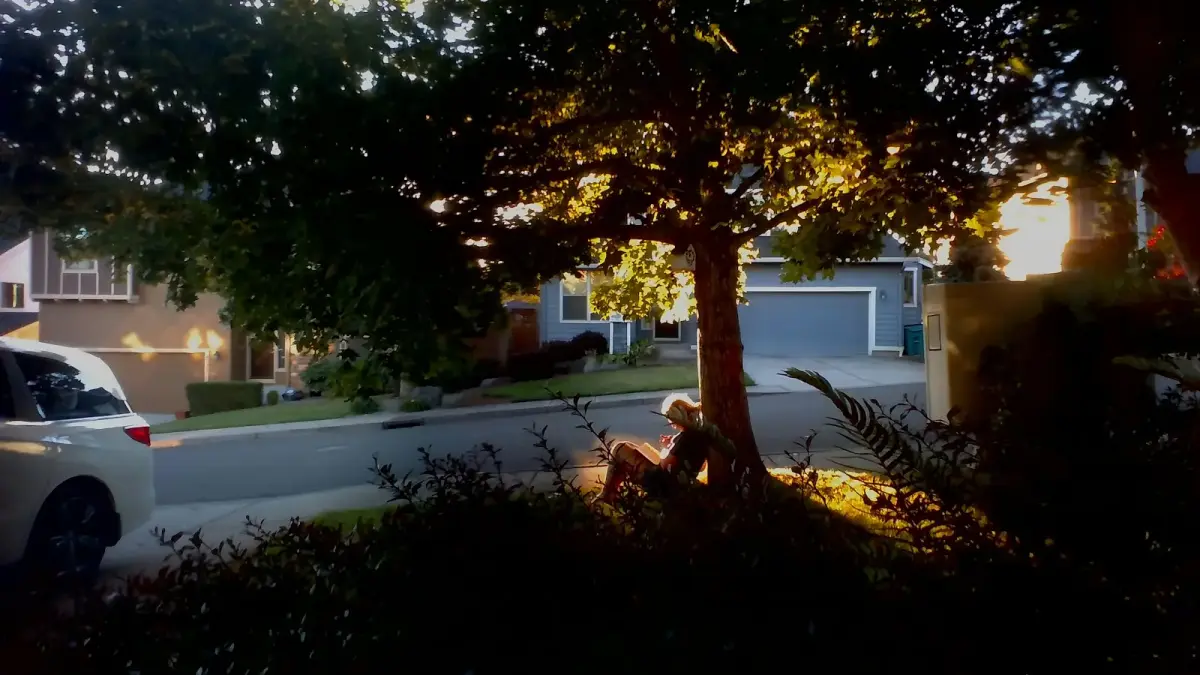
The engine was off but I could not move
I remember the first time I noticed myself doing it. Sitting in my own driveway with the engine cooling and the house right there, porch light on, the kitchen glowing warm through the window.
My wife was inside. My kids were inside. Everything I loved in the world was fifteen steps away.
And I could not get out of the car.
Not because I didn’t want to go in. I ached to go in. But somewhere between the office parking lot and my driveway, I had lost the thread of myself.
The version of me that had spent ten hours absorbing other people’s crises and converting panic into composure didn’t know how to hold his daughter gently.
That version couldn’t ask his wife about her day and actually hear the answer.
So I sat. I breathed. I stared at the garage door like it might tell me who I was supposed to be now.
It took me years to understand that I wasn’t hiding. I was trying to find myself before I walked in, because I’d learned the hard way that showing up as the role instead of the person is the thing that slowly poisons a house from the inside.
The labor nobody named
There is a kind of work that men do every day that has no vocabulary.
It is not physical labor. It is not intellectual labor. It is the labor of being steady when nothing inside you is steady.
Of being the person in the room who absorbs the tension so nobody else has to carry it. Of hearing bad news and converting it into calm before your face has time to change.
A 2015 study published in the Journal of Occupational Health Psychology found that emotional suppression at work - the constant effort of hiding what you actually feel to appear composed - predicted emotional exhaustion more reliably than workload itself. The weight was not the tasks. It was the mask.
For many men, this suppression is not a strategy. It is an identity forged so early it feels like personality.
Be strong. Be reliable. Handle it.
By the time a man pulls into the driveway, he has been handling it for ten hours straight. The transition from that person to the one who can sit on the floor and build a Lego castle is not a light switch. It is a slow dissolve, and it needs a minute that nobody thinks to give him.
The commute used to be the crossing
Here is something that nobody talks about.
Thirty years ago, the drive home was the transition itself. Forty-five minutes of highway and radio and slow decompression. By the time you reached your street, the office version of you had mostly faded.
Now the commute is twelve minutes. Or it is the walk from a home office to the living room. Or it is the sound of a laptop closing followed immediately by a child saying “Dad.”
The distance between identities did not shrink. The time to cross it did.
So the driveway became the decompression chamber. Five minutes, maybe ten, sitting in a cooling car with the seatbelt still on, staring at nothing. The body needs a pause that the schedule does not account for.
Research from the American Psychological Association has shown that role transitions - the psychological shift from one identity context to another - require what psychologists call “boundary work.” We need rituals and time to move between the selves we carry. Without that space, we bring the wrong self into the room.
And the wrong self in a marriage is not always the angry one. Sometimes it is the efficient one - the one who hears his wife describe her frustration and immediately starts problem-solving, because that is what he has been doing since seven in the morning.
What he is actually doing in that car
He is not avoiding his family. He is protecting them from the residue.
He knows what happens when he walks through the door still wearing the armor. He becomes short. He answers questions in his work voice.
He holds his son like a task instead of a person.
He has done this enough times to know exactly how it lands.
So the driveway pause is not selfishness. It is the only emotional maintenance he knows how to perform. The one quiet moment in his entire day where nobody needs him to be anything.
Daniel Goleman wrote extensively about the difference between emotional reactivity and emotional availability. You can be physically present and emotionally vacant, and most people feel the difference even when they cannot name it.
The man in the driveway understands this in his bones. He knows his kids can feel the difference between Dad and the person Dad becomes when he hasn’t had a second to land. He knows his wife can sense when she is talking to him versus talking to the echo of his workday.
So he takes the only time he can. In the car, in the quiet, before anyone needs anything.
The story she writes in her head
She sees the car in the driveway. She sees the interior light glowing. She knows he is home and he is not coming in.
The story that forms in her mind is almost never the right one.
He does not want to be here. He is dreading this. He would rather sit in a parked car than be with us.
That story hurts. Of course it does.
But the truth is almost always the opposite. He is sitting in that car because this is the only family he wants, and he is terrified of contaminating it with the version of himself the world spent all day constructing.
He does not have language for this. Nobody gave him language for it.
A 2021 study in Psychology of Men and Masculinities found that men who adhered most closely to traditional masculine norms reported the highest levels of emotional isolation. Not because they felt less, but because they had fewer words for what they carried.
The feeling was there. The permission to name it was not.
The driveway is what happens when you feel everything and have nowhere to put it except a parked car.
The boy underneath the man
This started long before the commute.
It started when a boy fell on the playground and was told to shake it off. When he cried at school and another kid laughed. When his father handled a family crisis by going silent, and the boy understood that quiet was what strength looked like.
It started in classrooms where girls were given space for feelings and boys were given space for opinions. Where emotional vocabulary was quietly coded as feminine, and stoicism was coded as maturity.
By the time that boy grows up and has a family of his own, the pattern is so deep it feels like identity. He does not think he is suppressing anything. He thinks this is just who he is.
Susan Cain has written about how the pressure to perform a specific version of yourself - whether extroversion or toughness - accumulates as a kind of psychic debt. The performance does not vanish when the audience leaves. It lingers, and it costs something to take off.
The driveway is where the cost comes due.
There is a version of walking in that nobody taught him
I want to say this to the man sitting in the car, because I was that man for a long time and nobody said it to me.
You are not weak for needing this pause. The gap between who the world required today and who your family deserves tonight is not a flaw. It is proof that you know the difference matters.
The man who does not pause - who walks straight from one performance into the next without noticing the shift - that is the one I worry about. He is not transitioning. He is running the same program in a different room.
You noticed that your kids deserve more than the professional leftovers. You figured out, without anyone teaching you, that your marriage needs the real person, not the competent, efficient, problem-solving machine the world rewards all day.
That recognition matters. Even if it looks like nothing from the outside.
The door does not have to be a costume change
Imagine walking in without having to become someone. Where the door is not a threshold between identities but just a door.
That version of the evening exists. But it requires something most men were never offered.
Permission to arrive slowly. Permission to say “I need ten minutes before I am fully here, and that is not about you.” Permission to walk through the door still carrying the day and let the people who love you watch you set it down, piece by piece, in real time.
The man in the driveway is not hiding from love. He is practicing the only form of emotional honesty he was ever allowed - the quiet kind, the invisible kind, the kind that happens where nobody can see him being human for a moment before the next role begins.
If you are that man, take the ten minutes. Let the engine cool and the day settle and the person underneath all of that performance rise back to the surface.
The people inside are not waiting for the man the world needed today. They are waiting for you.
And if you love that man - if you see his car in the driveway and the light still on - know that what he is doing in there is not distance. It is the closest thing to devotion he knows how to show.