There is a particular kind of man who still keeps a stack of folded road maps in the glove compartment of his car - Rand McNally state maps from gas stations that closed a decade ago, some from states he has not driven through since his children were small, the creases so worn the paper has thinned to tissue at the folds - not because he does not trust the GPS but because a boy who watched his father unfold a state across the kitchen table, trace a highway with his finger, and plot the next day's drive by the width of his thumbnail against the legend understood that knowing where you are was once a physical act that a father could teach a son, and the man who keeps the maps at sixty-one is not refusing the future but holding the last evidence of the afternoon his father spread out the whole country and said here is where we are and here is where we are going
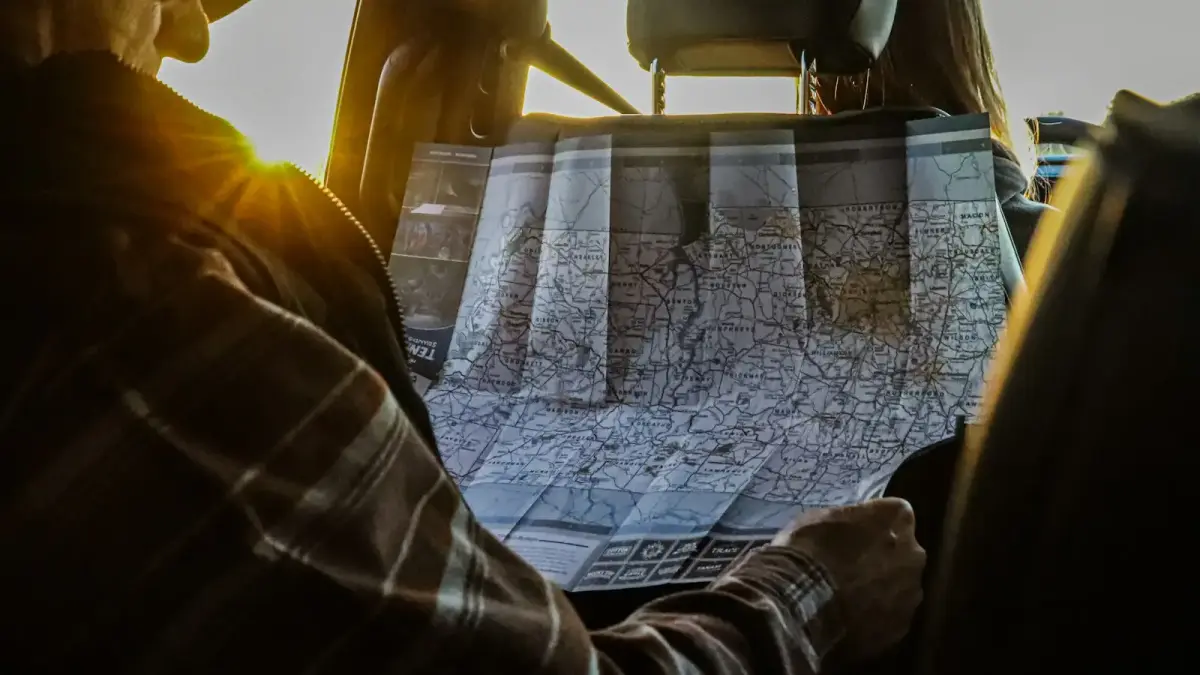
I found one last week in the pocket behind the passenger seat of my car. A Rand McNally map of Tennessee, the kind that used to come free with a full tank at the Texaco off the highway. The cover was sun-bleached to nothing. The folds had gone soft as cloth.
I haven’t driven through Tennessee in eleven years. I have no plans to drive through Tennessee. I put it back.
If you asked me why, I would tell you something about emergencies, about what happens when the signal drops in the mountains. But that’s not the reason. The reason lives somewhere deeper than logic, somewhere in the body, in the hands, in the particular way a man learns what it means to know where he is.
The Kitchen Table Atlas
My father planned every road trip the same way. The night before we left, he would clear the kitchen table of everything - the newspaper, the salt shaker, my mother’s small glass vase of whatever was blooming in the yard - and he would unfold a state.
That is the right word for it. Unfold. Because a road map, properly opened, was an act of revelation. The paper crackled. The creases resisted. And then suddenly the whole geography of a place you had never been was laid out before you in a web of red and blue and black lines, and your father’s finger was tracing one of them.
“We’re here,” he’d say, pressing his thumbnail into a small dot. “And we’re going here.” His thumb would slide across the paper to another dot, crossing rivers and county lines and the tiny italic names of towns too small to have an exit.
He’d measure the distance with his thumbnail against the legend at the bottom. Each thumbnail width was roughly fifty miles. He would count them off like a man stepping across stones in a creek.
That was navigation. Physical, spatial, something that happened between a man’s hands and a piece of paper and the real world outside the window. Something a father could show a son.
What It Meant to Know Where You Were
There was a time - and it wasn’t that long ago, not really - when knowing where you were required effort. It required attention. It required a kind of partnership between the driver and the passenger, the man behind the wheel and the person with the map unfolded across their lap, calling out exits and watching for landmarks.
“We should see the water tower in about six miles,” my father would say. And we would watch for it. And when it appeared on the horizon, faded red against the sky, there was a small, shared satisfaction. We had located ourselves in the world by our own intelligence.
A 2019 study published in Nature Communications found that people who regularly use GPS navigation show reduced activity in the hippocampus - the brain region responsible for spatial memory and cognitive mapping. The researchers discovered that when the GPS was providing directions, participants essentially switched off the neural circuits they would otherwise use to build their own internal representation of where they were.
I don’t bring this up to argue against GPS. I use GPS every day. I would be lost - literally, actually lost - without it.
But I think about what it means that we outsourced the knowing. That we handed over one of the most fundamental human questions - where am I, and how do I get to where I am going - to a voice that recalculates when we miss the turn instead of a father who pulls over and spreads the map across the hood and says, “All right, let’s figure this out.”
The Inheritance of Worn Paper
My father has been gone for nine years. His maps are still in my glove compartment. Not all of them - some fell apart, and some I lost in a car trade years ago. But there are six left. Ohio. Kentucky. Tennessee. Virginia. North Carolina. And one full United States map so old the interstates don’t include stretches that were finished in the nineties.
The creases have worn through on most of them. If you unfold the Kentucky map, it comes apart at the center like a letter that’s been read too many times. The red highways have faded. Some of the small-town names are illegible.
They are, by any practical measure, useless.
But I want to tell you what it feels like to open your glove compartment and see them there, stacked and folded the way he folded them - in thirds first, then in half, then in half again, a method that was particular to him and that I have never been able to replicate exactly. There is a physical inheritance in those folds. The paper remembers his hands.
Research published in the Journal of Personality and Social Psychology has explored what psychologists call “linked lives” - the way our identities are shaped not just by our own experiences but by our connection to the people who raised us. The objects we keep from our parents aren’t souvenirs. They’re evidence. Proof that we were taught, that someone took the time to show us how the world worked.
The maps are evidence.
A Boy Learning the Size of the Country
I was ten the first time I understood how big the country was. We were at the kitchen table and my father had unfolded the full United States map, the one that was almost too big for the table, the edges hanging off like a tablecloth. He pointed to the small town in Indiana where we lived, and then he pointed to my uncle’s house in Flagstaff, Arizona.
“That’s how far,” he said.
I remember measuring it with my own thumbnail. I lost count somewhere around fifteen hundred miles. The distance was incomprehensible to me. The map made it real in a way that a number on a screen never could have. I could see the space between us and there. I could feel the paper under my fingers, the slight raised texture of the state boundaries, the smudge where my father had already traced the route in pencil.
He let me plan part of it. He asked me which highway looked right, and I picked one, and he said, “That would work, but look - this one runs along the river here, and it’s prettier.” He was teaching me something that had nothing to do with roads. He was teaching me that there were choices in how you got somewhere, and that some of them were worth making just because the view was better.
That is a kind of wisdom that doesn’t survive the transition to algorithmic routing. The GPS finds the fastest way. It does not find the prettiest way. It does not know about rivers.
The Men Who Keep Things
I know I am not alone in this. I know there are men my age - sixty-one last March - who have boxes in the garage full of things that serve no function anymore. Film cameras with no film. Pocket watches that need winding. Tape measures that belonged to grandfathers who built their own shelves.
We are not hoarders. We are not sentimental in the way that word is usually used, as though sentiment were a weakness, a failure to move on.
We are holding evidence.
A 2016 study in the journal Cognition and Emotion found that physical objects connected to deceased loved ones serve a unique psychological function - they act as what researchers called “tangible anchors” for continuing bonds. The object doesn’t just remind you of the person. It carries something of their presence. It holds the shape of their hands, the evidence of their attention, the proof that they were here and they knew things and they passed those things to you.
My father’s maps are tangible anchors. They hold the creases his hands made. They hold the pencil marks where he planned our routes. They hold the memory of a man who could look at a piece of paper and see the whole country, who could place his thumbnail on a legend and tell you how far it was from here to anywhere.
Here Is Where We Are
I think about that phrase a lot. “Here is where we are.” Such a simple sentence. Such a profound act - a father showing a son his place in the world, literally pointing to a spot on a map and saying you are here.
GPS does this better, of course. More accurately, more constantly, with a blue dot that follows you in real time and never loses signal for long. It knows where you are to within a few feet. My father’s thumbnail against the legend was accurate to maybe fifty miles.
But my father’s version came with his voice. It came with his hands on the paper. It came with the smell of coffee in the kitchen and the particular way the overhead light hit the map and made the rivers look like veins. It came with a man who had been somewhere, who had driven those roads himself, who could tell you that this stretch through the Ozarks was beautiful in October and that there was a diner off this exit that made pie worth stopping for.
The GPS knows where you are. My father knew where we were going and why it mattered and what we might see along the way.
I keep the maps because they are the last physical record of those evenings. They are the last things his hands folded. They are worn and useless and falling apart at the creases, and they are worth more to me than any technology that replaced them.
If you are a man who keeps things like this - old tools, faded photographs, objects that make no sense to anyone but you - I want you to know that you are not stuck in the past. You are not refusing the future. You are carrying forward the evidence of someone’s love, the proof that you were taught, the physical record of an afternoon when someone spread out the whole world in front of you and said here is where we are and here is where we are going.
That is not nostalgia. That is inheritance. And it weighs almost nothing, folded up and tucked in the glove compartment, riding with you everywhere you go.