There is a particular kind of man who learned to love airports not for the travel but for the anonymity - who sits at a gate surrounded by a thousand people who need absolutely nothing from him, who can read or stare or simply exist without anyone scanning his face for what he is willing to give - and what he feels in that plastic chair between a stranger and a departure board is the closest thing to rest he has experienced since childhood, because a boy who grew up as the emotional anchor of a household where everyone else was allowed to fall apart discovered that the only place he could stop holding the room together was a place where the room did not belong to him
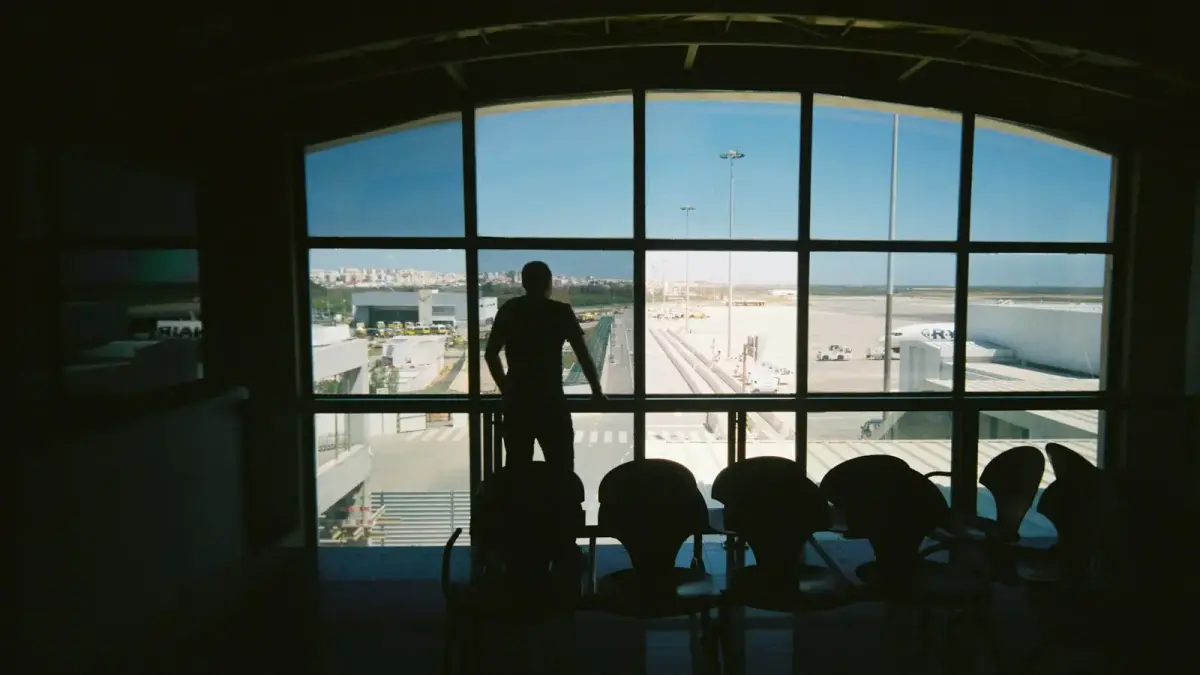
The first time I felt genuinely rested was in Terminal B of an airport I cannot even remember the name of, in a city I was only passing through, sitting in a molded plastic chair next to a man who was asleep and a woman who was reading a paperback with the spine cracked open.
Nobody needed me to be anything.
That sounds like a small thing. It was not a small thing. It was the first time in what felt like my entire life that I was occupying a space without maintaining it. No room to read. No tension to absorb. No face to watch for the first sign that someone was about to need something I would have to figure out how to provide. Just departure times and bad coffee and the particular hum of a building full of strangers with somewhere else to be.
I was thirty-seven. I sat there for two hours past my boarding time, watching planes taxi, and I felt something I did not have a name for. It was not happiness, exactly. It was not peace. It was the absence of a weight I had been carrying for so long that I had forgotten it was there. I called my wife from the gate and told her the flight was delayed. It was not delayed. I just was not ready to stop being nobody yet.
The boy who held the room together
My mother was a good mother. I want to say that clearly because what I am about to describe is not a story about bad parenting. It is a story about a household that needed a steady center, and the center was me.
My father traveled for work. Three weeks on, one week off. When he was gone, my mother held everything together with a kind of fierce, exhausted determination that I admired even as a child. But holding everything together cost her something, and by evening that cost was visible. The tightness around her eyes. The way her voice got thinner as the hours stacked up. The moment, usually around eight or nine, when she would sit at the kitchen table and go very quiet, and I understood without anyone telling me that quietness in my mother was not calm. It was the place before tears.
I learned to monitor that transition the way other children learn to read clocks. I learned to intercept it. I learned that if I made dinner simpler, if I kept my younger brother occupied, if I did not ask for anything that required her to produce one more unit of effort, the quietness would not arrive. Or at least it would arrive later, when I was in my room and could pretend I did not hear it through the wall.
A 2018 study published in the Journal of Family Psychology found that children who take on emotional caretaking roles - what researchers call “parentification” - often develop an extraordinary capacity for reading and managing other people’s emotional states. But the study also found that this capacity comes with a particular cost: a chronic inability to distinguish between rest and guilt. The parentified child grows into an adult who experiences stillness not as recovery but as dereliction. You are not resting. You are failing to notice something that someone needs.
That was the architecture of my childhood. Not abuse. Not neglect. Just a room that always needed someone watching it, and a boy who volunteered for the shift before anyone asked.
The man in the hotel lobby
I travel for work now. Not as much as my father did, but enough. And I have discovered something about myself that I find both embarrassing and necessary to say out loud.
I am happier in hotel lobbies than in my own living room.
Not because my living room is unhappy. My wife is there. My children are there. The dog who follows me from room to room like I am the most interesting thing that has ever existed is there. I love my living room. I love the people in it. I love the particular chaos of a Tuesday evening when homework is spread across the table and someone is arguing about what to watch and the dog needs to go out and my wife is telling me something about her day while I am trying to remember whether we have milk.
But in that living room, I am holding the room. I do not mean I am managing it or controlling it or doing anything anyone would notice. I mean I am scanning. I am tracking the temperature. I am watching my wife’s shoulders for the particular set that means she had a bad day. I am listening to my daughter’s voice for the pitch that means she is frustrated with her math and needs me to come sit next to her without being asked. I am doing the thing I have done since I was nine years old, which is monitoring the emotional weather of every room I enter and adjusting my own presence to stabilize it.
In a hotel lobby, that program shuts off. Not because I choose to turn it off. Because there is nothing to scan. The people around me are strangers. Their emotional states are not my responsibility. Their shoulders are not mine to read. Their silence is not a warning signal I need to interpret.
Susan Cain, the author who changed how millions of people think about introversion, has written about the difference between stimulation and demand. The introvert does not necessarily need fewer people. The introvert needs fewer people who need something. An airport is full of thousands of people, but it places zero social demands on you. No one expects you to be warm, available, interested, or helpful. You are allowed to exist in a crowd without being required by it.
That distinction - between a crowd that includes you and a crowd that requires you - is the entire geography of my inner life.
The coffee shop in a city where nobody knows your name
There is a coffee shop I go to when I travel to Chicago. I do not know why I keep going back. The coffee is acceptable. The chairs are not comfortable. The music is always slightly too loud.
But I have sat in that coffee shop and read for three hours without a single person looking at me. Without a single notification on my phone from someone who needs something. Without a single glance across the room that I need to interpret. And that experience - being present in a room without being needed by it - feels like surfacing from water. Like taking the first full breath after years of breathing carefully so you do not disturb the air.
I mentioned this to a friend once. A man I have known since college. He looked at me for a long time and then he said, “I do that too. I drive to a park on the other side of town sometimes. I just sit in the car.”
He was the oldest of four. His mother had depression. He was the one who made breakfast.
We sat there for a minute, two men in their forties who had both discovered the same secret: that anonymity is not loneliness. Anonymity is the only form of rest available to a person whose body never learned how to stop monitoring the room.
What we are not
I want to be precise about this because it matters.
We are not avoiding our families. We are not cold, distant, emotionally unavailable men who prefer solitude to connection. We are not the cliche of the husband who “needs his space” because he cannot handle intimacy.
We are men who handle intimacy so constantly and so thoroughly that our bodies require periodic disappearance in order to continue doing it.
A 2021 study in Frontiers in Psychology examined what researchers call “empathic fatigue” in men who grew up as emotional caretakers. The study found that these men did not score low on measures of emotional connection. They scored extraordinarily high. The problem was not a lack of attunement. It was an excess of it. They were attuned to everyone in every room all the time, and the only way their nervous systems could recover was through environments where attunement was unnecessary.
The airport. The hotel lobby. The coffee shop in a city where nobody knows your name. These are not escapes. They are recovery rooms for men whose bodies never learned the difference between being present and being on duty.
The plastic chair at the gate
I am forty-nine now. I still love airports.
I love the anonymity. I love the in-between quality of them - how an airport is not a place but a pause between places. I love that nobody there needs me to read their face or carry their mood or notice the thing they are not saying.
My wife understands this about me now, though it took years to explain it in a way that did not sound like rejection. “I am not leaving you,” I told her once. “I am leaving the version of me that cannot stop watching you. And I need to leave him somewhere for a little while so he can come back and do it well.”
She looked at me with that expression she gets - the one that means she is seeing something in me I did not know was visible. And she said, “You have been watching since you were nine years old. Of course you are tired.”
If you recognize this - the man who finds rest in places where nobody knows him, who recharges not in isolation but in anonymity, whose deepest comfort is a room full of strangers who need absolutely nothing - I want you to know something.
You are not broken. You are not avoidant. You are not the cold, detached man that people who have never carried a room for thirty years might assume you are.
You are a man who learned, before he was old enough to understand what he was learning, that his presence was load-bearing. And you have been holding the structure for so long that the only place you can set it down is a place where nobody built one.
That is not a flaw. That is a man who has been loving people so hard, for so long, that he forgot he was also a person who needed a place to sit down.
The airport is that place. The coffee shop is that place. The car in the parking lot of the park on the other side of town is that place.
You are not disappearing. You are refueling. And the fact that you always come back - that you always walk through the front door and pick the room back up and start watching again - is not something to apologize for. It is the evidence that you never stopped caring. You just needed five minutes where caring was not required.

