There is a particular kind of man who has never once asked someone to repeat themselves - who nods and fills in the missing word from context, who strains to catch every syllable in a crowded restaurant rather than lean forward and say 'what did you say' - because a boy who said 'what' at the dinner table and watched his father's face change learned that a man who asks you to say it again is a man who was not paying attention, and attention is the one thing a man is never allowed to withdraw
The Man at the Restaurant
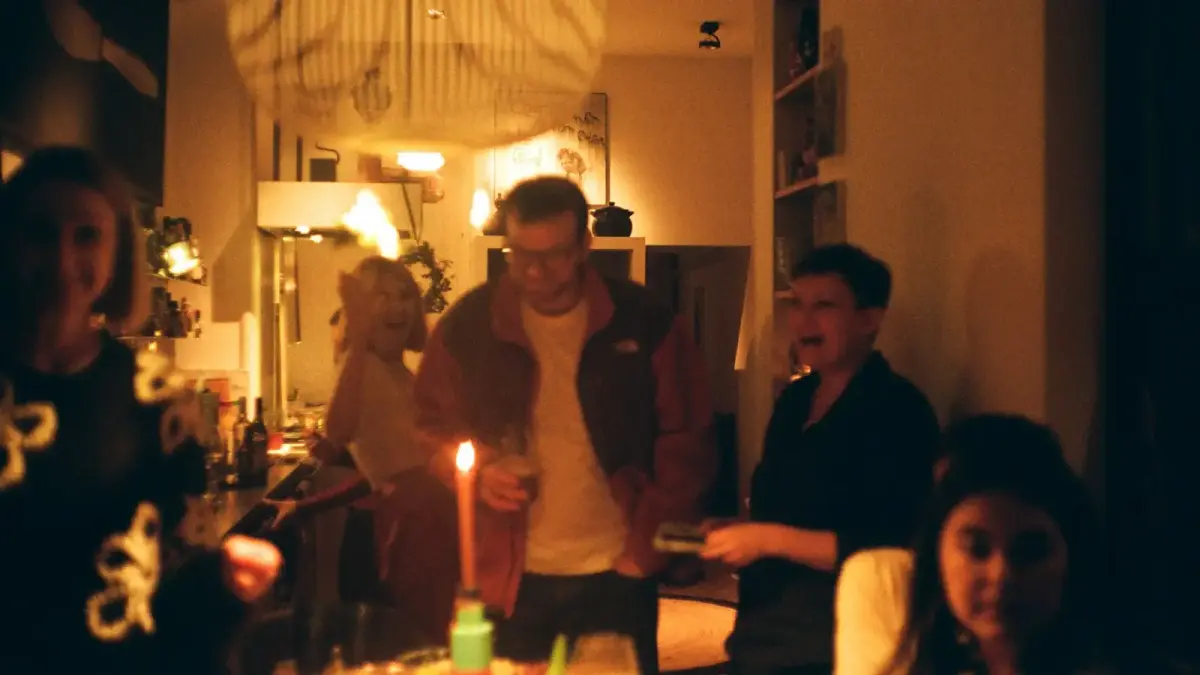
I watched a friend of mine last week at a dinner with six people. The restaurant was loud - one of those places where the music and the conversation and the clinking glasses all compete for the same airspace. His wife was telling a story and the punchline got swallowed by a burst of laughter from the next table over.
Everyone else leaned in. Someone said, “Wait, what was that last part?”
He didn’t. He nodded. He smiled at exactly the right moment. He filled in whatever he missed with context clues and moved on, seamlessly, as though he had caught every word.
I know he didn’t. I was sitting next to him. I didn’t catch it either. But I asked. He didn’t.
And I recognized it - that particular discipline of listening that has nothing to do with curiosity and everything to do with a promise a boy made to himself a very long time ago. A promise that he would never, not once, make someone feel like their words had fallen on a man who wasn’t paying close enough attention.
The Dinner Table
There is a moment that certain boys carry into manhood the way others carry a scar on a knuckle - small, faded, almost invisible, but you can feel it if you press.
For this particular kind of boy, the moment happened at a dinner table. He was seven, or nine, or twelve - the age doesn’t matter as much as the setting. His father was talking. Maybe telling a story about work. Maybe giving instructions. Maybe just making a point about something ordinary.
And the boy missed a word. Maybe he was watching the dog. Maybe his sister kicked him under the table. Maybe he was just seven, or nine, or twelve, and the world was full of things that pulled his attention in six directions at once.
He said “what?”
Just that. A single syllable. The most natural word a child can say.
And his father’s face changed.
Not dramatically. Not violently. This isn’t a story about rage. This is a story about something quieter and, in some ways, harder to recover from. His father’s face shifted from open to closed. From patient to disappointed. The kind of micro-expression a child can read with devastating accuracy even when he doesn’t have the vocabulary to describe it.
The message was instantaneous and total: you weren’t listening. You weren’t listening, and that means you don’t care. You don’t care enough about what I’m saying to stay present for it.
A 2019 study published in the Journal of Family Psychology found that children develop what researchers call “parental emotion schemas” - mental maps of which emotions are safe to express and which ones trigger withdrawal of parental warmth. These schemas, once formed, become nearly invisible to the person carrying them. They just feel like the way things are.
The boy didn’t argue. He didn’t explain. He just made a quiet internal note: asking someone to repeat themselves is an admission of failure. And failure, in this house, is not met with help. It is met with distance.
The Art of Never Missing a Word
He grew up. He got good at it.
Not just good. Masterful. The kind of listener people comment on at parties. The kind of man whose wife tells her friends, “He actually listens - like, really listens.” And she’s not wrong. He does listen. He listens with his entire body, his full nervous system, every ounce of processing power he has.
But what she’s seeing isn’t a gift. It’s a garrison.
He has developed, over decades, an almost supernatural ability to reconstruct sentences from fragments. He reads lips without knowing he reads lips. He tracks the rhythm of speech so that when a word drops out, he can feel the shape of what was supposed to be there and fill it in without anyone noticing.
In a crowded bar, he positions himself strategically - back to the wall, facing the speaker, angled away from the loudest source of noise. He does this automatically, the way a combat veteran scans exits. It isn’t conscious. It’s architecture.
He never says “sorry, what was that?” He never says “I missed that last part.” He never cups his hand behind his ear or leans in with a furrowed brow. Those are admissions. Those are confessions. Those are a boy at a dinner table watching warmth leave his father’s face.
Dr. Gabor Mate has written extensively about how childhood adaptations - the strategies we develop to maintain connection with our caregivers - become the invisible operating systems of our adult relationships. We don’t choose them. We don’t even see them. We just run on them, day after day, mistaking survival software for personality.
This man’s personality, as far as anyone can tell, is “incredible listener.” The truth is more complicated and more exhausting than that.
The Cost of Perfect Attention
Here is what nobody sees: he is tired.
Not occasionally tired. Fundamentally tired. The kind of tired that lives in your jaw and your temples and the muscles behind your eyes. Because perfect attention - not the relaxed, warm attention of genuine interest, but the hypervigilant, failure-is-not-an-option attention of a man who cannot afford to miss a syllable - is physically devastating.
A 2021 study in Frontiers in Psychology found that sustained auditory attention activates the same stress pathways as threat detection. The brain doesn’t distinguish between “I must catch every word my wife says at dinner” and “I must track a sound that might signal danger.” The cortisol response is identical. The exhaustion is identical.
He comes home from social gatherings drained in a way that his friends don’t understand. They had a great time. Why is he so wiped out? He doesn’t know how to explain that for him, every conversation is a performance - a high-wire act where the wire is someone else’s expectation and the net is made of his father’s disappointment.
He sometimes sits in his car for ten minutes before going inside after a party. Not because he’s upset. Not because anything went wrong. Because he needs to let his nervous system come down from three hours of total acoustic surveillance.
His wife asks if he’s okay. He says he’s fine. He is fine. He’s also running a monitoring system that hasn’t shut down since he was nine years old.
What His Wife Actually Sees
She tells her friends he’s the most attentive man she’s ever been with. And she means it as the highest compliment.
She doesn’t know that his attentiveness is not a choice. She doesn’t know that when she’s talking to him from the other room and he catches every word, it’s not because he’s devoted - though he is - but because missing a word feels, in his body, the way other people feel about running a red light. A small catastrophe. A near miss. A thing that could have exposed him.
She doesn’t know that sometimes, when she’s telling a story and he’s nodding along, he actually did miss something three sentences ago and has been quietly reconstructing the narrative architecture from context ever since. Filling in blanks. Making educated guesses. Nodding at the emotions rather than the details because the emotions are easier to track when the words go fuzzy.
She doesn’t know that when they argue and she says, “You never listen to me,” it lands like a knife in a wound that was already open. Because he does listen. He has been listening his whole life. Listening is the one thing he has never, not once, allowed himself to fail at.
And so the accusation, even when it’s just frustration talking, hits the original bruise: you weren’t paying attention. You don’t care enough.
He doesn’t say any of this. He just listens harder.
The Debt That Never Clears
Here is the deeper architecture of this pattern: for this man, attention is not a gift he gives. It is a debt he pays.
Somewhere in his early wiring, the equation got written: attention equals love. Inattention equals abandonment. And so every conversation becomes a transaction - not in a cynical way, not in a manipulative way, but in the way that breathing becomes urgent when you’ve been underwater. You don’t breathe because you want to. You breathe because the alternative is unthinkable.
He pays attention the way someone pays rent. Not joyfully. Not resentfully. Just necessarily. Because the cost of not paying is a door closing, a face changing, a warmth withdrawing. And he learned, before he had language for any of it, that withdrawn warmth might not come back.
Research by Dr. Ed Tronick - the developmental psychologist behind the famous Still Face Experiment - showed that when a caregiver suddenly becomes emotionally unresponsive, infants don’t just get sad. They mobilize. They work harder. They perform. They do everything in their power to re-engage the face that went blank.
That mobilization doesn’t stop when you turn eighteen. It just changes form. For some men, it becomes people-pleasing. For others, overwork. For this particular kind of man, it becomes listening - relentless, perfect, unsustainable listening. A performance of attention so convincing that no one, not even his wife, suspects it is a performance at all.
The Boy Who Said What
I want to go back to the dinner table for a moment. Back to the boy.
He didn’t do anything wrong. A child saying “what?” to a parent is one of the most ordinary moments in family life. It happens a thousand times in any household. It is completely unremarkable.
What made it remarkable was the response. Not abuse. Not yelling. Just a flicker of something in his father’s face that told the boy: your inattention caused me pain. Your inattention is a form of disrespect. Your inattention is something you should be ashamed of.
And the boy, because he loved his father and because children will do almost anything to maintain the attachment bond, absorbed that message whole. He didn’t question it. He didn’t push back. He just quietly, permanently, raised his standards for listening to a level that no human being can sustain without cost.
He became the man who never says “what.” The man who catches every word. The man whose attention is so total, so unwavering, that people feel genuinely seen in his presence.
They are seen. That part is real. The attention is real. The care beneath it is real.
But so is the exhaustion. So is the fear. So is the small, persistent belief that if he misses one sentence - just one - something essential will be withdrawn from him. Something he cannot get back.
Listening as Rest
If you recognized yourself in any of this, I want to say something that might feel foreign: you are allowed to miss a word.
You are allowed to lean forward in a noisy restaurant and say, “Sorry, I didn’t catch that.” You are allowed to let a sentence go by without reconstructing it from fragments. You are allowed to ask someone to repeat themselves without it meaning that you have failed them.
Attention is not a debt. It never was. That was a lesson taught by someone who didn’t know they were teaching it, absorbed by a boy who didn’t know he was learning it, and carried by a man who doesn’t know he’s still paying for it.
The people who love you - really love you - will say it again. They will say it louder. They will touch your arm and laugh and start over, and the warmth in their face will not change. Not even a little.
You can put the surveillance system down. You have been listening hard enough. You have been listening long enough.
It is okay to rest in a conversation the way other people do - loosely, imperfectly, with gaps and guesses and the occasional “wait, say that again?”
That is not failure. That is just what it sounds like when a person is finally, after all this time, listening for pleasure instead of survival.