There is a particular kind of man who still reads the farmer's almanac every morning even though he has not planted a single seed in forty years, because a boy who sat at his grandfather's kitchen table before dawn and watched a thick finger trace the frost dates and the moon phases learned that the earth keeps a schedule and the men who respected it were expected to know it by heart, and somewhere in him there is still a boy who believes that reading the sunrise time for a town he left at eighteen is the closest thing to prayer a man like him was ever taught
Every January I walk into the hardware store on Route 9 and buy the new farmer’s almanac. I do not go there for nails or caulk or the furnace filters my wife has been asking about since November. I go for the almanac. It is on a wire rack near the register, between the seed packets and the pocket calendars, and I pick it up the same way I have picked it up for thirty-seven years - with both hands, like it weighs something.
It does weigh something. Just not in any way a scale could measure.
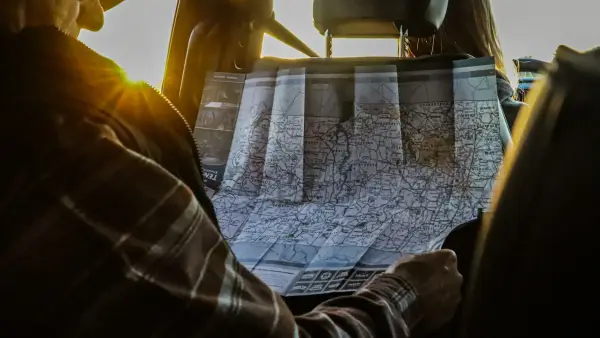
I have not planted a single seed since I was seventeen years old. I do not garden. I do not farm. I live in a subdivision with a half-acre lot and a riding mower and a driveway that leads to an office park twelve minutes away. There is nothing in my life that requires me to know when the last frost will come or what phase the moon is in tonight. And yet every morning, before the coffee is ready, I sit at the kitchen table and I open that almanac and I read the sunrise time, the sunset time, the moon phase, and the weather prediction for a county I have not lived in since Ronald Reagan was president.
My wife stopped asking about it years ago. She used to say, “What are you reading?” and I would say, “The almanac,” and she would nod the way you nod at something you have decided not to understand. I do not blame her. I am not sure I understand it myself. But I know where it started. And I know whose hands taught mine to hold that book.
The Kitchen Table Before Dawn
My grandfather’s kitchen smelled like coffee that had been on the burner too long and wood smoke that had seeped into the walls over fifty winters. He was up before anyone. Always. I would come downstairs at five-thirty in the morning during summers I spent at the farm and he would already be sitting there, the almanac open on the table, his reading glasses low on his nose, one thick finger tracing a line across the page.
He did not look up when I sat down. He did not need to. He just slid his coffee cup an inch to the left to make room for my elbows and kept reading.
I learned silence at that table. Not the silence of being ignored - the silence of being included in something that did not require words. He would read the frost dates out loud sometimes, almost to himself. “Last frost April twenty-second,” he would say, like he was confirming something the earth had promised him. Then he would check the moon. Then the tide tables, even though we lived two hundred miles from the coast. Then the sunrise.
A 2019 study published in the Journal of Environmental Psychology found that people who maintain deep connections to places they no longer inhabit often develop what researchers call “phantom engagement” - a continued psychological participation in the rhythms of a landscape they have physically left. The study noted that this was not confusion or denial. It was a form of ongoing relationship, a refusal to let distance sever what proximity had built.
That is my grandfather’s kitchen table. That is the almanac at five-thirty in the morning. That is the boy who sat there and absorbed, without knowing he was absorbing, the belief that the earth runs on a schedule and the men who loved it were expected to know that schedule by heart.
The Scripture Nobody Called Scripture
Here is what I have come to understand about the almanac, now that I am old enough to look back and see it clearly. It was not a reference book. It was not a tool. It was not something my grandfather consulted the way you consult a manual when something breaks.
It was scripture.
Not religious scripture. My grandfather went to church on Easter and Christmas and the occasional funeral, and that was the extent of his public devotion. But the almanac - the almanac he read every single day. He read it the way a devout man reads a psalm. With reverence. With the expectation that it would tell him something true about the world he lived in.
The earth keeps a schedule. The frost comes and goes. The moon waxes and wanes. The days lengthen and shorten with a precision that no human being controls or fully understands. And the men who worked that earth - the ones who planted by the moon and harvested by the frost and knew which week in September the geese would fly south - those men lived inside a rhythm that was larger than their own lives.
The almanac was proof that rhythm existed. It was the printed version of what the land already knew. And reading it every morning was not a chore or a habit. It was a way of saying: I am paying attention. I know what the earth is doing today. I am not separate from it.
A 2017 study in Psychological Science found that ritualized behaviors - repeated actions performed in a consistent sequence, even when the original practical purpose has faded - continue to provide significant psychological benefits, including reduced anxiety and an increased sense of meaning. The researchers noted that the power of a ritual lies not in its utility but in its consistency. The act of doing the same thing in the same way at the same time creates a structure that the nervous system interprets as safety.
My grandfather did not know any of that. He just knew that reading the almanac every morning before the sun came up made the day feel like it had a spine.
The Man Who No Longer Farms
I left the farm at eighteen. College, then a desk, then a mortgage, then a life that looks nothing like the one my grandfather lived. My hands are soft where his were calloused. My mornings are spent in traffic where his were spent in fields. I could not tell you when to plant tomatoes if my life depended on it.
But I can tell you that the sun rose at six forty-seven this morning. I can tell you that the moon is waning gibbous. I can tell you that the first frost in my grandfather’s county is predicted for October ninth this year, which is early, which would have worried him, which worries me for reasons I cannot defend to anyone who asks.
You know this feeling if you are the kind of man I am describing. You carry knowledge that no longer applies to your life but that you cannot put down. You check the weather for a town you left decades ago. You know the soil type of a county you will never farm. You read the planting guide in the back of the almanac the way someone else might read the sports page - not for information, exactly, but for the feeling of being inside something familiar.
A 2021 study in Frontiers in Psychology examined the phenomenon of intergenerational knowledge transfer - the way skills, habits, and frameworks for understanding the world pass from grandparents to grandchildren, often bypassing the middle generation entirely. The researchers found that knowledge transmitted through shared experience, rather than explicit teaching, was the most durable kind. The grandchild who sat beside a grandparent and absorbed a way of being in the world carried that framework long after the original context had disappeared.
That is what happened at the kitchen table. My grandfather never said, “You should read the almanac.” He never said, “This is important.” He never explained why he did it. He just did it, every morning, and I sat beside him, and something in me recorded the whole thing - the coffee, the silence, the finger on the page, the quiet authority of a man who knew what the moon was doing.
What It Actually Is
I want to be honest about what the almanac means to me now, because I think there are men like me who have never said it out loud.
It is not nostalgia. Nostalgia is warm and soft and looks backward with a kind of pleasant ache. What I feel when I open the almanac is not pleasant. It is something heavier. Something closer to obligation. Like there is a boy inside me who made a promise he never spoke, and every morning when I open that book I am keeping it.
The promise was this: I will pay attention. I will not become the kind of man who does not know what the earth is doing. I will not let the distance between this kitchen table and that one erase what you taught me without teaching me.
It is faith. Not faith in God, necessarily, though I would not argue with anyone who heard it that way. Faith in the idea that the world has a rhythm, that the rhythm matters, and that knowing it - even when knowing it serves no practical purpose whatsoever - is a form of respect.
My grandfather respected the earth the way some men respect their fathers. Quietly. Without explanation. Through action rather than language. And the almanac was where that respect lived. It was the daily practice of acknowledging that something larger than your own life is happening, and you are not too busy or too modern or too far from the farm to notice.
The Boy at the Table
If you are reading this and you recognized yourself in the first paragraph - if you are the man who buys the almanac every January, who checks the moon phase before bed, who knows the sunrise time for a place you have not lived in thirty years - I want you to know something.
You are not being sentimental. You are not being foolish. You are not clinging to a past that no longer exists.
You are keeping a promise. You are honoring a man who showed you, without ever saying a word about it, that the world deserves your attention. That the frost dates matter. That the moon matters. That the sunrise matters, even if you watch it from a subdivision instead of a field.
The almanac is not a book about farming. It never was. It is a book about paying attention. And the man who reads it every morning at a kitchen table that looks nothing like his grandfather’s kitchen table is not lost in the past. He is practicing the only form of devotion he was ever taught.
The sun rose at six forty-seven this morning. The moon is waning gibbous. The earth is keeping its schedule.
And so are you.