She is 63 and still pulls the dictionary off the shelf every time she encounters a word she does not know - not the phone, not the search bar, but the actual dictionary with the cracked spine and the tissue-thin pages that whisper when you turn them - because a girl whose mother never once answered a vocabulary question, who heard 'look it up' a thousand times and had to find every word with her own hands, learned that knowledge is not something you are given but something you go and get, and the woman who opens a dictionary in 2026 is not resisting anything but honoring the belief that a word you had to earn is a word that stays
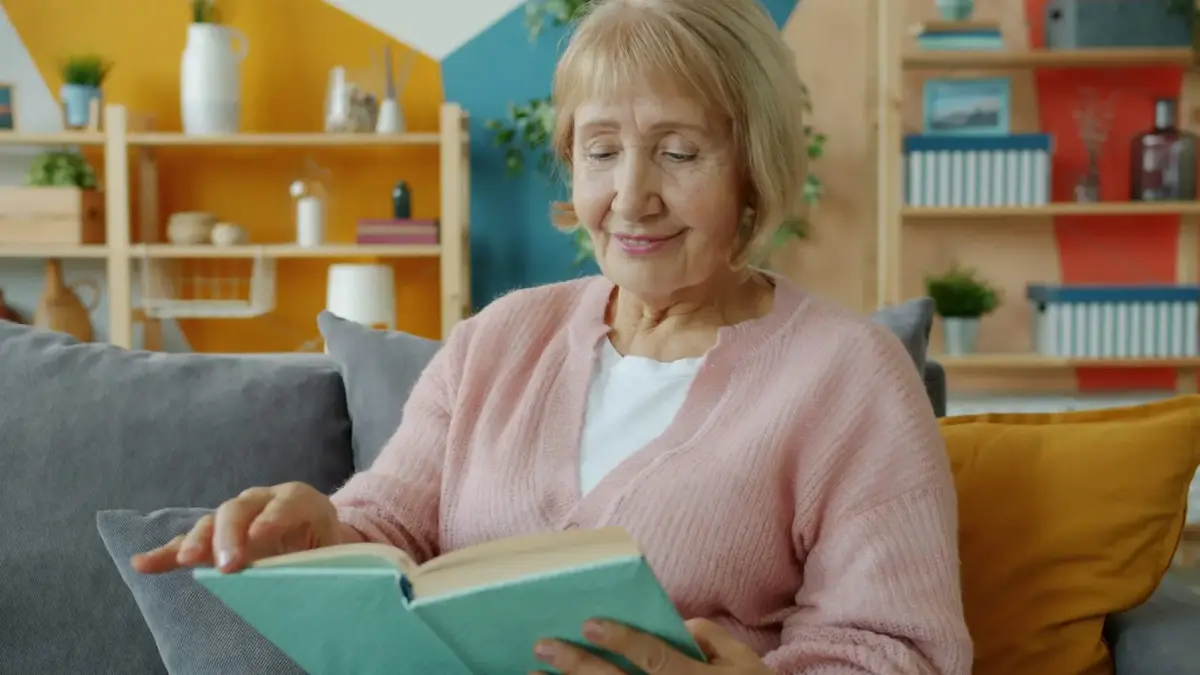
I was reading on the couch last Tuesday night when I hit the word “liminal.” I knew the shape of it. I had seen it before, circling the edges of essays I admired, hovering in book reviews I read on Sunday mornings. But I could not have told you what it meant if you had asked me to define it out loud. And so I did what I have done every time this has happened for the last forty-seven years. I set the book facedown on the cushion, stood up, walked to the hallway bookshelf, and pulled the dictionary down with both hands.
It is heavy. The spine cracked years ago and the cover bows slightly open when you lay it flat. The pages are so thin you can see the ghost of the next entry through the one you are reading. They make a sound when you turn them - not quite paper, not quite fabric. A whisper. That is the only word for it.
My phone was on the end table, three feet from where I had been sitting. I could have typed the word and had a definition in two seconds. I have never once done that. I am sixty-three years old and I have never once looked up a word on a screen. And until last Tuesday, I had never stopped to wonder why.
”Look It Up”
My mother had a phrase. Three words. She used them more than “I love you,” more than “be careful,” more than any other sentence in her entire vocabulary. When I asked her what “peculiar” meant at the dinner table, she said it. When I asked her what “mortgage” meant while she was paying bills at the kitchen counter, she said it. When I came home from school at fourteen and asked what “unrequited” meant because a boy in English class had read it aloud and I had felt something shift in my chest without knowing why, she looked at me over the top of her reading glasses and said it.
Look it up.
She never gave me the answer. Not once. Not when I was seven and the word was “curious.” Not when I was sixteen and the word was “sovereignty.” She would point at the shelf where the dictionary lived - second shelf, left side, between the phone book and the Bible - and she would wait. She would not go back to what she was doing until she heard me pull it down.
I hated it. I want to be honest about that. I hated the walk to the shelf. I hated that my friends’ mothers just told them. I hated that she made everything harder than it needed to be. I would stomp across the kitchen, yank the dictionary off the shelf, and slam it on the table with the full dramatic authority of a twelve-year-old who believed she was being persecuted.
And then I would find the word.
The Wandering
Here is what nobody tells you about looking up a word in a physical dictionary. You never find just the one you came for.
Your finger lands on the page and your eyes catch the guide words at the top - two words in bold that tell you the alphabetical range of that page. You scan down, looking for your word, and on the way you pass six or seven others you did not know existed. Words that sit beside the one you need, quiet neighbors you never would have visited on purpose.
I went looking for “melancholy” once and found “mellifluous” on the same page. I went looking for “benevolent” and my eye caught “benediction.” I did not plan to learn those words. They were accidents. Beautiful accidents that happened because the journey to the answer had a geography, and geography invites wandering.
A 2011 study published in Psychological Science explored what researchers call the generation effect - the finding that information you actively work to retrieve or produce is remembered significantly better than information handed to you passively. The researchers found that the effort of generating an answer, even when the effort is small, fundamentally changes how the brain encodes it. The harder you work to find something, the deeper the groove it leaves.
My mother did not know the term “generation effect.” She had never read a psychology journal in her life. But she understood, in the way that mothers sometimes understand things science takes decades to name, that a word I had to earn was a word I would keep.
The Weight of the Search
There is a difference between knowing a definition and owning a word. I think about this often. You can type “liminal” into a search bar and read “relating to a transitional stage” and nod and move on and forget it by Thursday. Or you can stand in a hallway with a five-pound book open across your forearms, reading the definition slowly, feeling the page under your fingertip, hearing the spine creak as you hold it open, and something about that weight - the physical, literal weight of the search - presses the word into you differently.
Psychologist Fergus Craik proposed what he called the depth of processing framework in research published in the Journal of Experimental Psychology. His work demonstrated that the deeper and more elaborately you process information, the more durable the memory becomes. Shallow processing - glancing at a screen, reading a quick answer - produces shallow encoding. Deep processing - engaging multiple senses, exerting effort, connecting the new word to the physical experience of finding it - produces memory that lasts.
I did not know any of this when I was twelve, pulling the dictionary down in a huff. I only knew that the words I found in that book stayed with me in a way that other information did not. “Melancholy” is not just a definition in my mind. It is a Tuesday evening in October, the kitchen light on, my mother humming at the stove, and my finger finding the word on a page that smelled like the inside of a drawer nobody opens.
The word lives in a place, is what I am saying. It has a home in my body because my body was involved in finding it.
What the Grandchildren Do Not Know
My granddaughter is eleven. She is brilliant and curious and she asks me what words mean constantly. Last Thanksgiving she asked me what “arbitrary” meant while we were setting the table together. I opened my mouth and I heard my mother’s voice come out before I could stop it.
Look it up.
She pulled her tablet off the counter and had the answer in four seconds. She read it out loud, nodded once, and went back to folding napkins. And I stood there holding a serving spoon and feeling something I could not quite name. Not anger. Not judgment. Something closer to grief, maybe. Or the quiet awareness of a distance I could not cross.
I do not think her way is wrong. I want to be clear about that. She will grow up in a world where information is instant and abundant and she will be fluent in systems I cannot imagine. I am not mourning her future. Her future does not need my mourning.
But I know something she does not know yet. I know that when you have to work for an answer - when the answer is not handed to you but hidden inside a heavy book on a high shelf, and you have to reach for it and carry it and open it and search - the answer changes shape on the way to finding you. It becomes yours in a way that an instant result never quite does.
A 2019 study in Frontiers in Psychology examined the role of embodied cognition in learning and found that physical interaction with learning materials significantly enhanced both comprehension and long-term retention. The researchers concluded that the body is not merely a vehicle for the mind but an active participant in how we come to understand things. When your hands are involved in the search, your hands remember what they found.
My granddaughter will know what “arbitrary” means for as long as she needs to. I have known what “melancholy” means since I was twelve years old, and I will know it until the day I cannot remember anything at all. The difference is not intelligence. The difference is the walk to the shelf.
What She Was Really Teaching Me
I used to think my mother was being difficult. Withholding. I used to think “look it up” was a refusal to help, a wall she put up instead of a bridge she was building. It took me forty years to understand that it was the opposite.
She was teaching me that I was capable of finding things on my own. That I did not need someone to hand me the answer. That the moment of not knowing - the uncomfortable pause between the question and the discovery - was not a failure but a doorway. She was teaching me to trust the search itself.
And she was teaching me something else, too. Something I only understood when I became a mother myself. She was teaching me to respect language. To treat words as things with weight and history and texture, things that deserve the effort of pursuit. A word you can get for free feels different than a word you had to go and find. Not better or worse. Just different. The way a meal you cooked yourself tastes different from one that was delivered to your door. The nourishment is the same. But your relationship to it is not.
The Dictionary in 2026
The dictionary is still on the second shelf. Left side. The phone book is gone. The Bible is still there. The cover has faded from burgundy to something closer to rust, and I have reinforced the spine with packing tape twice. The pages at the front, where I look up words beginning with A and B, are softer than the pages in the middle, touched more often, worn thinner by decades of my fingers turning them.
It is not a relic. It is not resistance. It is not a performance of some old-fashioned virtue I am trying to prove to anyone.
It is a conversation with my mother that never ended. Every time I pull it down, I hear her. Every time my finger finds the guide words and scans to the entry I need, I am standing in her kitchen again, twelve years old, furious and obedient, learning something I did not want to learn and would never be able to unlearn.
If you are the kind of person who still reaches for the book instead of the screen - who still writes the word down after you find it, who still reads the words above and below because your eyes cannot help themselves - I want you to know something.
You are not behind. You are not slow. You are not refusing to adapt to a world that moved past you.
You are carrying a belief that someone planted in you a long time ago, with patience and repetition and a love that looked like stubbornness. The belief that knowledge is not something you receive. It is something you go and get.
And the woman who opens a dictionary in 2026, who runs her finger down the page while the tissue-thin paper whispers under her hand, is not holding onto the past. She is holding onto the truest thing she was ever taught.
A word you had to find is a word that stays.
Your hands know. They have always known.