There is a particular kind of man who still drives past the house he grew up in whenever he is anywhere near that neighborhood - slows the car, looks at the porch and the window that was his bedroom and the tree he climbed when he was nine, never stops, never knocks, and keeps going - because his nervous system still registers that address as home
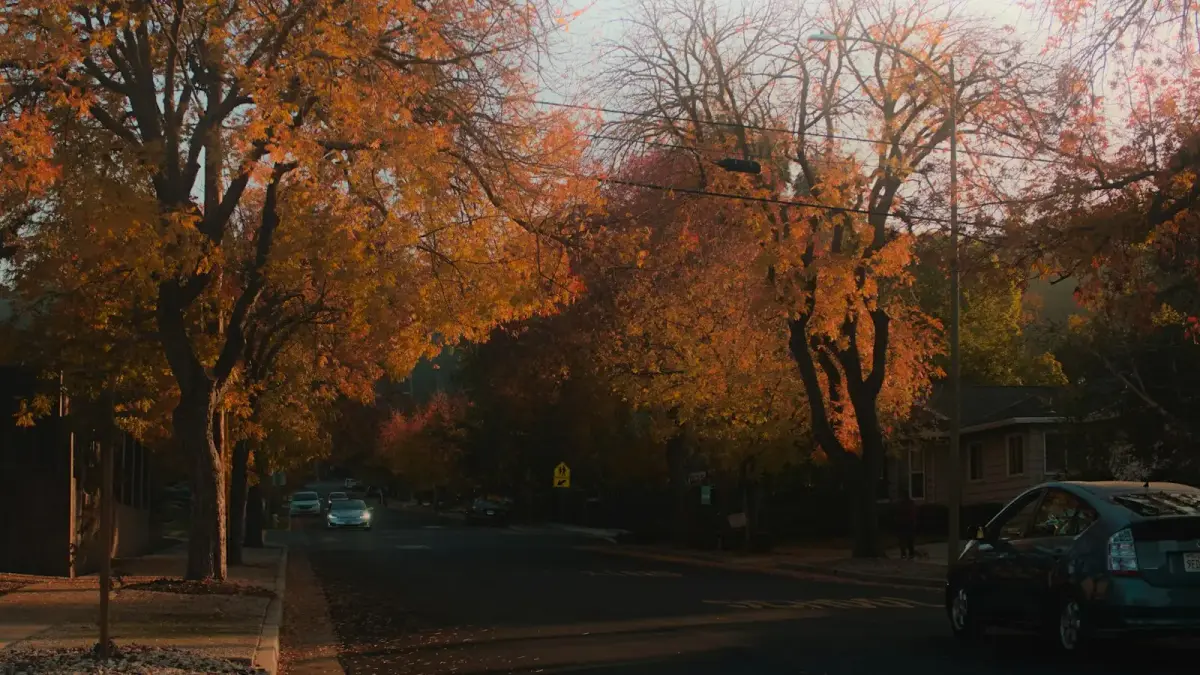
I took the long way to the hardware store last Saturday. That’s what I told myself. The long way. As if there were only one alternative route and it just happened to pass through the neighborhood where I spent the first eighteen years of my life.
I slowed the car at the corner of Maple and Fourth. I looked at the porch - repainted now, a shade of blue that my father would have called ridiculous. I looked at the upstairs window, the one that used to be mine, the one I’d press my forehead against on summer nights when the room was too hot to sleep. Someone had hung different curtains. Yellow ones.
I kept driving.
I have done this maybe two hundred times in the last thirty years. I have never once stopped the car. I have never knocked on the door. I have never introduced myself to the family who lives there now and said, “I know this sounds strange, but I used to be a boy in this house.” I just slow down, look, and keep going. And every single time, something in my chest settles into a shape it doesn’t hold anywhere else.
The compass that never recalibrates
The geographer Yi-Fu Tuan spent decades studying what he called “topophilia” - the deep, often inexplicable bond between a person and a particular place. Not a type of place. A specific one. A particular arrangement of walls and windows and yard that becomes so embedded in your sense of self that you cannot fully separate the building from the person you became inside it.
I think about Tuan’s work every time I catch myself turning left when the hardware store is to the right.
There’s something that happens in the body when you approach the place where you first learned what safety meant. Your shoulders drop half an inch. Your breathing slows. You don’t decide to do this. It just happens, the way your pupils dilate in darkness - automatic, ancient, beyond the reach of your conscious mind.
A 2017 study published in the journal Current Biology demonstrated that the hippocampus - the brain region responsible for memory formation - encodes spatial environments and emotional experiences together, as a single unit. You cannot remember a place without remembering what it felt like to be in that place. The house is not separate from the feeling. The house is the feeling, given walls and a roof and an address the post office recognizes.
This is why a man can sell his childhood home, move across the country, build a career, raise children of his own in a completely different house, and still feel his hands grip the steering wheel a little differently when he turns onto that old street. The map has been redrawn. The compass hasn’t.
A boy’s whole world in twelve hundred square feet
Here is what people forget about childhood, or maybe what we choose not to remember because it’s too tender to hold for long.
For a boy between the ages of four and twelve, the house is not a building. It is the entire known universe. His bedroom ceiling is the last thing he sees before sleep and the first thing he sees after waking. The hallway between his room and the kitchen is a distance that feels, in memory, as vast and specific as any landscape he will ever cross.
He knows which stair creaks. He knows the exact sound the back door makes when his father comes home. He knows the rectangle of light that falls across his bedroom floor at three in the afternoon and the way it moves, slowly, across the carpet as the hours pass.
He measured himself against the kitchen doorframe. Pencil marks and dates in his mother’s handwriting. He didn’t know it then, but those marks were the most honest autobiography he would ever produce - nothing but height and time, proof that he was here and he was growing.
The house knew every version of him. The version that cried over a goldfish. The version that figured out how to ride a bike. The version that locked his bedroom door for the first time, not because anyone was coming in, but because he needed to practice having a boundary. The version that sat at the top of the stairs and listened to his parents argue about money and understood, for the first time, that adults were not in control of everything.
No other address will ever carry that much of him.
The secure base and the man who keeps circling back
John Bowlby, the British psychiatrist who gave us attachment theory, wrote extensively about what he called the “secure base” - the place or person from which a child ventures out into the world and to which the child returns when frightened, tired, or overwhelmed.
We talk about secure bases in terms of people. Mothers, usually. Caregivers. But Bowlby understood that the base was often physical, too. The house itself. The specific room. The particular corner of the yard where a child would sit when things felt too big.
A 2020 study published in the Journal of Environmental Psychology found that adults who reported strong emotional bonds with their childhood homes scored higher on measures of identity coherence and emotional regulation. The researchers suggested that place attachment in childhood creates a kind of psychological anchor - a fixed point in the story of the self that makes all subsequent chapters feel like they belong to the same book.
I think about this when I think about why I still drive past that house.
It isn’t nostalgia. Nostalgia is warm and soft and safe, and what I feel on that street is something sharper. Something closer to recognition. As if the house is a mirror that still reflects a version of me that every other mirror has forgotten. The version before the resume. Before the mortgage. Before the divorce and the rebuilding and the second marriage and the careful way I learned to hold my feelings at arm’s length so they wouldn’t interfere with function.
The house doesn’t know about any of that. The house only knows the boy. And driving past it is the only way I have left to visit him.
Someone else’s curtains in his window
The hardest part is the evidence of other lives.
The tree I climbed is still there, but someone has hung a tire swing from the branch I used to sit on. There’s a basketball hoop in the driveway where my father’s truck used to be. The garden my mother kept along the side of the house - the one she spent every Saturday morning in from April to October - is gone. Replaced by a strip of mulch and a few ornamental grasses that require no tending.
This is not a complaint. These are good changes. They mean a family is living in that house, using it the way a house should be used. Some other child is pressing their forehead against that upstairs window on hot nights. Some other boy is learning which stair creaks.
But there is a grief in it that doesn’t have a name. It is the grief of knowing that the physical space that once held every version of you now holds no trace of you at all. The pencil marks were painted over. The ceiling your eyes memorized has been patched and repainted. The house has forgotten you entirely, and you are the only one still carrying the memory of what it was.
A 2019 study in Frontiers in Psychology examined what researchers called “place bereavement” - the emotional response to losing access to a meaningful physical environment. They found that the loss of a childhood home produced grief responses remarkably similar to interpersonal loss, complete with yearning, searching behavior, and a persistent sense that something essential had been misplaced.
Searching behavior. That’s what the drive-by is. I am not visiting the house. I am searching for something the house used to hold, something I can’t name and can’t find and can’t stop looking for.
Home is not architecture
Here is what I have come to understand after thirty years of taking the long way to the hardware store.
Home is not a building. Home is not architecture or plumbing or the particular shade of blue someone decided to paint the porch. Home is autobiography written in plaster and wood. It is the place where you first practiced being a person - where you first tried out fear and joy and boredom and wonder and heartbreak, all within the same twelve hundred square feet, all under the same roof that leaked in the southeast corner every spring.
You don’t drive past a house. You drive past a self.
And the reason you slow down is not because you want to go back. You can’t go back. The boy who climbed that tree is fifty-three now. His knees wouldn’t make it past the first branch. The room that felt like a universe is probably someone’s home office.
You slow down because for three or four seconds, as the porch and the window and the tree slide past your driver’s side window, you are in the presence of the only place that ever knew you completely. Before you chose which parts of yourself to show and which to hide. Before you learned to perform competence and calm. Before you became the man you are, which is a good man, a decent man, but a man who was built on top of that boy the way a city is built on top of its ruins.
The ruins are still there. And they are not ruins at all. They are the foundation.
The long way home
I’ll take the long way again next Saturday. I already know I will. I’ll slow down at the corner, look at the porch, notice whatever small change the new family has made, and keep driving. I won’t stop. I won’t knock.
But something in me will be quieter for the rest of the afternoon. Something in me will feel located, the way you feel located when you look at a map and find the small dot that says “you are here.” Not because the house is where I live. But because the house is where I started. And there is a kind of man who needs to keep driving past where he started, not to go back, but to remember that everything he built since then has roots.
That the man at the steering wheel and the boy at the window are the same person.
That they always were.