There is a particular kind of man who walks every person he loves to their car after every visit - who stands in the driveway or the parking lot and watches until the taillights have turned the corner and the street has gone quiet, not because the world is dangerous but because a boy who watched his father do the same thing in every season learned that love's last sentence is not goodbye but the moment you turn to go back inside and the car is already out of sight
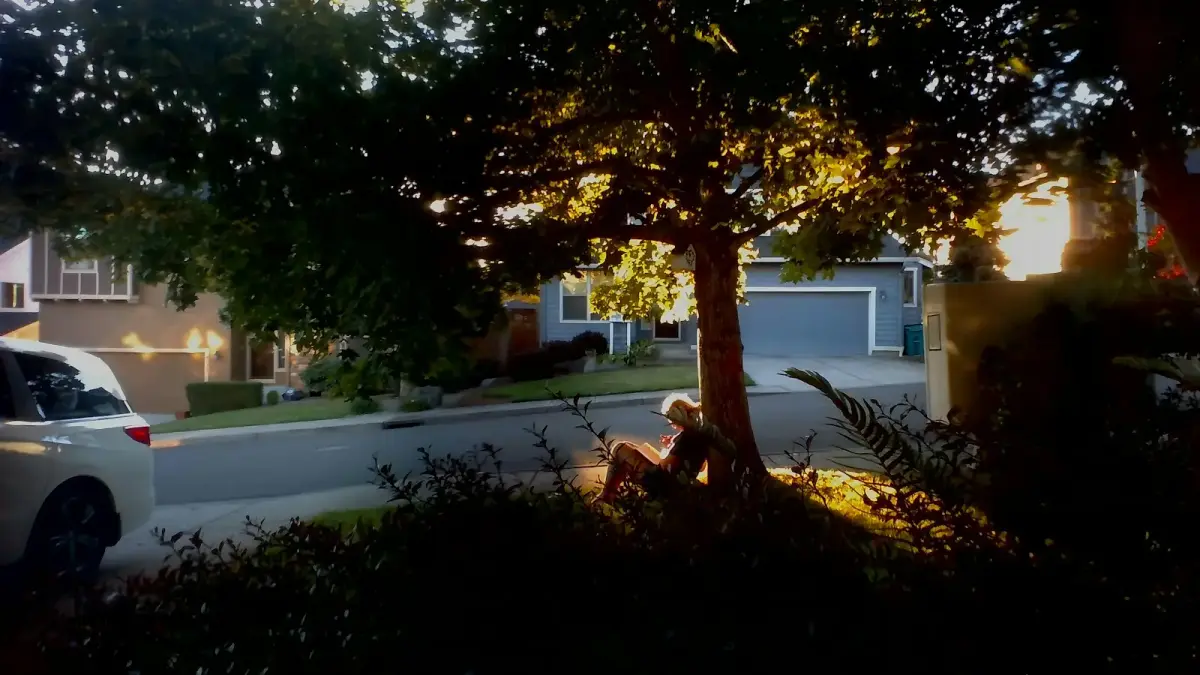
My father never said “I love you” at the end of a visit. He said “hold on, let me walk you out.” And then he stood in the driveway with his hands in his pockets while I backed out, while I straightened the wheel, while I pulled away slowly enough to wave one more time through the window. He stood there in every kind of weather. July heat. November drizzle. That brittle cold in February when your breath looks like something leaving your body.
I didn’t understand what he was doing until I caught myself doing the same thing.
My wife noticed it first. “You always stand out there,” she said one Thanksgiving after my sister left. “You know she’s fine, right? She’s driven that road a thousand times.” I did know that. I knew the road was safe and the car was reliable and my sister was a grown woman who didn’t need a man watching over her departure like a sentry at the edge of something fragile.
But I couldn’t go back inside until the car was gone.
The threshold between here and gone
There is a geography to goodbye that most people never think about. The front door. The walkway. The car. The driveway. The street. Each one is a small border crossing, a point where the person you love moves a little further from the warm center of your attention and a little closer to the ordinary world where you cannot keep them.
The man who walks you to your car knows this geography by heart.
He has memorized it without studying it. He knows exactly how many steps it takes to get from the kitchen table to the driver’s side door. He knows the sound your keys make in the dark. He knows the particular pause between when you get in and when the engine turns over, and he holds his breath during that pause every single time, not because he thinks something will go wrong but because silence between loved ones always feels like a question.
This isn’t politeness. Politeness is holding the door at a restaurant. This is something else entirely - something that lives deeper in the body than manners ever reach.
What the driveway really is
John Bowlby, the British psychiatrist who gave us attachment theory, described something he called the secure base phenomenon. The idea is simple but it explains nearly everything about how we love. A child explores the world confidently when they know there is a safe person to return to. The secure base doesn’t follow the child everywhere. It stays. It remains. It is the fixed point from which adventure becomes possible.
A 2015 study published in the Journal of Personality and Social Psychology found that this dynamic doesn’t end in childhood. Adults who feel securely attached to someone - a partner, a parent, a close friend - show the same exploratory confidence. They take risks. They try new things. They venture further from home. But only because they know, in their bones, that someone is still standing where they left them.
The man at the edge of the driveway is the secure base.
He doesn’t follow you. He doesn’t get in the car. He doesn’t insist on driving or call you three times on the way home. He just stays. He holds his position at the last place where the two of you were together and he doesn’t collapse it - doesn’t turn off the porch light, doesn’t go back to the couch, doesn’t return to his life - until you have safely arrived somewhere else.
That is not a small thing. That is the architecture of love expressed in the simplest possible terms.
The language his body learned
Here is what I think most people don’t understand about the men who do this: they are not choosing to do it. Not in the way you choose to send a thank-you card or remember a birthday. This behavior was installed in them by watching. By years of watching a father or grandfather or uncle perform the same ritual at the same threshold, in the same posture, with the same quiet face.
My father learned it from his father, a man who worked with his hands and spoke in short sentences and would not have recognized the word “attachment” if you’d read it to him from a dictionary. But every time someone left his house - his children, his neighbors, the minister after a Sunday visit - he walked them to their car and he stood in the yard until the car was out of sight.
He did this when he was forty and strong. He did this when he was seventy and slow. He did this in his last good year, leaning on a cane, taking twice as long to get to the end of the sidewalk, refusing to let anyone abbreviate the ritual on his behalf.
Research on masculine emotional expression helps explain why. A 2019 study in Frontiers in Psychology found that men are significantly more likely to express care through protective and instrumental behaviors - actions, logistics, physical presence - than through verbal or emotional disclosure. This isn’t a deficit. It’s a dialect. The man who can’t tell you he’s afraid you’ll get hurt on the drive home can stand in forty-degree weather and watch your taillights for three minutes without flinching.
His body says what his mouth was never trained to.
The grief of being the one who watches
There is something nobody talks about when they talk about these men. Something that sits underneath the warmth of the ritual like a stone at the bottom of a clear river.
It is this: the man who always walks people to the car is always the one who watches people leave.
That is his position in the story. Not the one who goes. The one who stays. The one who stands in the driveway while the world moves away from him, one set of taillights at a time. His children grow up and drive away. His friends visit less often. His parents - the ones who taught him the ritual in the first place - eventually stop coming at all.
And still he walks to the edge of the driveway. Still he stands there.
Adam Grant has written about how the most generous people in any relationship often carry an invisible weight - the weight of always being the one who holds the structure together so others can move freely. The driveway man carries this weight without naming it. He is the porch light and the fixed point and the last face you see before the road takes over. He is the reason you can leave without anxiety. And the cost of being that for everyone is that he has practiced watching people leave more than almost anything else in his life.
A 2022 study published in the Journal of Research in Personality found that individuals with high levels of protective caregiving behaviors often score lower on measures of self-focused emotional awareness. They are exquisitely attuned to whether you are safe, comfortable, and cared for. They are significantly less attuned to the fact that standing alone in a cold driveway at nine o’clock at night might be its own kind of sadness.
What he is really saying
If you could translate the driveway ritual into words - if you could take the posture, the patience, the hands-in-pockets stillness and run it through some kind of emotional interpreter - this is what it would say:
I know I cannot keep you here. I know you have your own home and your own life and your own road to drive. I am not trying to hold you. I am trying to do the last thing I can do for you before you are out of my reach, which is to stand in the space between my house and the rest of the world and make sure the transition is safe. I am trying to be the bridge between warm and cold, between together and apart, between the meal we just shared and the silence that will follow.
I cannot say this out loud. So I walk you to the car instead.
This is the inheritance these men carry. Not money or property or instructions written in a will. Just a posture. A position. A willingness to stand outside in any weather and watch the people they love disappear down a road, and to do it again the next time, and the next time, and every time after that until their legs cannot carry them to the edge of the yard anymore.
The night I understood
My father passed away four years ago. The last time I visited him in the hospital, he was too weak to stand. But when I told him I was leaving for the night, he turned his head toward the window. He couldn’t see the parking lot from his bed. He couldn’t see my car. But he looked in that direction anyway - toward the place where, in every other version of this goodbye, he would have been standing.
I understood then that the ritual was never about the driveway. It was never about the car or the weather or the road.
It was about refusing to let a departure happen without witnessing it. About saying, with the whole body, what a certain kind of man cannot say with his mouth: that your leaving is an event in my life. That I do not take it lightly. That the last thing I will do before I go back to my quiet house is make sure you got away safely, because that is the only prayer I know how to pray.
If you have someone who walks you to the car every time - who stands there watching no matter how short the visit was, no matter how many times you’ve made the drive before - you do not need to tell them you understand.
They already know you do. They saw it in the way you slowed down at the corner so they could watch you a little longer.
That was your version of standing in the driveway.