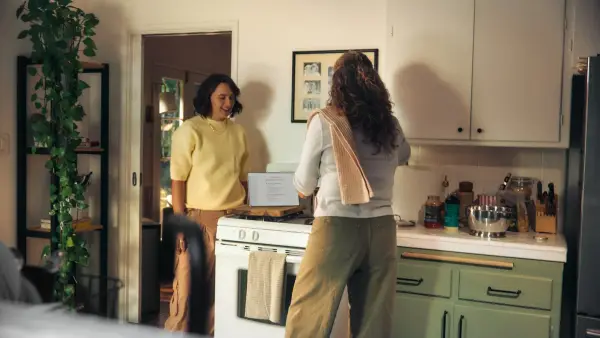
There are people who walk into a room full of family on a Sunday afternoon and immediately begin looking for something to carry, something to wipe, something to tend to, not because they are generous but because standing still in the middle of people who love them is a sensation their body has never learned to trust
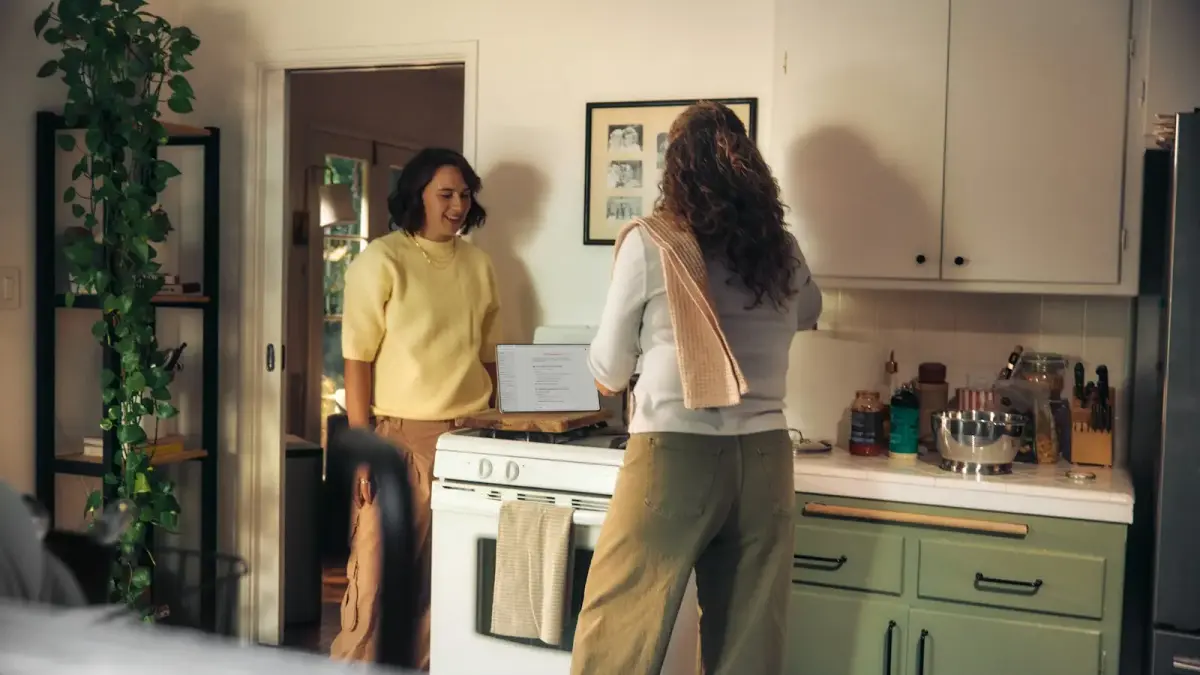
I arrived at my sister’s house last Thanksgiving and had my coat off before I’d said hello to anyone. I don’t mean I was rude. I mean my body moved toward the kitchen the way water moves downhill - without decision, without thought, with a kind of gravitational certainty that bypassed every conscious intention I had to just walk in and sit down this time.
I told myself I would. In the car, I rehearsed it. Walk in. Hug people. Sit on the couch. Be a person in the room who is simply there.
Instead, I found the cutting board. I found the potatoes that needed peeling. I found a sponge and a counter that was already clean and I wiped it anyway, because my hands needed a reason to exist in that room and “being loved” has never felt like a sufficient one.
If you know this choreography - the immediate scan for a task, the orbiting of the kitchen, the strange relief of having something to carry so your presence has a justification - then I am writing this for you. Not because something is wrong with you. But because something happened to you, a long time ago, that taught your body a very specific lesson about what earns you a place among people.
The ones who never sit down
You know who they are because you might be one of them. They arrive at the family dinner and they don’t settle. They circulate. They refill drinks no one asked for. They notice the napkins are running low before anyone else does. They are the last to sit at the table and the first to stand up and start clearing.
Everyone calls them the helpful one. The reliable one. The one who just has that nature.
But watch closely and you’ll see something underneath the helpfulness that doesn’t look like generosity at all. It looks like vigilance. Their eyes scan the room for what needs doing the way a lifeguard scans the water - not calmly, but with a low-grade urgency that never fully switches off.
They are not helping because they want to. They are helping because they don’t know how to stop. Because somewhere in their history, being still in a room full of people meant being seen without a purpose. And being seen without a purpose meant being vulnerable to a question they have spent their whole life outrunning: Do these people actually want me here, or do they just want what I do?
Where the pattern begins
This doesn’t start at a holiday table. It starts much earlier.
A 2016 study published in the Journal of Personality and Social Psychology found that children who received praise primarily for helpfulness and compliance - rather than for their character or presence - developed what researchers described as “contingent self-worth.” Their sense of value became structurally dependent on being useful. Not on being loved. Not on being enjoyed. On being needed.
The distinction matters enormously. A child who is loved for who they are learns that they can sit in a room and take up space and that is enough. A child who is loved for what they do learns something different. They learn that love is a transaction. That the room tolerates them because they are carrying something, fixing something, anticipating a need before it’s spoken.
These children grow into adults who cannot rest in the presence of people they love. Not because they are anxious in the clinical sense. But because their nervous system was calibrated around a single organizing principle: your value is your output. Stop producing and the love stops too.
It doesn’t matter that this isn’t true. It doesn’t matter that the people in the room would love them just as much if they sat down and did nothing. The body doesn’t update its beliefs based on evidence. It updates based on repetition. And the repetition, for years and years, was: be useful or be invisible.
What busyness actually protects
There is a particular kind of discomfort that hits when you force yourself to sit down at a gathering and just be there. Not helping. Not fetching. Not solving any small domestic crisis. Just sitting on a couch with a drink in your hand while other people talk.
For most people, this is relaxation. For people who built their identity around usefulness, it is almost unbearable.
The discomfort isn’t boredom. It’s exposure. Without a task, you are just a person. And just a person, without a function, without a contribution, without proof that you have earned your square footage in the room - that feels like standing naked in a crowd. Like everyone can suddenly see what you have always suspected about yourself: that underneath the competence and the reliability, there is someone who isn’t quite sure they belong here.
Psychologist Harriet Braiker wrote extensively about what she called the “disease to please” - the compulsive need to earn acceptance through service. Braiker observed that the busyness isn’t altruism. It’s armor. It gives you a role, a script, a reason to be in the room that doesn’t require you to trust that your bare presence is enough.
The woman clearing the table isn’t being thoughtful. She’s being safe. The man who volunteers to do the dishes isn’t being generous. He’s found a room where no one will notice that he doesn’t know how to join the conversation, because in the kitchen, alone with the running water, he has a purpose that no one can question.
The cost that nobody counts
Here is what usefulness costs when it becomes identity: you miss the thing you’re supposedly there for.
You are at your niece’s birthday party and you spend the whole time arranging the food table. You are at Christmas dinner and you eat standing up in the kitchen because you never quite found the right moment to sit. You are at your own mother’s eightieth birthday and someone asks you later what your favorite moment was and you realize, with a slow sinking feeling, that you don’t have one. You were too busy making sure everyone else’s moments went smoothly.
A 2019 study in Frontiers in Psychology examining the relationship between compulsive caregiving and emotional well-being found that individuals who chronically prioritize others’ comfort over their own presence report significantly higher rates of what the researchers called “relational absence” - the experience of being physically present at meaningful events but emotionally and experientially somewhere else entirely.
You were there. You have the photos to prove it. But you weren’t there. You were in the kitchen, wiping something.
And the people who love you - they noticed. Not the wiping. They noticed the absence. They noticed that you never sat next to them. That you were always moving, always on the periphery, always one room away from where the actual living was happening. They just didn’t know how to say it without sounding ungrateful. Because how do you tell someone who does so much that the thing you actually want from them is nothing at all?
The terror of just sitting down
I tried it once. At a family barbecue two summers ago. I walked in and I sat down on the patio and I did not get up. I didn’t check the grill. I didn’t refill the ice. I didn’t collect empty bottles or wipe a single surface.
It lasted about eleven minutes.
The sensation was physical, not mental. My legs felt restless. My hands kept reaching for things - the edge of my chair, my phone, a napkin I folded and refolded until it fell apart. My chest tightened. I felt like I was being irresponsible, like something was going to go wrong because I wasn’t preventing it, and everyone would know it was because I was just sitting here, contributing nothing.
Nobody noticed. Nobody cared. The food got served. The table got cleared. Other people did the things I normally do, and they did them fine, and the world did not collapse because I wasn’t holding it together.
But my body didn’t believe that for a second. My body was convinced that I was failing. That I was being selfish. That the moment I stopped being useful, some invisible clock started counting down to the moment someone would realize I wasn’t worth the chair I was sitting in.
That’s not a thought. That’s a belief written into muscle and bone by years of learning that love and labor were the same word.
What it would look like to stay
I’m not going to tell you to stop helping. I’m not going to give you five steps to sitting still at family gatherings, because this isn’t a behavior problem with a behavioral fix. This is an identity wound, and identity wounds heal slowly, in inches, through repeated exposure to the very thing that terrifies you.
What I want to offer instead is permission. Not to fix anything. Just to notice.
Notice the moment you walk into a room and your eyes start scanning for a task. Don’t stop yourself. Just watch it happen. Watch the way your hands reach for the dish towel before anyone has asked you to dry a single thing. Watch the relief that floods in when you find something to do.
And then, if you can bear it, ask yourself the question underneath: What am I afraid will happen if I just stand here?
The psychologist Carl Rogers wrote that the curious paradox of human change is that it begins the moment we accept ourselves as we are. Not as we should be. Not as we would be if we could just relax and be normal for once. As we are - restless and vigilant and wiping the counter for the third time because love without labor is a language we never learned.
You are not broken for needing to be useful. You are someone who learned, very young, that the safest way to be in a room was to be needed by it.
But the room doesn’t need you to carry anything. The room just needs you in it.
And maybe one day, for twelve minutes instead of eleven, you’ll let yourself believe that.