There is a particular kind of person who processes every difficult emotion behind a steering wheel - who drives forty-five minutes to a store fifteen minutes away, not because they took the wrong route but because the car is the only room in their life with no audience, no doorbell, and a windshield that faces only forward, and the woman at fifty-three who tells her husband she needs to run an errand and then drives in complete silence for an hour is not avoiding her life, she has found that the only place her mind can safely unpack something heavy is a seat that moves in the same direction she is trying to go
The errand that was never about the errand
I drove past the pharmacy twenty minutes ago. I saw the sign. I watched it slide by in my peripheral vision like a suggestion I wasn’t ready to accept.
I kept going.
Not because I forgot. Not because I missed the turn. I kept going because something was sitting in my chest that hadn’t finished becoming a thought yet, and the car was the only place I could let it take shape without someone asking me if I was okay.
I was fifty-one the first time I admitted to myself that I do this. That I have always done this. That when my mother called to tell me my father’s diagnosis had changed, I didn’t sit down at the kitchen table. I didn’t call my sister. I picked up my keys, told my husband I needed a few things from the store, and drove for an hour and twelve minutes through neighborhoods I had never seen before.
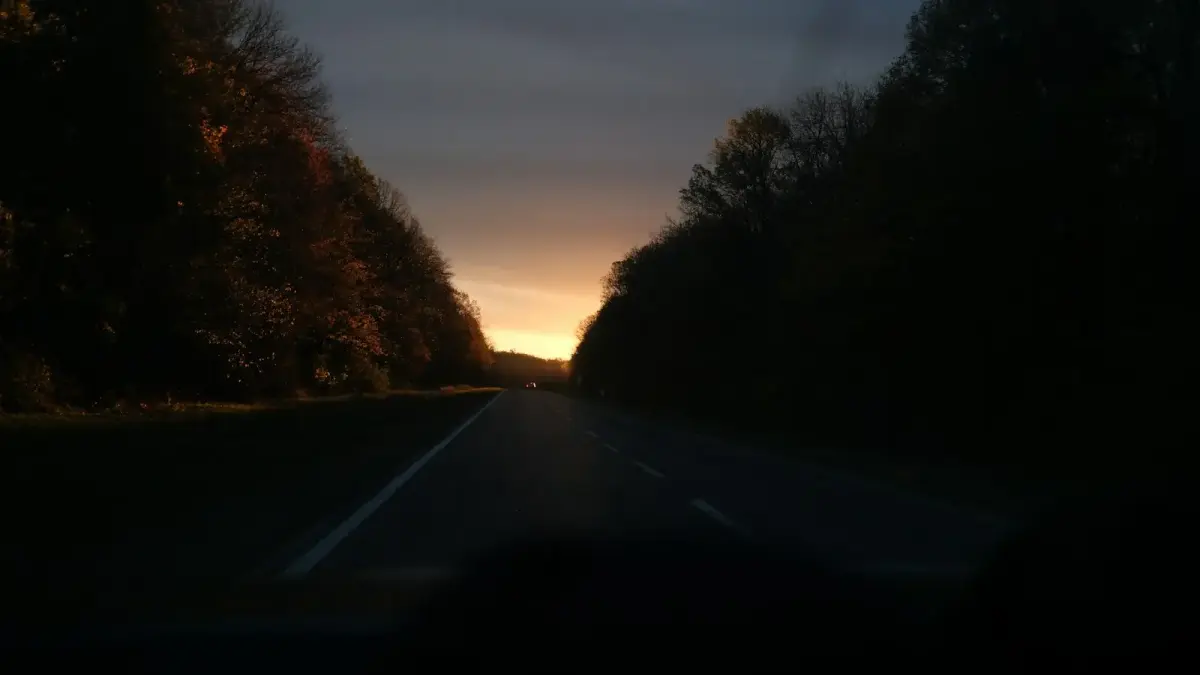
I came home with a gallon of milk and a box of tissues. Those were the “few things.” But the real errand - the one I actually completed - happened somewhere on a quiet stretch of road where the trees were thick enough to block the afternoon sun and the only sound was tires on pavement and my own breathing finally slowing down.
If you have ever done this - if you have ever invented a reason to leave the house so you could sit alone in a moving car and let something heavy settle - then you already know what I’m about to say. The car was never the escape. It was the only room in your life where your mind had permission to feel the full weight of something without performing composure for someone else.
What the car offers that no other room can
Think about every room you spend time in. Your kitchen has someone in it, or the evidence of someone - dishes in the sink, a schedule on the fridge, the quiet expectation that you will be the version of yourself that manages things. Your bedroom carries the weight of shared sleep and the unspoken understanding that lying awake too long will worry the person beside you.
Even rooms where you are technically alone carry an audience. The living room has windows. The bathroom has a time limit. The backyard has neighbors.
But the car. The car is the one space in an introvert’s life where three things happen simultaneously that almost never coexist anywhere else.
First, there is forward motion. You are going somewhere. This matters more than you think, because it means your stillness doesn’t look like stalling. No one - including you - can accuse you of wallowing when the speedometer says you are moving at sixty-two miles an hour.
Second, there is no eye contact. No one is across from you, reading your face, calibrating their response to your expression, waiting for you to summarize your feelings into something digestible. Your eyes are on the road. Your face belongs to you.
Third, and maybe most importantly, there is a windshield. And a windshield only faces forward. You cannot look backward through it. The entire architecture of the car is designed to carry you in one direction, and something about that physical fact makes it easier to think about hard things without feeling trapped inside them.
You are not sitting with your grief. You are driving through it. And that distinction is not small.
The moments that send you to the car
You know exactly which moments I mean.
After the argument that wasn’t really an argument - the one where no one raised their voice but something shifted between you and a person you love, and you could feel the new distance like a weather change, and you needed to understand what just happened before you could look at them again.
After the funeral where you held it together so well that three people told you how strong you were, and you smiled and said thank you and carried the casserole dish to the car and then sat in the parking lot for fifteen minutes before turning the key because your hands were shaking and the strong person they just praised didn’t exist anymore now that no one was watching.
After the phone call with the news. Not always devastating news. Sometimes just complicated news - the kind that requires you to feel six things at once and you can’t do that in front of other people because they will want to help you narrow it down to one.
After the long day. Not the dramatic kind. The kind where you were simply looked at by too many people for too many hours, and your nervous system is vibrating at a frequency that only silence and motion can quiet.
A 2022 study in the journal NeuroImage found that the brain’s default mode network - the system responsible for self-referential thought, autobiographical memory, and emotional processing - becomes significantly more active during routine, low-demand tasks. Driving a familiar route is almost the perfect activation trigger. Your hands know what to do. Your eyes are engaged just enough. And your mind, finally freed from the social performance of being present for others, begins to do the work it has been waiting all day to do.
You are not zoning out. You are zoning in - to yourself.
Why forward motion unlocks what stillness cannot
There is a reason therapists ask you to walk when you talk. There is a reason EMDR therapy uses bilateral stimulation - rhythmic, side-to-side movement - to help the brain reprocess traumatic memories. There is a reason pacing feels natural when you are anxious, and rocking feels natural when you are grieving.
The human brain processes emotion differently when the body is in motion.
Dr. Francine Shapiro, who developed EMDR in the late 1980s, discovered that bilateral stimulation - the alternating left-right engagement that happens naturally during walking, running, and yes, driving - helps the brain move distressing material from short-term emotional storage into long-term narrative memory. It is the difference between reliving something and remembering it. Between being inside the feeling and being able to look at it.
Driving offers a gentle, continuous version of this. Your hands alternate on the wheel. Your eyes scan left and right. The road scrolls beneath you like a visual metronome. And your brain, lulled by the rhythm, begins to do something it cannot do when you are sitting across from someone at a dinner table pretending to be fine.
It begins to file things.
A 2021 study published in Frontiers in Psychology found that participants who engaged in light physical activity while reflecting on emotional events reported greater clarity and reduced emotional intensity compared to those who reflected while stationary. The researchers described it as “cognitive defusion” - the ability to observe a thought or feeling without being consumed by it.
That is what the car gives you. Not numbness. Not avoidance. Defusion. Enough distance to see the shape of the thing without it filling your entire field of vision.
The woman at fifty-three who drives past the store and keeps going is not running away. She is running the only operating system her brain has ever trusted for processing something that matters.
The long way home
There is a man I know - fifty-eight, married for thirty-one years, good job, good family, the kind of person you would describe as steady - who adds twenty minutes to his commute every single day.
He doesn’t talk about it. His wife thinks he leaves work late. His kids assume traffic. But what he does, every afternoon, is take the highway that curves along the river instead of the direct route through town, and he drives those extra miles in complete silence with the windows cracked just enough to hear the wind.
He told me once, in one of those rare moments of honesty that men his age almost never allow themselves, that the driveway is where the performance begins again. That the moment he pulls in, he is Dad. He is Husband. He is the person who asks how everyone’s day was and fixes the thing that’s broken and doesn’t mention that his back hurts or that his department is being restructured or that he’s been thinking about his brother who died four years ago and he never really grieved because there wasn’t time and now there’s even less.
The twenty minutes on the river road is where he is allowed to be the person who carries all of that.
Not to fix it. Not to solve it. Just to let it exist in his chest without someone asking him what’s wrong.
If you recognize this man - if you are this man, or you are married to this man, or you raised this man - I want you to understand something. He is not distant. He is not withdrawing. He is doing the only emotional maintenance his life has room for in the only space where no one needs him to be anything.
The car is not where he hides from his family. It is where he becomes capable of showing up for them again.
The room you built for the parts of yourself that need to move
I want to say something to the person reading this who has always felt slightly guilty about the driving.
Who has wondered if it’s weird. Who has caught themselves forty minutes into a drive they didn’t plan and thought, what am I doing? Who has lied - just a small lie, a white lie, “I need to grab a few things” - because the truth felt too strange to say out loud. The truth being: I need to sit in a moving car and think, and I don’t know why, but it is the only thing that works.
It is not weird. It is not avoidance. And the fact that you need it does not mean you are failing at being present in your own life.
Psychologist Adam Grant has written about how introverts often require what he calls “restorative niches” - specific environments where they can return to their baseline after periods of social expenditure. For some people that’s a quiet room. For some it’s a walk. For you, it’s a car with no passengers and a road that doesn’t require directions.
You built this room yourself, without realizing it. You built it out of motion and silence and the particular mercy of a windshield that only faces one direction. You built it because every other room in your life has someone else’s needs in it, and this is the only one where the only expectation is that you keep moving forward.
And maybe that’s the most honest metaphor you’ve ever stumbled into. That the place where you process the hardest parts of being alive is a seat that faces forward, in a vehicle designed to carry weight, on a road that does not ask where you’ve been.
It only asks where you’re going.
The car is not an escape. It is a room you built for the parts of yourself that need to move forward before they can settle down. And the fact that you found it - that you keep returning to it - is not a sign that something is wrong with you.
It is a sign that you have always known, quietly and without anyone teaching you, exactly what you need.