Psychology says people over fifty-five who still wash the dishes by hand even though the dishwasher works perfectly fine are not being inefficient - they are the last generation that learned a task done slowly with your own hands was not wasted time but the only form of thinking that never required anyone's permission, and the warm water at sixty is not about the plate but about the only twenty minutes of the day when no one is asking you for anything
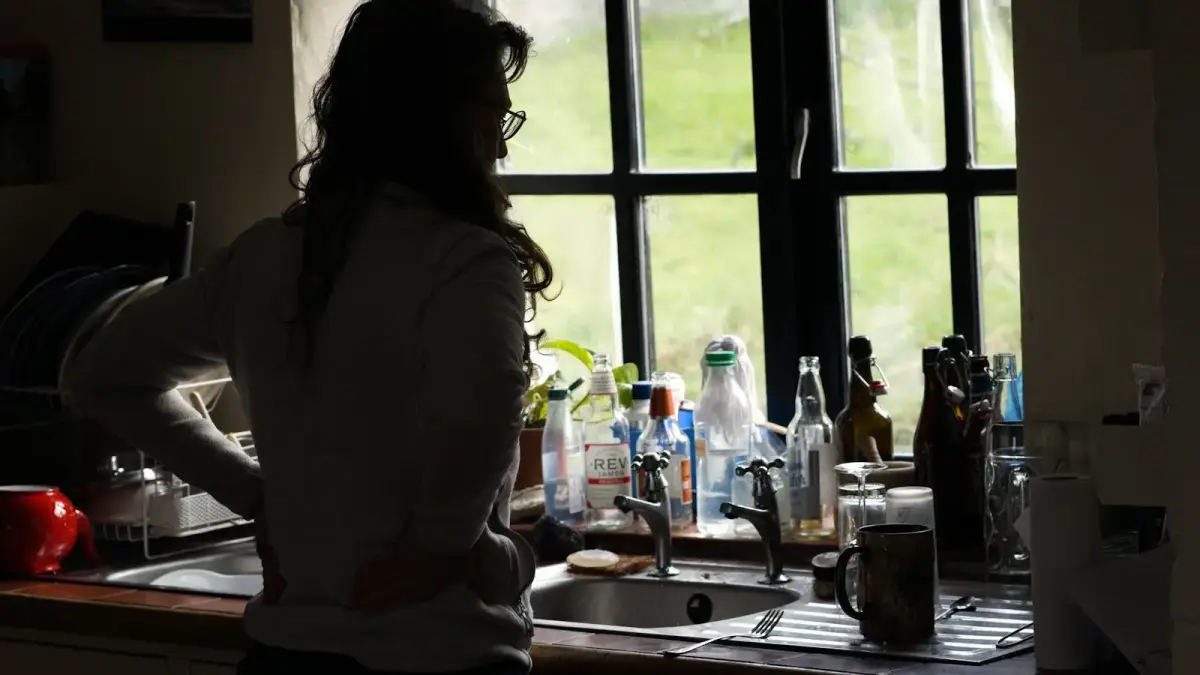
It is 7:15 on a Tuesday evening and I am standing at the kitchen sink with my hands in warm water.
The dishwasher is six inches to my left. It works perfectly. My daughter loaded it after dinner last week and looked at me the way she looks at me when I insist on writing checks instead of using Venmo - a mix of affection and gentle exasperation. “Mom, why do you do this? It’s literally right there.”
I opened my mouth to answer and realized I didn’t have a sentence for it. Not one that would make sense to a thirty-year-old who schedules her meditation through an app and tracks her mindfulness in weekly reports to herself. What I wanted to say was something like: this is the only part of my day that belongs entirely to me, and I didn’t know that until just now, standing here trying to explain it to you.
I couldn’t say it. So I said, “The dishwasher doesn’t get the bottoms of the pans right,” which was true but wasn’t the truth.
The truth is something quieter. And I think a lot of people over fifty-five know exactly what it is, even if they’ve never said it out loud either.
The sink is not about the dishes
Here is what nobody tells you about getting older: the number of minutes in your day that belong to no one - not your spouse, not your work, not your health insurance company, not the adult children who still need you in ways they’d never admit - shrinks every year. The obligations don’t decrease. They just change texture. You stop driving to soccer practice and start driving to doctor’s appointments. You stop managing homework and start managing prescriptions.
And somewhere in the middle of all that quiet rearrangement, you find yourself standing at the sink at the end of the day, and the warm water hits your hands, and for twenty minutes, nobody needs anything from you.
You are not producing. You are not optimizing. You are not on hold with anyone. You are just standing in your own kitchen, doing something small and repetitive with your hands, and the window above the sink shows you the yard going dark, and your mind is allowed to wander without a destination.
That is not inefficiency. That is the last remaining pocket of unstructured time in an adult life that has been structured to the minute since roughly 1987.
What your hands know that your phone doesn’t
There is a field of research called embodied cognition, and it has been quietly validating what your grandmother already understood: thinking is not something that happens exclusively in your head. It happens in your body. It happens in your hands.
A 2010 study published in Psychological Science found that physical actions - particularly repetitive hand movements - directly influence cognitive and emotional processing. The researchers demonstrated that the tactile experience of handling objects changes how people evaluate ideas, process emotions, and form judgments. Your hands are not just tools executing commands from your brain. They are part of how your brain thinks.
When you wash a dish by hand, you are not just cleaning a plate. You are engaging a whole-body cognitive loop. The temperature of the water. The weight of the ceramic. The circular motion of the sponge. The slight resistance of dried food giving way. Each of these micro-sensations is sending information to your prefrontal cortex, and your prefrontal cortex is doing something it rarely gets to do anymore: process without urgency.
Dr. Guy Claxton, a cognitive scientist who has studied intelligence and the body for decades, has argued that modern Western culture dramatically undervalues what he calls “physical thinking” - the intelligence that lives in the hands, the kind of knowing that doesn’t translate into words but translates into a felt sense of rightness. He suggests that we have built a world that privileges speed and abstraction and gradually dismissed the slow, physical, hand-driven cognition that humans relied on for thousands of years.
People over fifty-five didn’t dismiss it. They grew up inside it.
You were raised in the age of hands
If you were born before 1971, you grew up in a world that was built on manual competence. Your parents fixed things. Your mother’s hands were in bread dough, in garden soil, in soapy water. Your father’s hands were under the hood of a car, around the handle of a wrench, gripping a paintbrush on a Saturday afternoon.
Nobody called this mindfulness. Nobody called it anything. It was just life.
But here is what it taught you, at a level so deep you could never unlearn it: a task done slowly with your own two hands is not wasted time. It is a form of presence. It is how you process the day. It is how you grieve without calling it grief, how you worry without spiraling, how you solve problems without sitting down to solve problems.
A 2014 study published in the British Journal of Occupational Therapy found that engaging in repetitive manual activities - knitting, woodworking, cooking, washing - produced measurable reductions in cortisol and self-reported anxiety. The researchers noted that these effects were strongest when the activity was familiar, low-stakes, and done without external pressure. In other words, the calming power of the task wasn’t in the task itself. It was in the fact that no one was watching, no one was grading, and no one was waiting for a result.
That is the sink. That is why you keep going back to it.
The dishwasher solves a problem you don’t actually have
The dishwasher is an extraordinary piece of engineering. It saves time. It saves water, technically. It is objectively more efficient than standing at a sink for twenty minutes scrubbing a pot you could have loaded into a rack.
But efficiency assumes that time saved is time gained. And for many people over fifty-five, the math doesn’t work that way.
What do you do with the twenty minutes the dishwasher saves you? You sit down. You check your phone. You watch the news, which makes you anxious. You start a conversation with your partner that neither of you has the energy to finish. You think about calling your son but decide it’s too late. You go to bed twenty minutes earlier and lie there in the dark wondering why you feel vaguely unsatisfied.
The dishwasher didn’t give you twenty minutes. It took twenty minutes - the ones that belonged to you.
Mihaly Csikszentmihalyi, the psychologist who pioneered the concept of flow, spent decades studying the conditions under which people feel most fully absorbed and alive. What he found was not what most people expect. Flow doesn’t come from exciting, novel experiences. It comes from tasks that are moderately challenging, repetitive enough to be calming, and just engaging enough to keep the mind from wandering into rumination. Washing dishes by hand fits every criterion.
You are not avoiding technology when you wash by hand. You are choosing a state of mind that technology cannot replicate.
The silence at the sink is not empty
There is a particular quality to the silence that happens at the kitchen sink in the evening. It is not the silence of being alone. It is the silence of being with yourself - maybe the only version of that distinction that matters after fifty-five.
Your spouse is in the other room. The television is on low. You can hear the house doing its house things - the furnace clicking, the refrigerator humming, a dog repositioning on the couch. And you are standing there with warm water running over your fingers, and you are thinking about nothing and everything. Your mind drifts to your mother’s kitchen. To the way she stood at her own sink, and you sat at the table behind her doing homework, and neither of you said anything, and it was the safest you ever felt.
You didn’t know, at ten years old, that she was having her twenty minutes. You didn’t know that the sink was where she went when the rest of the house was too much. You just knew that she was there, solid and quiet and present, and the sound of water was the sound of a home that was holding together.
Now you stand at your own sink, and you are her.
It was never about the plate
The people who love you will keep asking why you don’t use the dishwasher. They will buy you a nicer one. They will send you articles about water conservation. They will assume you are being stubborn or sentimental or old-fashioned, and you will shrug and say something about the bottoms of pans because the real answer is too big and too quiet and too much yours to hand over in a kitchen conversation.
The real answer is that you are fifty-seven or sixty-three or seventy-one, and the world asks something of you every single minute of every single day, and has for decades, and the sink is the one place where the asking stops.
You are not cleaning a dish. You are keeping an appointment with yourself. One that no one scheduled, no one approved, no one even knows about. It is the most private ritual you have. It predates your marriage, your career, your children’s first words. It is something you learned by watching someone who never explained it either.
And it is not old-fashioned. It is not resistance. It is not inefficiency.
It is a woman standing at a window with her hands in warm water, thinking her own thoughts at her own pace, in the only part of the day that never learned how to rush her.
If you are that woman - or that man, standing at the sink after everyone has gone to bed, running the water a little longer than you need to - you are not behind the times.
You are the last person in the house who remembers what it feels like to be completely, unproductively, beautifully present. And the warm water already knows it, even if no one else does.