Psychology says the man who always offers to carry the heaviest bag - who reaches for the suitcase before you've touched the handle, who insists on making two trips so you don't have to make one - is not being chivalrous or controlling, he is a boy who learned that the only love his father ever modeled was labor, and carrying something heavy became the only sentence he knows how to say in a language he was never taught to speak
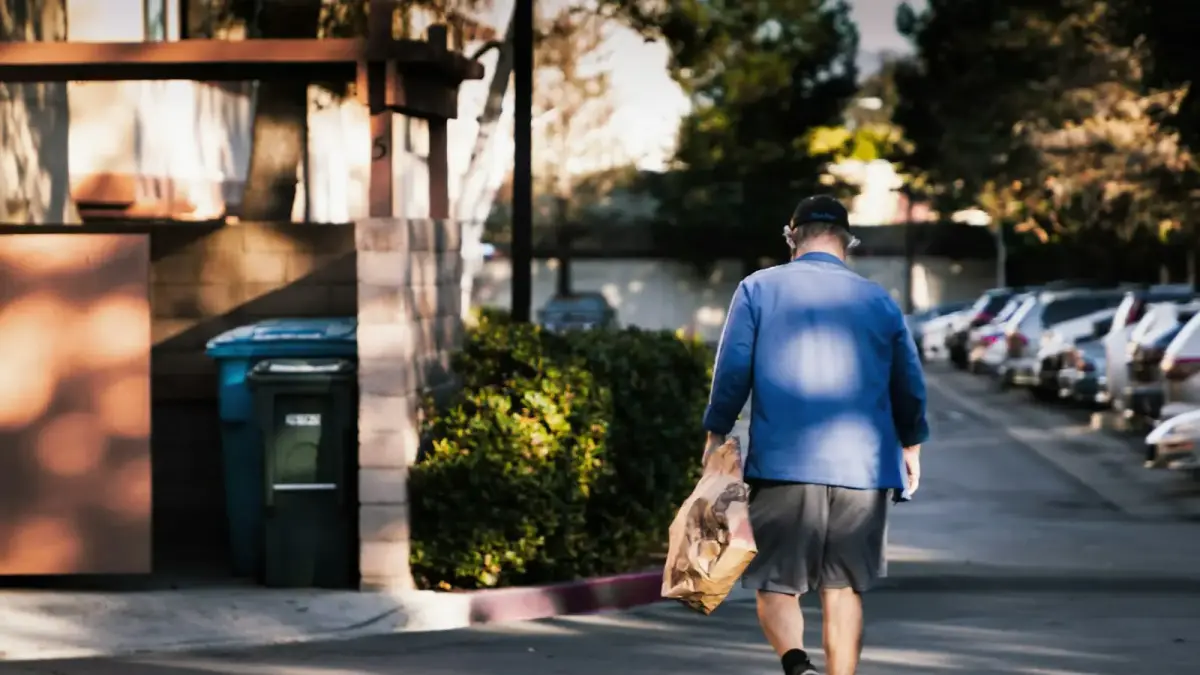
I watched a man in a parking lot last week do something that stopped me mid-step. His wife was reaching for a bag of groceries in the trunk - not a heavy one, just a regular canvas bag with some bread and vegetables - and he crossed behind her, lifted it from the other side before her fingers could close around the handle, and tucked it under his arm alongside the three bags he was already carrying.
She didn’t react. He didn’t explain. It happened in less than two seconds.
And something about the way he moved - not showy, not performative, completely automatic - made my throat tighten. Because I recognized it. I’ve been studying it for twenty years. That wasn’t chivalry. That wasn’t a man asserting control over what his wife could carry.
That was a boy doing the only thing that ever felt like love.
The weight his father handed him
There is a particular kind of father who never says “I love you” and never hugs his children but will wake up at four in the morning to shovel the driveway before anyone else has to walk through snow. Who will carry every piece of luggage from the car to the hotel room in a single trip, arms shaking, rather than let his family make a second walk. Who will spend his Saturday underneath a sink he could afford to have fixed because his hands doing the work is the only prayer he knows.
These fathers are not cold. They are not absent, not in the way the word usually means.
They are men who grew up in homes where love was labor. Where providing was the proof. Where the body was the vehicle for everything tender that the mouth could not deliver.
A 2019 study published in the Journal of Family Psychology examined intergenerational transmission of emotional expression styles among working-class fathers and sons. Researchers found that sons of fathers who primarily expressed care through instrumental behavior - physical tasks, repair, labor, material provision - were significantly more likely to replicate those patterns in their own adult relationships, even when they had developed broader emotional vocabularies in other contexts.
The study called it “embodied caregiving.”
I call it the only sentence some men were ever taught to say.
When love lives in your hands
Think about what it means to grow up watching your father and never - not once - hearing him say the words. But watching his hands. Always watching his hands.
His hands changing a tire on the shoulder of a highway in August. His hands pulling a splinter from your finger with a sewing needle, steady as a surgeon, his face showing nothing. His hands gripping the steering wheel on a long drive while everyone slept, holding the family’s safety between ten fingers and saying nothing about it.
You learn something from those hands. You learn that love is not something you declare. Love is something you carry.
And so you start carrying things. You carry them at twelve, when you insist on bringing the firewood inside by yourself. You carry them at seventeen, when you take the heavy end of the couch during the move. You carry them at thirty-five, when you reach for every grocery bag in the trunk before your partner’s hand can get there.
You are not showing off. You’re not trying to signal strength or capability or dominance.
You are trying to say something your mouth was never trained to form.
The dialect no one recognizes
Here is the part that aches. The people who love these men often misread the behavior entirely.
Some see control. “You don’t have to carry everything - I can do it myself.” And the man nods, puts one bag down, feels something deflate inside him that he can’t name. Because what he heard was not “I’m capable.” What he heard was “I don’t need what you’re offering.” And what he was offering was the closest thing to a love letter his body knows how to write.
Some see stubbornness. “Why won’t you just let me help?” And the man shrugs, says “it’s fine,” keeps walking. Because letting you help means letting go of the thing. And the thing is not the bag. The thing is the connection. The carrying is the connection. Without it, he’s just standing next to you with empty hands and no idea how to matter.
Dr. Ronald Levant, who spent decades studying normative male alexithymia - the difficulty many men have in identifying and expressing emotions - found that for men raised in environments where emotional language was restricted, physical action becomes what he called a “primary affective channel.” The body replaces the voice. Labor replaces language. The man doesn’t know he’s doing it. His nervous system is doing it for him.
This is not a flaw in the man. This is a fluency in a dialect that most people don’t recognize as speech.
What his body learned before his brain could intervene
I want to be precise about something. This is not about all men. And it’s not about performing masculinity or fitting a cultural stereotype.
This is about a specific kind of nervous system wiring that happens when a child watches a parent express love exclusively through physical acts and receives no other model.
The child’s brain doesn’t think “my father is emotionally limited.” The child’s brain thinks “this is how you show someone they matter to you. You pick up the heavy thing. You make two trips. You don’t complain about your back hurting. You don’t ask for acknowledgment. You carry, and the carrying is the proof.”
A 2022 study in Frontiers in Psychology examining attachment behavior and embodied cognition found that adults whose primary caregivers used physical acts of service as their dominant expression of care showed distinct neurological patterns when given opportunities to help others. Their reward systems activated more strongly during physical assistance than during verbal affirmation - suggesting that for these individuals, the body literally experiences carrying something for someone else the way another person’s brain experiences hearing “I love you.”
Read that again.
His hands reaching for the suitcase before you can touch it - that is not a habit. That is his nervous system producing the neurochemical equivalent of a declaration.
The cost of speaking only one dialect
There is tenderness in this pattern. And there is also real loss.
Because the man who can only say love through labor often cannot receive love through words. His partner tells him “I appreciate you” and he nods, looks away, changes the subject. Not because he doesn’t want to hear it. Because the words land on a surface that doesn’t know how to absorb them. It’s like pouring water on glass.
He can receive love through labor in return. Cook him dinner and he feels it. Fix something he hasn’t gotten to yet and his whole body softens. But say “I love you” and watch his shoulders tighten - just slightly, just for a moment - because the words arrive in a language his childhood never installed the translator for.
This is where the grief lives. Not in what he does, but in what he cannot let himself feel when someone tries to give him back what he gives.
Brene Brown has written extensively about how vulnerability requires what she calls a “vocabulary of emotional experience” - not just the willingness to be seen but the literal words and frameworks to name what is happening inside you. The man who learned love only as labor often has the willingness. He simply doesn’t have the words. He stands at the edge of emotional expression the way a person stands at the edge of a foreign country without a passport. The desire to cross is real. The barrier is not courage. The barrier is that nobody ever taught him the language on the other side.
What he is actually saying
Let me translate it for you. Let me tell you what the man is saying when he reaches for the bag.
He is saying: I was taught that people who love you make things easier for you with their body. My father came home exhausted every night and still fixed the fence on Saturday. He never once said he was tired. He never once asked to be thanked. He just appeared, and the fence was fixed, and the bags were inside, and the car was running, and the snow was cleared. That was how I knew I was loved. That was the only evidence I had.
And now I am giving you the only evidence I know how to produce.
He is saying: I don’t know how to sit next to you and tell you what you mean to me. I don’t know how to hold your face in my hands and say the thing. But I know how to carry the heavy bag. I know how to take the suitcase. I know how to make two trips so you only have to make none.
He is saying: this is my entire emotional vocabulary. Every bag I carry is a word. Every door I open is a sentence. Every time I insist on doing the heavy thing myself, I am writing you a letter with the only alphabet I have.
What he needs you to know
He doesn’t need you to stop him from carrying the bag. He doesn’t need you to convince him he doesn’t have to be this way. He already knows, somewhere deep and unreachable, that there are other ways to love. He sees men on television who hold their partners and cry and say beautiful things and he watches them the way you might watch someone speaking a language you studied but never became fluent in. You understand the grammar. You can’t produce the sounds.
What he needs is for someone to see the carrying for what it actually is.
Not chivalry. Not control. Not stubbornness or performance or outdated masculinity.
A boy who watched his father’s hands and learned that love is something you lift. Something you haul. Something that makes your arms ache and your back tighten and your grip hold on a little longer than seems necessary.
He learned it before he had words for it. His hands memorized the grammar before his mouth could form a single syllable.
And every heavy thing he reaches for - every bag, every box, every suitcase he takes from your hand before you’ve touched the handle - is that boy, still speaking. Still trying to make sure you know.
The weight is not the point. You are the point. You have always been the point.
He just doesn’t know how to say it any other way.