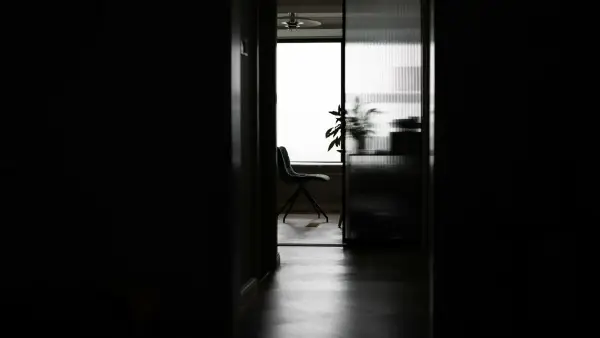
Psychology says men who cannot sit still on a Saturday morning without finding something to fix, build, or organize are not avoiding their families or running from their own thoughts - they are men who grew up in homes where a father's worth was measured entirely by what he could produce, and the restlessness they carry at fifty-five is a boy who was never once told that his presence in the room, without a purpose attached, was enough

Last Saturday I sat down on the couch at nine in the morning with nothing planned. No list. No errand. Just coffee and the quiet hum of the house.
I lasted eleven minutes.
I know because I checked the clock when I stood up - already heading toward the garage, already scanning for something that needed tightening, replacing, organizing. My wife didn’t say a word. She didn’t have to. We both know this about me. The idle body, the rising hum in my chest, the way stillness feels less like rest and more like failure.
For years I assumed this was discipline. Work ethic. The thing that made me reliable. But lately I’ve started to wonder whether what I call drive is actually something older and sadder - a belief I absorbed before I had words for it, in a house where a man sitting down in the middle of the day was a man who had given up.
The house where worth had a sound
In the homes many of us grew up in, a father’s presence was measured in noise. The lawnmower on Sunday. The drill in the basement. The scrape of a shovel against concrete at six in the morning.
My father didn’t announce love. He built a deck. He re-grouted the bathroom. He spent an entire Thanksgiving weekend insulating the attic while the rest of us watched football.
I never once saw him sit in a room and simply be there. Not reading, not fixing, not planning the next project - just existing in the space alongside us without a tool in his hand or a task justifying his presence.
And the message I received, without anyone saying it aloud, was clear: a man earns his right to be in the room by what he contributes to the room. Take away the contribution, and what’s left?
The restlessness that masquerades as ambition
Here’s what nobody tells you about productivity-as-identity: it feels good. It feels virtuous. Everyone around you benefits from it - the fixed fence, the organized garage, the shelves that finally got mounted.
Nobody stages an intervention for the man who can’t stop being useful.
But underneath that usefulness is a question most of us have never been brave enough to ask out loud: If I stopped producing, would anyone still want me here?
A 2019 study published in the Journal of Personality and Social Psychology found that men who strongly identified with traditional masculine norms around self-reliance and productivity reported significantly higher anxiety during periods of enforced rest - illness, unemployment, retirement. The researchers noted that for these men, stillness didn’t register as recovery. It registered as worthlessness.
That’s the part that catches in my throat. Not that we’re busy. But that being busy is the only state in which we feel we’ve earned our place at the table.
What a boy learns when he watches his father
Children don’t learn values from speeches. They learn them from what gets rewarded with attention and what gets met with silence.
If your father was praised when he built something, noticed when he fixed something, and invisible when he simply sat in the living room - you learned the equation early. Presence minus productivity equals irrelevance.
Gabor Mate writes about the way children internalize their environment’s conditions for love. Not the love itself - most of our fathers loved us - but the conditions under which that love became visible. For many men of a certain generation, the condition was output. You were good when you were useful. You were enough when you were doing.
That boy doesn’t disappear when you turn fifty. He just finds bigger projects.
The Saturday morning anxiety
I want to name what this actually feels like, because I think a lot of men experience it without recognizing it for what it is.
It’s Saturday. You have nowhere to be. Your wife is reading. The house is quiet. And within minutes, something starts building in your chest - not panic exactly, but a low-grade alarm. A sense that you’re wasting something. That the clock is moving and you’re not keeping pace with it.
So you get up. You find the thing. The gutter that needs clearing. The drawer that’s been sticking. The oil change that could wait another month but why not now.
And the moment your hands are busy, the alarm quiets. You feel like yourself again.
This isn’t laziness avoidance. This is identity maintenance. You are returning to the only version of yourself that was ever fully validated - the one with a purpose attached to his presence.
A 2021 study in Frontiers in Psychology examining retired men found that those who struggled most with the transition weren’t the ones who missed their careers. They were the ones who had never developed a sense of self outside of function. Without a role to perform, they didn’t know who they were in the room.
The cost nobody talks about
Here’s what I’ve learned at fifty-three, and I’m still learning it badly: the people who love you don’t need your productivity. They need your presence.
My daughter told me once - she was maybe sixteen - that she wished I would just watch the movie with them instead of fixing the kitchen faucet during family night. I remember feeling confused. The faucet was dripping. It was bothering everyone. I was solving a problem.
But what she was actually saying was: Dad, we want you in the room. Not your hands. You.
And I didn’t know how to be in the room without my hands doing something. That’s the inheritance. That’s the thing passed down from a generation of men who showed love through labor because nobody taught them another language for it.
The reframe that might set something free
I want to be careful here because I’m not interested in pathologizing hard work or making men feel broken for being industrious. There is genuine joy in building things. There is real satisfaction in a well-organized garage.
But there’s a difference between choosing a project from a place of fullness and reaching for a project because stillness makes you feel empty.
The first is creativity. The second is a wound dressed up as virtue.
Daniel Goleman’s work on emotional intelligence suggests that self-awareness - the ability to distinguish between a genuine desire and a compulsive pattern - is the foundation of every other emotional skill. And for men who grew up in production-based households, that distinction can take decades to develop.
You’re not broken for needing to stay busy. But you might be ready to ask yourself a question your father never got to ask: What if I’m allowed to just be here?
Learning to stay in the room
I’m not going to pretend I’ve mastered this. Last weekend I reorganized the entire tool wall in my garage - color-coded, labeled, the works. Nobody asked me to. Nobody needed me to.
But I did notice something. I noticed the impulse before I acted on it. I felt the hum start. I recognized it as the old alarm - the boy saying you’re not doing enough, you’re not earning this Saturday, get up and prove something.
I reorganized the tools anyway. But I noticed. And noticing, I think, is where it starts.
The men I know who carry this - and we are everywhere, in every hardware store on a Saturday morning, in every garage at seven a.m. - we are not avoiding our families. We are not running from intimacy or allergic to stillness.
We are boys who were taught a man’s worth lives in his hands. And we are only now, slowly, with great difficulty, learning that it might also live in his quiet presence on a couch on a Saturday morning - coffee going cold, nothing fixed, nothing built, nothing produced.
Just a man in a room, being enough.