Psychology says men who sit in comfortable silence with their friends for hours without saying anything important are not avoiding real conversation - they are practicing the only form of closeness a generation of boys was ever taught would not get them ridiculed, and the reason they look so peaceful is that parallel presence was the first safe love they learned
My friend Dave and I have been fishing together for twenty-three years. We drive forty minutes to the same lake, set up two chairs about three feet apart, cast our lines, and proceed to say almost nothing for the next four hours.
Sometimes one of us will comment on the water. Sometimes we’ll split a sandwich without asking who wants which half. Sometimes we’ll sit so still and so quiet that a heron will land six feet away and just stand there, like it counted us as part of the landscape.
My wife asked me once what Dave and I talk about on those trips. I told her the truth - not much. She looked at me like I’d described the saddest thing she’d ever heard. Two grown men, an entire morning, and nothing to show for it.
But here’s the thing she didn’t understand, and honestly, the thing I didn’t have words for until recently: those mornings with Dave are the closest I’ve ever felt to another human being who isn’t her. Not despite the silence. Because of it.
The behavior everyone misunderstands
If you’ve ever watched a group of men in their fifties or sixties sitting together - on a porch, in a garage, around a fire pit, in a fishing boat - you’ve probably noticed something that looks, from the outside, like emotional poverty. They’re not sharing. They’re not processing. They’re not making eye contact and saying “I feel seen by you.”
They’re just… there. Together. Doing very little. Saying even less.
And the cultural narrative around this is brutal. Men don’t know how to be vulnerable. Men can’t do emotional intimacy. Men are stunted, avoidant, closed off. They sit in silence because they don’t know how to do anything else.
I believed that story about myself for a long time.
But psychology is starting to tell a very different one.
What parallel presence actually is
Researchers call it parallel presence or co-presence - the experience of being physically alongside another person without the requirement of direct interaction. And far from being a lesser form of connection, a growing body of research suggests it may be one of the most psychologically regulating forms of intimacy humans experience.
A 2021 study published in the Journal of Social and Personal Relationships found that feelings of closeness between friends were not primarily driven by self-disclosure or emotional conversation. They were driven by accumulated time spent in shared physical space - including time spent in silence.
The researchers noted something striking: for many male participants, the depth of a friendship was measured not by what had been said but by how comfortable the silence had become.
Think about that for a second. The silence isn’t the absence of intimacy. The silence is the proof of it.
You don’t sit in comfortable quiet with someone you don’t trust. You can’t. Your nervous system won’t let you. Silence with a stranger is tense. Silence with someone you’re fighting with is suffocating. But silence with someone who feels safe - that silence is a room you can rest in.
Where boys learned it
Here’s where it gets painful, and where I think the reframe matters most.
If you grew up male in the 1960s, 70s, or 80s, you were handed an extraordinarily narrow set of instructions about closeness. You could bond over activities. You could bond over competition. You could bond over shared labor - building something, fixing something, moving something heavy.
What you could not do, under any circumstances, was bond the way girls were allowed to bond. Face to face. Eye to eye. Talking about what you felt, what scared you, what kept you up at night.
Psychologist Niobe Way spent years studying adolescent boys for her research at New York University, and what she found shattered the myth of the emotionally indifferent male. Young boys, she documented, form intensely close, emotionally vulnerable friendships - they talk about love, about fear, about needing each other. They are wide open.
And then, around age fifteen or sixteen, they learn to shut it down. Not because they want to. Because the social cost of emotional closeness between boys becomes too high. They get mocked. They get questioned. They get called names that teach them, with devastating efficiency, that tenderness between men is a target.
So they adapt. They find workarounds. They discover that you can sit next to your best friend for five hours and never say a word and still feel held - and nobody will punish you for it.
Parallel presence isn’t a failure of emotional development. It’s an adaptation born from emotional survival.
The garage, the boat, the porch
I want you to think about the spaces where men gather in silence. Really picture them.
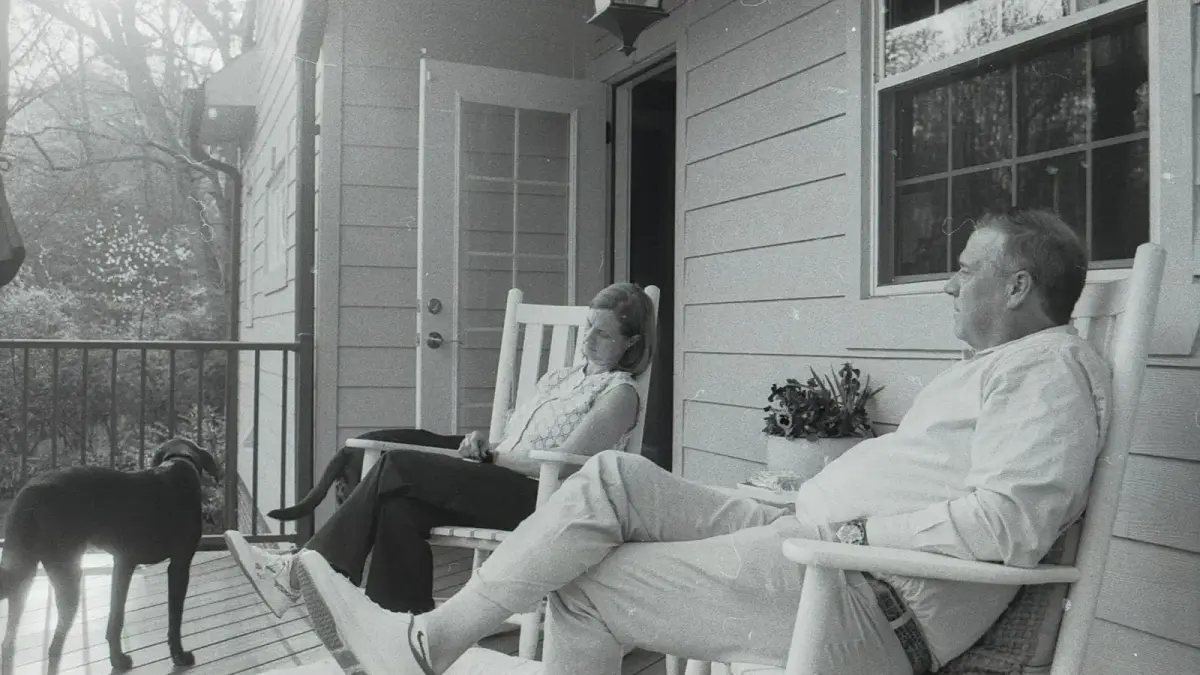
The garage with the truck that doesn’t actually need that much work. The dock where the fish aren’t really biting. The porch where two chairs face the same direction - outward, always outward, never toward each other - and the coffee gets cold because nobody’s in a hurry to go inside.
These spaces are not accidental. They are architectures of permission. They are rooms men built - sometimes literally - where closeness is allowed because it never has to be named.
A 2019 paper in Psychology of Men and Masculinities found that men who maintained long-term “activity-based” friendships reported levels of emotional well-being and social satisfaction comparable to those who maintained “disclosure-based” friendships. The mechanism was different. The outcome was the same.
The men in the study didn’t describe their friends as people they talked to about their problems. They described them as people they could be around without pretending. People who knew them without having to be told.
That’s not a lesser form of knowing someone. That’s one of the deepest forms there is.
Why it looks like nothing from the outside
I think part of the reason this gets dismissed is that we’ve built an entire cultural vocabulary around intimacy that privileges verbal expression. We talk about “opening up,” “sharing,” “using your words.” The therapeutic model of closeness is essentially linguistic - you process, you articulate, you name the feeling, and in the naming, you are healed.
And that model works. I’m not arguing against it.
But it’s not the only model. And when we treat it as the only valid one, we accidentally pathologize an entire gender’s way of loving each other.
Daniel Goleman, in his work on emotional intelligence, has written about the difference between empathic accuracy - knowing what someone feels - and empathic presence - simply being with someone in a way that communicates safety. Men, he observed, often score lower on the first measure and higher on the second than we give them credit for.
Your father might not have been able to name what he felt. But he showed up at every game. He sat in the driveway with you while you cried about something you never actually told him about. He didn’t ask. He didn’t need to. He was just there, and somehow, that was enough.
That wasn’t emotional failure. That was the only fluency he was given.
What the silence is actually saying
When a man sits beside his friend and says nothing, here’s what his nervous system is communicating, even if his mouth isn’t:
I trust you enough to stop performing.
I don’t need to entertain you to justify my presence here.
You don’t need to explain yourself to me.
We have been through enough together that words would actually get in the way.
This is the safest I feel anywhere.
A 2023 study in Frontiers in Psychology examined physiological markers of stress during social interactions and found that cortisol levels dropped most significantly not during emotionally disclosive conversations but during periods of low-demand social contact - being near someone familiar without task pressure or conversational expectation.
In other words, the calmest your body gets in the presence of another person is when you don’t have to do anything at all. You just get to exist together.
That’s what those two men on the porch are doing. They’re not avoiding each other. They’re resting in each other.
The reason this matters now
I’m writing this because I think a lot of men my age - fifties, sixties, older - carry a quiet guilt about the way they love their friends. They’ve been told, directly or indirectly, that what they do isn’t enough. That real friendship requires more words, more vulnerability, more of the kind of emotional performance that was never made available to them without cost.
And I want to say something clearly: the way you love your friends is not broken.
It was shaped by a world that gave you very few safe options and you found one anyway. You found a way to be close to another person that didn’t require you to expose the parts of yourself you’d been taught to hide. You built something real out of presence, repetition, and the kind of loyalty that doesn’t need to announce itself.
That fishing trip where you didn’t say anything important? You said everything that mattered. You said, I am choosing to spend my finite hours on earth sitting next to you, doing nothing, needing nothing, and that is the most honest declaration of love I know how to make.
The silence was never empty.
It was the safest room you ever built. And the fact that you keep showing up to sit in it, year after year, with the same person beside you - that’s not the absence of emotional intimacy.
That’s the purest version of it you were ever allowed to learn.
And it counts. God, does it count.