Psychology says men who use a completely different voice when they talk to their dog - who drop into a softness so tender it would startle anyone who only knows them from work or the dinner table - are not being ridiculous, they are men who finally found a living thing that would let them practice the gentleness they were never given permission to show a human being, and the voice at fifty-three is not baby talk but the only dialect of love they were ever allowed to speak without rehearsing first
The voice no one was supposed to hear
I was fifty-three the first time my daughter caught me talking to my dog in the garage.
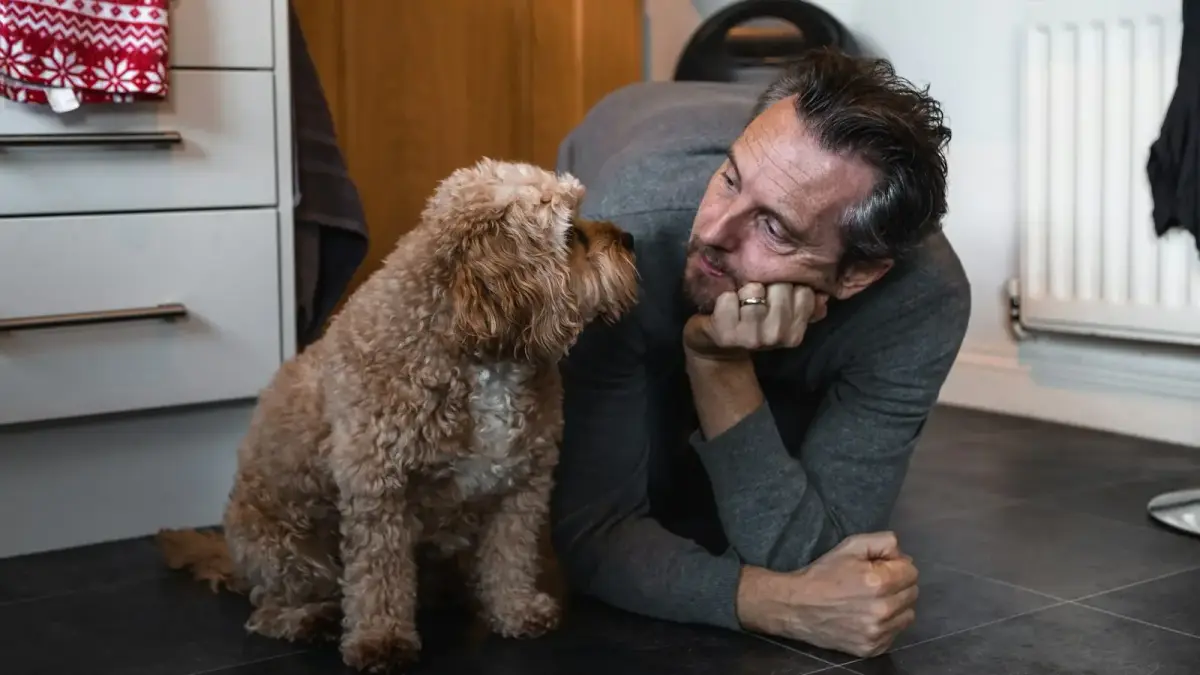
I didn’t hear her come in. I was crouched next to the workbench with my hand on my retriever’s chest, telling him he was the best boy in the entire world in a voice that would have been unrecognizable to anyone who’d ever sat across from me in a conference room. High. Soft. Almost musical. The kind of voice you’d use to talk a frightened child through a thunderstorm.
My daughter stood in the doorway for maybe ten seconds before I noticed her. She had this look on her face that I still can’t fully describe - somewhere between amusement and something that might have been grief. Like she’d just stumbled onto evidence of a person she’d always suspected existed but had never been allowed to meet.
“Dad,” she said. “Who was that?”
I laughed it off. Made some joke about the dog being spoiled. Changed the subject. But the question stayed with me for weeks, because she wasn’t asking about the dog. She was asking about me. About the tenderness I’d been keeping in a register she’d never had access to.
And I think a lot of men know exactly what I’m talking about.
The voice was always there
Here’s what nobody tells you about masculine tenderness: it doesn’t disappear when boys are taught to suppress it. It just goes underground. It finds workarounds. It learns to express itself in the gaps where nobody is evaluating, nobody is keeping score, and nobody is going to use it against you later.
For millions of men, the gap is a dog.
The soft voice - that high, lilting, impossibly gentle register - is not something men invent when they get a pet. It’s something they finally let out. The voice existed at six, at twelve, at twenty-five. It was there during the years when showing that kind of softness would have earned a correction, a sideways look, a quiet reclassification from “strong” to “weak.”
A 2019 study published in the Journal of Research in Personality examined how adherence to traditional masculinity norms predicted emotional suppression across contexts. The researchers found that men who scored highest on conformity to masculine norms didn’t report fewer emotions - they reported fewer outlets. The feelings were identical. The permissions were not.
That distinction matters enormously. Because it means the man in the driveway cooing at his border collie isn’t performing some new version of himself. He’s performing the original version. The one that existed before he learned which parts of himself were acceptable to bring into a room.
Why the dog gets what people don’t
There’s a reason the dog becomes the safe recipient, and it’s not because men love their dogs more than their families. It’s because the dog offers something that almost no human relationship can guarantee: the absolute certainty that tenderness will not be met with evaluation.
Your dog will never raise an eyebrow. Will never say “that’s not like you.” Will never store the softness away as leverage for a future argument. Will never look uncomfortable and change the subject. The dog receives gentleness the way a lake receives rain - completely, without commentary, without memory of what you were before you arrived.
A 2020 study published in Frontiers in Psychology found that oxytocin levels during human-animal bonding were significantly higher when the interaction involved vocal communication - specifically, when people spoke to their pets in infant-directed speech patterns. The researchers noted that this vocal register activated the same neurological caregiving pathways as parent-infant bonding. It wasn’t performance. It was biology recognizing a safe place to practice its deepest function.
For men who grew up learning that caregiving was conditional - that you could be nurturing only if you’d first established your competence, your strength, your right to also be soft - the dog removes every condition. You don’t have to earn the right to be gentle with your dog. You just are, and the dog responds with its whole body, and for a few minutes in the kitchen at six in the morning, you get to be the version of yourself that doesn’t need armor.
What boys learn about softness
I want to talk about where the voice went in the first place, because understanding that is the whole story.
Most men over forty can point to a specific season when they learned that certain tones, certain emotions, certain physical expressions of care were being quietly sorted into categories. There was the acceptable kind of strength - protection, provision, stoicism under pressure. And there was the kind of softness that made adults nervous.
Not always through cruelty. That’s the part people miss. Often it was through absence. Nobody modeled what it looked like for a man to be tender without occasion. Fathers were gentle at funerals, at hospital bedsides, in the specific gravity of crisis. But ordinary tenderness - the kind that exists on a Tuesday for no reason at all - was simply not in the vocabulary.
Research from psychologist Ronald Levant, who spent decades studying normative male alexithymia - the difficulty many men have identifying and expressing emotions - found that the issue was rarely about emotional capacity. Men didn’t feel less. They had fewer practiced pathways for converting feeling into expression. The hardware was intact. The software had been selectively uninstalled.
So the voice went somewhere. It folded itself into the spaces where evaluation didn’t reach. Into the way a man talks to a baby when no one else is in the room. Into the way he sings in the car alone. Into the low, private frequency he uses with a dog who will never report back to anyone about what it heard.
The workarounds men build
Once you start looking, you see the workarounds everywhere.
The man who can’t say “I love you” to his adult son but will drive four hours in a snowstorm to fix his furnace. The father who never hugged his children past age ten but will carry a sleeping grandchild through an airport like he’s transporting something sacred. The husband who can’t talk about his feelings but will spend three hours researching the exact right anniversary gift because getting it perfect is the only dialect of devotion he trusts himself to speak.
The dog voice is the same architecture. It’s tenderness routed through the one channel where the man has decided the cost of vulnerability is zero.
And here’s what makes it beautiful rather than sad: it works. A 2022 study published in the journal Anthrozoology found that men who reported high levels of emotional engagement with their pets also showed increased emotional expressiveness in other relationships over time. The pet wasn’t a dead end. It was a practice field. The softness that started with the dog didn’t stay with the dog. It leaked.
It leaked into how they talked to their partners in the morning. Into how they answered the phone when their kids called. Into the micro-permissions they started granting themselves - to be warm without reason, to be gentle without crisis, to let the voice exist in rooms where other humans could hear it.
The dog didn’t replace human connection. The dog made human connection less terrifying to attempt.
What happens when someone overhears
Every man who has been caught using the voice knows the moment I’m describing. The split second of exposure. The instinct to correct - to deepen the register, to laugh, to explain it away as something silly.
But watch what happens in the person who overhears it. Watch their face carefully.
It’s almost never mockery. It’s almost always recognition. A wife who hears her husband talking to the dog in that voice is hearing something she’s been waiting years to be offered. A child who catches their father in that register is meeting a person they’ve always sensed but never been introduced to.
The voice is not embarrassing. The voice is evidence. It’s proof that the man contains multitudes he was taught to keep in storage, and sometimes, in the presence of something that asks nothing of him except his company, he lets the inventory out.
I’ve talked to men in their sixties and seventies who describe the moment they got their first dog in retirement as something close to revelation. Not because the dog was exceptional, but because for the first time in decades, they had a daily relationship that had no performance requirements. No role. No script. Just a living thing that wanted to be near them, and a voice that had been waiting forty years for an audience that wouldn’t flinch.
The tenderness was never the problem
Here’s what I want you to hear if you’re a man who talks to his dog like that, or if you love a man who does.
That voice is not weakness. It’s not immaturity. It’s not something to be embarrassed about or grow out of. That voice is the sound of a man who found a way to keep the most human part of himself alive despite decades of training that suggested he shouldn’t.
A 2021 study in Psychological Science found that emotional suppression doesn’t reduce emotional experience - it reduces emotional connection. The men who suppress tenderness don’t stop feeling tender. They stop letting other people benefit from it. The feeling has to go somewhere, and for many men, it goes to the one relationship where tenderness has no cost and no consequences.
The dog didn’t teach that man to be gentle. The man was always gentle. The dog just stood there and didn’t make it weird.
If you are someone who drops into that voice - in the kitchen, in the backyard, in the car on the way to the vet - I want you to know something. The people who love you aren’t laughing at that voice. They’re grieving all the years they weren’t allowed to hear it. They’re wondering what it would feel like to be spoken to with that kind of unguarded warmth.
And they’re right to wonder. Because the voice you use with your dog is not a lesser version of you. It’s the version that existed before anyone told you which parts of yourself were allowed to stay. It’s the original draft, before the edits, before the rewrites, before someone convinced you that the soft parts needed to be cut for the final version to hold together.
The voice at fifty-three is not baby talk. It is the first language you ever spoke - the one you learned before you learned to be careful. And the fact that it survived everything that tried to train it out of you is not something to be embarrassed about.
It’s the most remarkable thing about you.