Psychology says people who keep a jigsaw puzzle going on a table in their house - a thousand-piece landscape that stays out for weeks, that they return to in the quiet hour between dinner and sleep, that no one else in the household touches - are not wasting time or avoiding their lives but performing the one act of restoration a particular kind of childhood made necessary, because a child who grew up in a house where nothing stayed in its place learned that the only peace available was the kind you assembled yourself, one piece at a time
The table that never gets cleared
It is 10:47 on a Tuesday night and the house has gone quiet. The dishes are done. The hallway light is off. Everyone else has drifted toward their rooms, toward their screens, toward sleep.
But she is still awake.
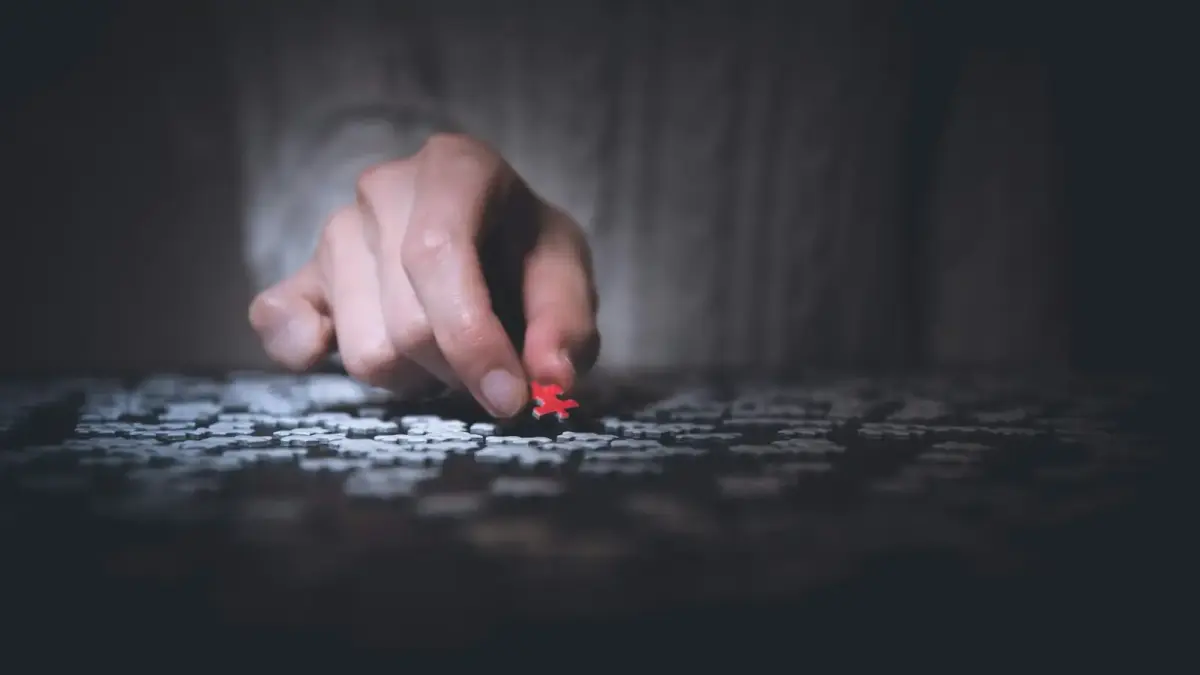
She pulls the chair out slowly, careful not to scrape it against the floor. The puzzle is where she left it last night - a thousand-piece image of a coastline, half-assembled, the ocean mostly done, the rocky cliffs still scattered in loose piles sorted by color. She sits down. She picks up a piece she has been thinking about since this morning, one with a faint curve of amber that she is almost certain belongs near the lighthouse. She tries it. It clicks into place.
And something inside her exhales.
There is no phone in her hand. No list running through her head. No one needs anything from her right now. For the next forty minutes, the only task in the world is finding where these fragments belong.
If you have ever watched someone like this - or if you are this person - you have probably heard the gentle teasing. The puzzle takes up half the dining room table. Guests have to eat around it. It has been there for three weeks. Someone always asks, half-laughing, “Are you ever going to finish that thing?”
She smiles. She does not try to explain.
Because what she is doing at that table is not what it looks like from the outside.
What the puzzle is actually doing
From a distance, a jigsaw puzzle looks like a hobby. Something pleasant but nonessential. A way to pass the time for people who do not like television.
But psychologists who study attention and restoration have a different framework for what happens when someone sits with a puzzle for an extended period.
A 2010 study published in the Journal of Environmental Psychology expanded on what researchers call Attention Restoration Theory - originally developed by Rachel and Stephen Kaplan. The theory proposes that our directed attention, the kind we use for work, planning, decision-making, and managing other people’s emotions, is a finite resource. It depletes throughout the day. And when it depletes, we do not just feel tired. We feel scattered, reactive, unable to prioritize.
The puzzle restores that capacity. Not because it is relaxing in the way a bath is relaxing, but because it engages a different kind of attention entirely. The Kaplans called it “soft fascination” - an effortless, absorbing focus that allows the directed-attention system to rest and rebuild.
She is not wasting time at the puzzle table. She is performing cognitive restoration.
Her brain is doing what it cannot do during the day, when she is managing logistics and absorbing everyone else’s anxiety and holding the shape of the household together with both hands. At the puzzle table, she is finally allowed to think without urgency. To focus without consequence. To let the problem-solving part of her mind run freely on something that has a guaranteed solution.
Every piece belongs somewhere. Every fragment has a place. And if she is patient enough, she will find it.
Why puzzles and not something else
You might wonder why the puzzle specifically. Why not reading, or gardening, or cooking, or any of the other activities people use to unwind.
The answer is in the structure of the task itself.
A jigsaw puzzle is one of the few activities that makes order visible. You can see it happening. You start with a pile of disconnected fragments - hundreds of them, jumbled, edge pieces mixed with center pieces, colors blurred and overlapping. And then, slowly, through nothing but patience and pattern recognition, a coherent image emerges.
It is not abstract. It is not conceptual. It is right there on the table. You can touch it. You can see the gaps closing. You can watch chaos transform into something whole.
A 2022 study published in Frontiers in Psychology found that jigsaw puzzles engage visuospatial processing, working memory, and cognitive flexibility simultaneously - but in a low-stakes, self-paced environment. The researchers noted that this combination produces what psychologists call a flow state, the experience of being fully absorbed in a task where challenge and skill are perfectly matched.
Mihaly Csikszentmihalyi, who first described flow, observed that people in flow states report feeling a temporary dissolution of self-consciousness. The inner critic goes quiet. The anxious narrator who usually runs commentary on your life - am I doing enough, am I good enough, did I handle that conversation badly - stops talking.
For some people, running produces this. For others, painting or playing piano. But for the puzzle person, the specific magic is in the visible assembly. Watching something scattered become something whole. Holding the proof in your hands that disorder is not permanent.
And that is where the childhood comes in.
The house where nothing stayed in its place
Not everyone who does jigsaw puzzles grew up in chaos. Some people simply enjoy the quiet and the pattern matching and the satisfaction of completion.
But there is a particular kind of puzzle person - the one who needs it, who returns to it like a ritual, who feels a low-grade agitation on the nights she skips it - and that person often carries a very specific history.
She grew up in a house where things moved. Not in the way all houses change, with seasons and growth and the natural rearrangement of family life. In her house, things moved unpredictably. The furniture might be in a different place when she came home from school. The parent who was warm this morning might be cold by dinner. The rules that applied on Tuesday would not apply on Thursday. The other children in the house might be there or might be gone. Plans were made and unmade. Promises appeared and evaporated.
Nothing she arranged ever stayed arranged.
If she lined up her stuffed animals on the bed, they would be swept onto the floor during a cleaning fit she did not see coming. If she organized her desk, someone would rifle through it looking for something. If she built something with blocks, it would be dismantled before she was done.
She learned, early and wordlessly, that order was not a stable condition. Order was something you had to build, and it would not last, and you would have to build it again.
A 2019 study in the Journal of Research in Personality found that adults who scored high on the need for cognitive closure - the desire for definitive answers and predictable structure - were significantly more likely to have experienced household instability during childhood. The researchers described it as a compensatory pattern. The adult mind, still carrying the echoes of an unpredictable environment, develops a heightened appetite for tasks that produce visible, tangible certainty.
The puzzle is that certainty.
The ritual that holds her together
Here is what most people do not understand about the woman at the puzzle table.
She is not avoiding her life. She is not checked out. She is not procrastinating.
She is doing the most sophisticated form of self-regulation she knows.
Gabor Mate has written extensively about how the coping mechanisms we develop in childhood are not pathologies. They are adaptations. They are the strategies a young nervous system invented to survive an environment it could not control. And many of those strategies - the ones we tend to judge or dismiss in adulthood - are remarkably intelligent.
The child who could not make her household predictable found something she could make predictable. She found that if you start with the edges and work inward, if you sort by color and shape, if you are patient and systematic, the picture will come together. It will not shift overnight. It will not rearrange itself while she sleeps. When she comes back to it tomorrow, every piece she placed will still be exactly where she left it.
That reliability is not trivial. For a nervous system trained on chaos, it is medicine.
And the ritual quality matters too. The same chair. The same hour. The quiet house. The warm light. The familiar motion of scanning, selecting, testing, placing. This is what therapists call a “grounding practice” - an embodied routine that signals safety to the nervous system. It says: you are here. This is real. This will not change while you are not looking.
She is not building a picture of a coastline. She is building proof that order can hold.
The peace you assembled yourself
There is a particular expression that crosses someone’s face when they press a puzzle piece into place and hear it click. It is not excitement, exactly. It is not triumph.
It is relief.
A quiet, private confirmation that the world makes sense. That things fit. That if you look carefully enough and try patiently enough, you will find where the fragment belongs.
If you are the person at the puzzle table - if you are the one your family teases, the one who stays up past midnight with the lamp on and the box lid propped up for reference, the one who feels a small grief when the puzzle is finally finished and the table is suddenly bare - I want you to know something.
You are not wasting time. You are not being unproductive. You are not hiding from the complexity of your life.
You found something remarkable when you were very young. You found that the only peace available in an unpredictable world was the kind you built yourself, out of patience and attention and the stubborn belief that all these scattered pieces had to go somewhere.
And you were right.
A 2021 study published in the journal PLOS ONE found that engaging in jigsaw puzzles was associated with improved cognitive function across multiple domains - including visual perception, constructional praxis, and mental flexibility - particularly in adults over 50. The researchers suggested that the sustained, multi-session nature of complex puzzles made them uniquely beneficial compared to single-sitting cognitive tasks.
You have been doing something good for your brain this whole time. But more than that, you have been doing something good for the part of you that still remembers what it felt like to live in a house where nothing stayed where you put it.
Every puzzle you finish is a small, quiet correction of that old story.
You can build something orderly. You can return to it and find it intact. You can sit in the stillness of your own making and know, in your body, that this is safe.
The puzzle is not a hobby. It is the architecture of your peace.
And you built it yourself - one piece at a time.