Psychology says people who keep a terrarium on a shelf in their home - a sealed glass jar with moss and tiny ferns that sustains itself without any help, that asks nothing of them, that they just watch through the glass the way you would watch snow falling - are not being whimsical or decorative but maintaining the only kind of ecosystem a child from a chaotic household ever learned to trust, one small enough to protect entirely, contained enough to never collapse, and self-sustaining enough to survive even if they forget about it for a while
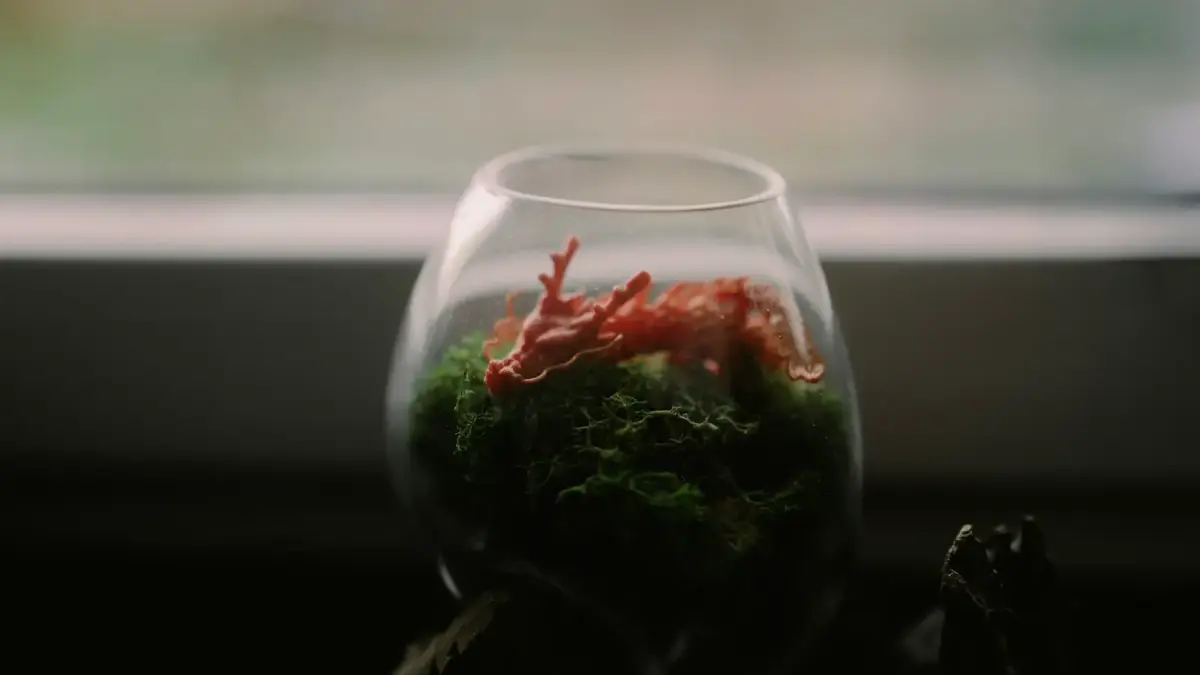
I bought my first terrarium at a flea market when I was twenty-six. It was nothing special - a round glass jar with a metal clasp, some sphagnum moss packed loosely around a few tiny ferns, the glass fogged with condensation on the inside. The woman who sold it to me said it had been sealed for three years.
Three years. No water added. No soil changed. No intervention of any kind.
I carried it home on the passenger seat of my car like it was something alive, which I suppose it was. I set it on a shelf near the window in my apartment, and I just looked at it. For weeks, I would walk past it and pause. I would check the condensation on the glass in the morning. I would notice which fern had shifted slightly toward the light.
It never needed me. And I found that fact almost unbearably comforting.
I didn’t understand why until years later, when a therapist asked me to describe a space where I felt completely safe. I didn’t describe a room. I didn’t describe a person’s arms or a childhood bedroom. I described a sealed glass jar on a shelf with moss and ferns inside it, and then I started crying, and I still couldn’t tell you exactly why.
But I think I know now.
The thing nobody told you about growing up in chaos
If you grew up in a household where the emotional weather was unpredictable - where Tuesday could be calm and Wednesday could be a storm, where you learned to read the sound of a car door closing or the specific weight of a footstep on the stairs - you developed a very particular relationship with environments.
You learned, before you had words for it, that ecosystems collapse. That the people around you could not be relied upon to self-regulate. That peace was conditional, temporary, and usually a sign that something worse was building.
A 2019 study published in the journal Development and Psychopathology found that children raised in unpredictable environments develop what researchers call “vigilance schemas” - cognitive frameworks organized entirely around detecting instability. These children don’t just fear chaos. They become specialists in it. They learn to monitor systems the way air traffic controllers monitor radar, scanning for the signal that everything is about to fall apart.
This doesn’t go away when you grow up. It just changes shape.
You become the person who notices when a friend’s tone shifts by half a degree. You become the partner who can sense an argument forming twenty minutes before it arrives. You become someone who is always, quietly, taking the temperature of every room you enter.
And sometimes, you become someone who puts a sealed glass jar on a shelf and watches the moss grow, and you don’t even know why it calms you down.
Why a terrarium is not what it looks like
Here is what most people see when they look at a terrarium: a cute little garden. A decorative object. A hobby for plant people. A conversation piece you buy at a craft fair and forget about.
Here is what it actually is for some of us: a complete, closed system where nothing can go wrong from the outside.
Think about what a sealed terrarium does. It creates its own water cycle. The moisture evaporates, hits the glass, condenses, drips back down into the soil. The plants photosynthesize during the day and release carbon dioxide at night. The microbes in the soil break down dead material and recycle it into nutrients.
Nothing gets in. Nothing gets out. It just sustains itself, quietly, behind glass.
For a person who spent their childhood trying to hold an entire household together - managing a parent’s moods, mediating between siblings, being the emotional thermostat for a family that couldn’t regulate itself - a terrarium is not a decoration.
It is proof of concept.
It is evidence that an ecosystem can survive without someone constantly intervening. That life can sustain itself without a hypervigilant child standing guard. That a small, contained world can simply be okay on its own.
The psychology of objects we don’t know we need
Psychologist Donald Winnicott spent decades studying what he called “transitional objects” - the blankets, stuffed animals, and familiar items that children use to self-soothe during moments of separation or distress. His work, foundational in developmental psychology, showed that these objects aren’t childish comforts. They are bridges between the internal world and the external one. They help us feel safe when the environment does not.
Most people assume we outgrow transitional objects. We don’t.
We just get better at disguising them.
The coffee mug you use every single morning and would be genuinely upset to lose. The specific blanket on the couch that you reach for without thinking. The playlist you return to when the world feels too loud. These are not random preferences. They are anchors.
A terrarium, for someone who grew up monitoring chaos, functions as something deeper than even a transitional object. It is what I would call a “proof-of-safety object” - something that exists in your environment specifically to demonstrate, every single day, that a system can remain stable without your constant attention.
You don’t water it. You don’t feed it. You don’t rearrange it.
You just watch it through the glass, the way you used to watch your family through the doorway of your bedroom, except this time nothing inside is breaking.
The quiet difference between control and containment
There is an important distinction here, and it matters.
People who grew up in chaotic homes are often described as “controlling.” They like things a certain way. They organize obsessively. They have strong opinions about how the dishwasher should be loaded or how plans should be made.
But what gets called “controlling” is usually something else entirely.
A 2021 study in the Journal of Personality and Social Psychology examined adults who reported high levels of childhood household unpredictability. Researchers found that these individuals didn’t actually score high on measures of dominance or interpersonal control. What they scored high on was something the researchers called “environmental containment seeking” - a desire to create bounded, manageable spaces where outcomes were visible and predictable.
They didn’t want to control other people. They wanted to build a world small enough to keep safe.
That is exactly what a terrarium is. It is not an act of control. It is an act of containment. You are not forcing anything to grow a certain way. You are simply creating conditions where collapse is not possible, and then you are stepping back and watching life do what life does when it isn’t being disrupted.
For someone who never got to experience that as a child, watching it happen inside a glass jar can feel almost sacred.
What you are really doing when you check the glass
If you have a terrarium - or if you’ve ever been drawn to one in a store, lingered over it longer than you expected, picked it up and felt something you couldn’t name - I want you to consider the possibility that you are not just looking at plants.
You are rehearsing trust.
You are practicing the experience of watching something alive remain alive without your intervention. You are letting a small ecosystem prove to you, day after day, that survival does not always require a guardian. That sometimes the water cycle just works. That sometimes the ferns just grow.
This is not a small thing for someone who grew up believing that the moment they stopped paying attention, everything would fall apart.
Psychologist Bessel van der Kolk, in his research on how trauma lives in the body, has written extensively about how survivors of chaotic environments often struggle with what he calls “neuroception” - the body’s unconscious assessment of safety. For people whose early environments were unstable, the nervous system often defaults to a baseline assumption that nothing is safe, that everything requires monitoring, that rest is a luxury you cannot afford because rest is when things go wrong.
A terrarium speaks directly to that part of the nervous system.
It sits on its shelf, day after day, asking nothing. Needing nothing. Remaining green and alive and unchanged. And slowly, almost imperceptibly, it begins to teach the body something that the mind has been trying to learn for decades.
Some things stay okay without you.
The world you built on a shelf
I still have terrariums. Three of them, actually, lined up on a shelf near my desk where I can see them while I work. The oldest one has been sealed for over six years now.
Sometimes I catch myself pausing in the middle of a sentence to look at it. The moss is a shade of green that almost doesn’t seem real. The condensation forms tiny rivers on the inside of the glass that evaporate before they reach the bottom. A fern that was barely a centimeter tall when I sealed the jar is now pressing gently against the lid.
Nobody told me I was building something when I bought that first terrarium. Nobody told me I was reconstructing, in miniature, the kind of childhood environment I never had - one that was sealed off from outside disruption, one that regulated itself, one that I could observe without having to manage.
But that is exactly what I was doing. And if you recognize yourself in any of this - if you have ever been drawn to a small, self-contained world behind glass and felt something in your chest you couldn’t quite explain - I want you to know something.
You were not being whimsical. You were not wasting money on a decoration.
You were building, with your own two hands, the first ecosystem you ever trusted.
And the fact that you can sit and watch it without anxiety, without checking on it every hour, without bracing for the moment it falls apart - that is not a small thing.
That is years of healing, condensed into a glass jar on a shelf.
That is you, learning to believe that something beautiful can sustain itself.
And it can. It already is.