Psychology says people over 55 whose handwriting is still beautiful - who can produce the same flowing cursive they learned in third grade with loops and flourishes their teacher would recognize - but who cannot send a text message without three typos and an autocorrect error that changes the meaning of the entire sentence are not losing fine motor control but revealing that the hand builds its deepest pathways during the years when every letter was practiced one hundred times on lined paper, and fingers that learned to form a capital Q at eight years old carry that instruction in a place that no amount of typing on glass will overwrite
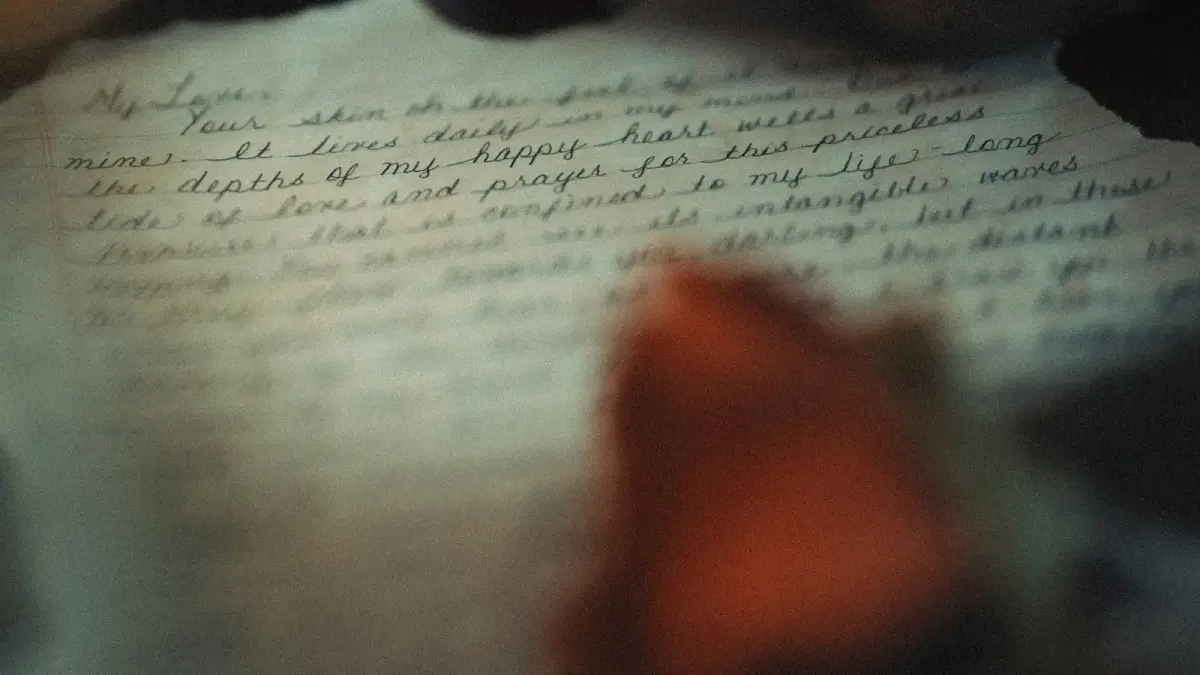
My mother writes birthday cards that look like calligraphy. Every letter connects to the next in a single unbroken stream, the loops on her lowercase g’s perfectly round, the crossbars on her t’s tilted at the same slight angle they’ve held since 1964. She learned to write on paper so rough you could feel the grain through the pencil tip, sitting in a classroom where the alphabet was pinned above the chalkboard in perfect Palmer method script, and her hand still remembers every lesson.
Last Thursday she texted me “I’ll be there ar 4” and then “sorry, at 4” and then “I meant at 3” and then nothing for ten minutes because she accidentally turned on voice-to-text and didn’t know how to turn it off.
She laughed about it when I arrived, but I could hear the thing underneath the laugh. The small, quiet worry that her hands are starting to fail her. That the typos are the first tremor of something larger. That the phone knows something about her body that she doesn’t want to face yet.
She’s wrong. And the science behind why she’s wrong is one of the most reassuring things I’ve ever learned about the aging brain.
Your hand already has a language
Here is what was actually happening in that third-grade classroom, the one with the green chalkboard and the alphabet strip and the lined paper with the dashed center line that told you exactly how tall a lowercase a should be.
Your brain was building motor circuits that would last the rest of your life.
A 2017 study published in Frontiers in Neuroscience examined how motor skills acquired during critical developmental periods become deeply embedded in procedural memory - the kind of memory that operates below conscious thought. The researchers found that fine motor skills practiced intensively during childhood undergo a process called myelination, where the nerve fibers carrying those movement instructions get wrapped in a fatty insulating sheath that makes signal transmission faster and more permanent.
Think of it like this. When you were eight years old, sitting at that desk, practicing rows of lowercase a’s until your hand ached, your brain wasn’t just learning a shape. It was building a highway. And highways built during childhood - when neural plasticity is at its peak and the nervous system is literally wiring itself into its adult configuration - don’t just hold up over time. They become the deepest, most automatic pathways your body owns.
That’s why your cursive still flows. Your hand doesn’t need to think about how to form an uppercase Q. It knows. It has known since the Carter administration. The instruction lives in the same place that holds how to ride a bicycle or tie your shoes - below language, below conscious recall, in the part of your nervous system that simply does.
Texting is not handwriting on a different surface
This is the part that nobody explains to people, and it matters.
When you write with a pen, your hand performs a continuous flowing movement. The pen stays on the paper. Letters connect to each other. Your wrist rotates, your fingers apply varying pressure, and the whole motion unfolds as a single integrated gesture that uses your hand, your wrist, and your forearm in coordination. It is, from a motor control standpoint, one of the most complex continuous fine motor skills humans perform.
When you text, your thumb taps glass.
These are not the same skill performed on different materials. They are entirely different motor systems. Cursive handwriting is a continuous motor task - the movement never stops, the pen never lifts, the muscles maintain a flowing chain of micro-adjustments. Texting is a discrete motor task - each letter requires a separate targeted tap on a flat, featureless surface that provides no tactile feedback about where your thumb actually landed.
Research published in the Journal of Neurophysiology in 2019 demonstrated that continuous and discrete motor skills are processed by different neural networks. They are stored differently, consolidated differently, and - crucially - they are learned during different sensitive windows. Your handwriting was learned during the golden age of motor acquisition. Your texting was introduced to your already-adult hands sometime around 2007.
Your hand is not failing at texting because it’s declining. Your hand is struggling with texting because it was never given a childhood to learn it.
The pen gave you something the screen never will
There’s a sensory dimension to this that goes beyond motor pathways, and it matters more than most people realize.
Pick up a pen. Press it to paper. You can feel the texture of the page through the tip. You can feel resistance. You can feel the ink flowing. Your hand receives constant sensory feedback about exactly where it is and exactly what it’s doing, and that feedback loop - the conversation between your hand and the surface - is part of how motor skills get refined and maintained.
Now press your thumb to a phone screen. The glass is smooth, uniform, and gives you nothing back. There’s no texture to guide your thumb. There’s no resistance to tell you how hard you’re pressing. The tiny vibration the phone produces when you tap is the same for every letter, every position, every word. Your hand is operating blind.
A 2021 study in Psychological Science examined how tactile feedback influences motor accuracy across age groups. The finding was striking - older adults showed minimal decline in motor tasks that provided rich tactile feedback, but significantly more errors in tasks performed on smooth, featureless surfaces. The researchers concluded that this wasn’t a story about aging hands losing precision. It was a story about certain interfaces failing to give experienced hands the information they need to be precise.
The paper knows how to talk to your hand. The glass doesn’t.
The shame that doesn’t belong to you
I want to talk about the part that makes me angry, because someone should.
You have been made to feel embarrassed. You’ve said “sorry, fat fingers” to your children when you sent a garbled text. You’ve laughed at yourself - that particular self-deprecating laugh that covers real worry. You’ve handed your phone to someone younger and watched them type at a speed that felt like a personal indictment. And somewhere in the back of your mind, a story started forming - that your body is betraying you, that the typos are a symptom, that the struggle with this small glass rectangle is the beginning of a larger unraveling.
That story is wrong.
You are not watching your fine motor control decline. You are watching your hands be asked to perform a skill they learned in middle age, on a surface that provides no feedback, using a motor system that was never given the developmental window it needed to become automatic. And you are comparing your performance to people who grew up swiping screens before they could write their own names.
Of course they’re faster. They had a childhood with glass. You had a childhood with paper. And the skills your childhood gave you - the flowing cursive, the beautiful handwriting, the ability to produce letters that look like they belong in a frame - those skills are still there, still perfect, still running on neural highways that were paved sixty years ago and show no signs of crumbling.
What your handwriting actually proves
Dr. Claudia Amunts, a neuroanatomist who has spent decades studying how motor skills are stored in the brain, has written extensively about the permanence of early-acquired procedural memories. The motor cortex, she notes, does not treat all skills equally. Skills learned during critical developmental periods - roughly ages five through twelve for fine motor coordination - receive a level of neural investment that later-acquired skills simply cannot match.
Your handwriting is not a relic. It is not a charming artifact from a bygone era. It is evidence that your motor system was given something genuinely worth learning during the years when learning was at its deepest, and it learned that thing so thoroughly that sixty years of living haven’t dimmed it.
The beautiful cursive Q you can still produce on demand is not nostalgia. It is neuroscience. It is proof that your hands work precisely the way they should - carrying forward the skills they were built to carry, with the same fidelity, the same grace, the same quiet competence they’ve always had.
The text message is not a test you’re failing
I think about my mother’s birthday cards. The way each word connects to the next like a river following a path it carved decades ago. The way her handwriting looks identical to the handwriting in the letter she wrote my father in 1978, which I found in a shoebox in the closet and recognized immediately, because a hand that learned its language that young doesn’t forget.
And I think about her texts - the typos, the autocorrect disasters, the accidental voice memos. The way she holds the phone like it’s slightly hostile, which honestly, for her hands, it is. The glass gives her nothing to work with. No grain, no resistance, no feedback, no familiar grooves.
She’s not losing anything. She’s just being asked to speak a language her hands were never given the chance to learn the way they learned the first one - slowly, on paper, one hundred repetitions at a time, in a classroom where the only screen was a window and the most important technology in the room was a pencil.
Your typos are not a decline. They are your hands telling you they already have a language. They already have a deep, permanent, beautifully encoded way of turning thought into movement on a surface.
And glass was never part of that alphabet.
The next time you write something by hand - a grocery list, a birthday card, your name on a dotted line - pay attention to how effortless it feels. How your hand moves without instruction. How the letters come out looking the same way they’ve looked for as long as you can remember.
That’s not muscle memory fading. That’s muscle memory holding. That’s your hand doing exactly what it was built to do, with exactly the skill it was given when the building was at its best.
Your hands are not failing you. They are faithful to their first language. And there is nothing - nothing - wrong with that.