Psychology says people over 55 who can navigate the exact layout of the grocery store they shopped at in 1985 - every aisle, every turn, the precise spot where the pharmacist knew their name and asked about the children - but who get completely disoriented in the store they have been going to for three years are not losing their spatial memory but revealing that the brain builds its deepest maps during the years when every errand still felt like a small expedition into a world that was not yet routine, and a woman at sixty who wanders the wrong aisle is not confused but carrying the permanent architecture of every room where someone once knew her name
I can draw you a floor plan of the grocery store my mother took me to when I was seven.
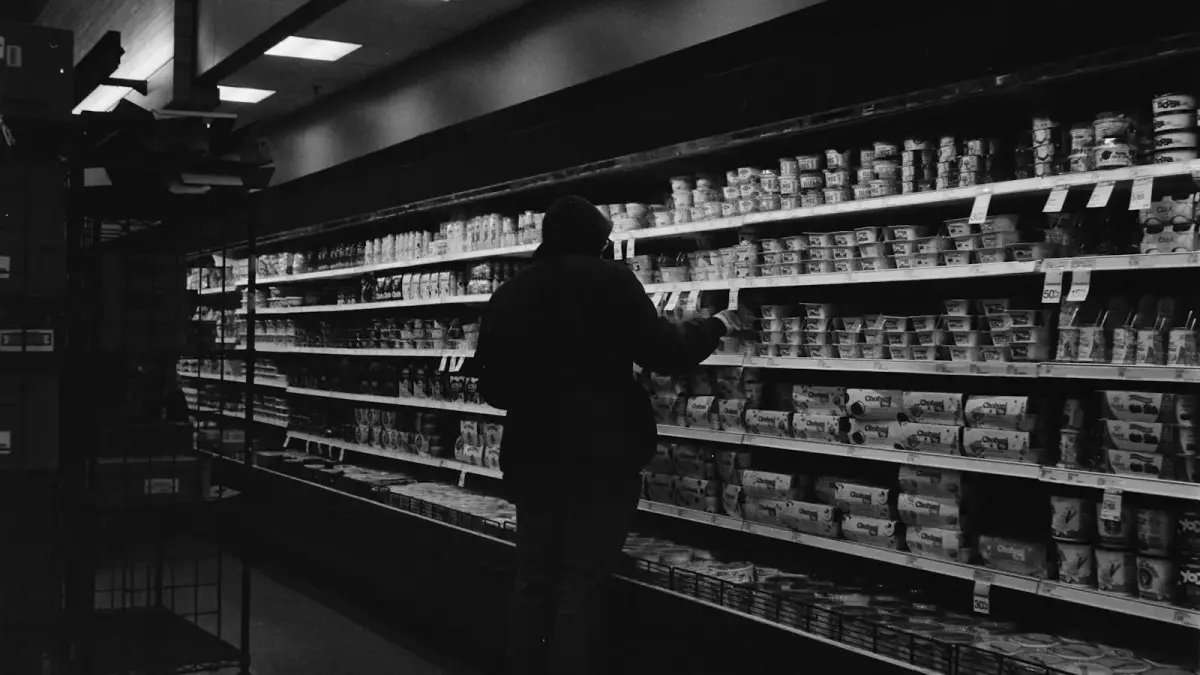
Not a rough sketch. A real map. The produce section that smelled like wet cardboard and cold lettuce on the left as you walked in. The narrow aisle where the cereal boxes towered above me and I had to stand on my toes to reach the one with the cartoon on it. The pharmacy counter at the back, where a man named Mr. Deluca would lean over and ask my mother how the new house was coming along while I pressed my face against the glass case of reading glasses.
I could walk that store blindfolded. I know the creak in the floor near the dairy case. I know the angle of the light that came through the front windows at four in the afternoon.
But the store I go to now - the one I have visited nearly every week for the last three years - I cannot tell you with certainty which aisle has the olive oil. I stood there last Tuesday, turned the wrong direction, and ended up in front of the pet food wondering how I got there.
And for a long time, I thought that meant something was slipping.
The Map That Never Fades
Here is what I have come to understand, both from the research and from sitting with this question for a long time: the brain does not build all spatial maps equally.
Some places get etched into the architecture of your mind so permanently that they become part of you - as fixed as your own name, as automatic as the route your hand takes to the light switch in a dark room. Other places, no matter how frequently you visit them, stay on the surface. Present but not permanent. Functional but not felt.
And the difference has almost nothing to do with how often you go there.
A 2014 study published in the journal Hippocampus found that the strength and durability of spatial memories are heavily modulated by emotional arousal during encoding. The researchers discovered that environments experienced during states of heightened emotion - novelty, attachment, wonder, even mild anxiety - produced spatial representations in the hippocampus that were measurably more detailed and more resistant to decay than those formed during emotionally neutral repetition.
In plain language: your brain maps the rooms where your heart was awake.
And it lets the rooms where you were just going through the motions fade to a kind of blur.
Why 1985 Stays and 2023 Doesn’t
Think about who you were at twenty-five or thirty. Think about the texture of daily life when you were still building everything from scratch.
You were learning a neighborhood for the first time. You were figuring out which street had the bakery that stayed open late. You were discovering the shortcut through the parking lot that saved you ten minutes on the walk to daycare. The pharmacist who remembered your daughter’s ear infection and asked, without being prompted, how she was doing.
Every errand carried a small charge of novelty. Every trip to the store was embedded in a web of first experiences - first apartment, first baby, first time navigating the world as the adult in the room. Your brain was not just recording the location of the canned goods. It was encoding the feeling of being someone who had people depending on her, someone whose name was known, someone who was weaving herself into the fabric of a place.
Now think about the store you go to today.
You drive there on autopilot. You park in roughly the same area every time. You walk the same loop through the aisles, barely looking up. Nothing about it is new. Nothing about it is emotionally charged. The cashier does not know your name. You do not know theirs.
Your brain registers the route the way it registers the pattern of your shower tiles - present, functional, and profoundly forgettable.
The Emotional Encoding Window
Neuroscientist Eleanor Maguire, whose groundbreaking research on London taxi drivers revealed that the hippocampus physically grows in response to intensive spatial learning, made another observation that gets far less attention. The quality of a spatial map depends not just on repetition but on the cognitive engagement during formation.
When someone is actively problem-solving their environment - finding their way through an unfamiliar town, memorizing the layout of a new workplace, learning the rhythms of a neighborhood where they are raising small children - the hippocampus engages in a mode of deep encoding that produces maps of extraordinary permanence.
But when someone navigates a familiar environment on autopilot - which is what most of us do by our fifties and sixties - the hippocampus essentially delegates to the caudate nucleus, a brain structure that handles habitual, automatic navigation. The map still works. You still get to the store and back. But it is a shallow map. A map of routine, not discovery.
This is why a woman at sixty can tell you exactly where the cough syrup was in the pharmacy she visited during the winter her son had bronchitis in 1987, but she cannot remember whether the cough syrup in her current store is in aisle four or aisle seven.
One map was drawn during a year when she was learning the world. The other was drawn during a year when she was just moving through it.
The Places Where Someone Knew Your Name
There is another layer to this, and it is the one that moved me most when I first encountered it.
A 2019 study published in Psychological Science examined how social belonging affects spatial memory in older adults. The researchers found that people formed significantly stronger and more durable cognitive maps of environments where they experienced personal recognition - where someone greeted them by name, remembered their preferences, or engaged them in brief personal conversation.
The effect was not subtle. Participants who had socially warm interactions in a new environment encoded its layout with nearly the same richness as participants decades younger. Social connection was essentially acting as an amplifier for the hippocampus, boosting spatial encoding in ways that mere repetition could not.
Think about what that means for the stores, the post offices, the neighborhood streets of your twenties and thirties.
The butcher who saved you the cut you liked. The librarian who pulled books for your kids before you asked. The neighbor who waved every morning from the porch. These were not just social niceties. They were neurological events. Every time someone recognized you - by name, by habit, by the simple fact of your presence - your brain was drawing the walls of that place in permanent ink.
And the store you go to now, where you scan your own groceries and nobody looks up?
Your brain is drawing those walls in pencil. And it is not the brain’s fault for letting the lines fade.
What the Wrong Aisle Actually Means
I want to tell you about a moment I had last year.
I was at the store - the current one, the one I can never quite map - and I turned a corner expecting to find the bread. Instead I was facing a wall of cleaning supplies. I stood there for a second, disoriented, and felt something I can only describe as a flicker of fear.
Am I losing it?
That question. That quiet, private terror that sits in the chest of almost every person over fifty-five who momentarily loses their bearings in a familiar place. We do not say it out loud. But we all feel it. The small cold hand of worry that touches us when the aisle does not match the expectation.
But here is the reframe, and I believe it completely: that moment of disorientation is not evidence of decline. It is evidence of a brain that is still, decades later, running the deep maps from the years when you were most alive.
Your brain is not confused. It is referencing a richer, older, more emotionally saturated set of spatial data. It is expecting the world to be organized the way it was when every place had a person in it who knew you.
Daniel Schacter, the Harvard memory researcher, has written extensively about how memory errors in older adults are often the result of strong encoding rather than weak encoding. The brain does not lose its grip. It holds too tightly to the maps that mattered most.
The Architecture You Carry
I think about my mother’s grocery store sometimes - the real one, the one from 1983, the one I could draw you a map of right now.
It closed in 1997. The building is a dental office now. But in my mind, it is still there - the fluorescent lights, the squeak of the cart wheels, the way Mr. Deluca would slide a lollipop across the counter for me without saying a word, as if it were a secret between us.
That map is not nostalgia. It is architecture. My brain built it during the years when the world was not yet routine, when every errand was an expedition, when being known by someone behind a counter felt like proof that you existed in the world.
And if I get turned around in the store I go to now - if I wander down the wrong aisle or forget which way the exit is - I am not going to panic about it anymore.
Because I understand now that my brain is not failing to learn the new store. It is simply holding, with extraordinary fidelity, every room where someone once knew my name. Every aisle where the world still felt large and particular and mine.
You are not confused. You are carrying permanent architecture. And the building is magnificent.