Psychology says people over fifty-five who still give directions using landmarks that no longer exist - turn left where the Woolworth's used to be, go past where the bakery was before it became a bank - are not confused or stuck in the past, they are the last generation that built their maps out of people and places instead of coordinates, and the reason they cannot describe the route any other way is that the town they are navigating was never made of streets but of the lives that once lined them
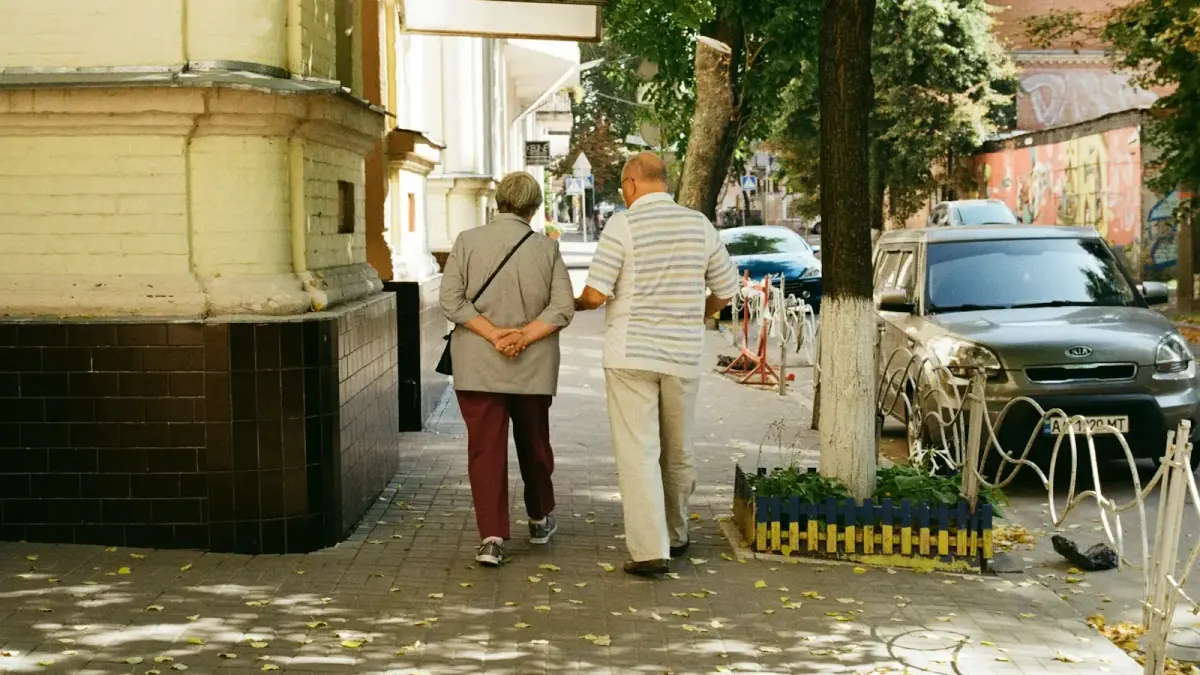
My father hasn’t lived in his hometown in over thirty years, but he can still walk you through it block by block. Not with street names. With stories. “You go down past where Helen’s fabric shop was, take a right at the lot where they tore down the movie theater, and it’s just beyond where the Hendersons had their garden before their kids sold the house.”
I used to gently correct him. I’d pull up Google Maps and show him the actual route, with numbered streets and clean blue lines. He’d look at it, nod politely, and then go right back to describing the town the way he knew it - a town that doesn’t exist on any map anymore, because it was never really made of roads.
It took me years to understand that he wasn’t giving bad directions. He was giving perfect directions - to a place that had changed around him while his memory of it stayed whole.
If you’ve ever listened to someone over fifty-five describe how to get somewhere and thought they were a little confused, a little stuck, a little too attached to a version of the world that’s gone - I want to offer you a different reading. One that psychology actually supports.
They are not lost - they are navigating a richer map
There’s a common assumption that when older adults give directions using defunct landmarks, it signals cognitive decline. A failure to update. A mind clinging to outdated information because it can’t process the new.
But that assumption gets the direction of the arrow exactly wrong.
What research in environmental psychology actually shows is that people who navigate by landmarks - especially personal, relational ones - are using a more complex and emotionally integrated form of spatial cognition than those who navigate by coordinates. They’re not doing less with their memory. They’re doing more.
A 2003 study published in the Journal of Environmental Psychology found that older adults consistently relied on what researchers call “narrative wayfinding” - constructing routes as stories rather than sequences of turns. Their mental maps were organized not by distance or direction but by meaning. The pharmacy wasn’t at the corner of Fifth and Main. It was next to where your mother got her hair done every Thursday.
This isn’t confusion. This is a fundamentally different relationship with place.
The brain builds maps from what matters
Cognitive scientists have long understood that the brain doesn’t store maps the way a GPS does - as grids of roads and intersections. Instead, the hippocampus encodes spatial memory through what are called “place cells” and “landmark anchors,” and the anchors it selects are not random.
The brain prioritizes landmarks that carry emotional weight.
A 2014 study in Psychological Science demonstrated that emotionally significant locations are encoded with greater spatial precision and are more resistant to forgetting than neutral ones. The places that mattered to you - where you bought your first suit, where your kids got their haircuts, where you sat with your best friend the afternoon she told you about the diagnosis - those places become the skeleton of your internal map.
So when someone over fifty-five tells you to turn left where the Woolworth’s used to be, they’re not referencing a building. They’re referencing a node in a deeply personal network of meaning. The Woolworth’s isn’t a landmark in the geographic sense. It’s a landmark in the emotional sense - a fixed point in a life that was lived on foot, face to face, in a town small enough to be known.
Their world was built by walking it
There is a generational divide here that matters, and it’s not about intelligence or adaptability. It’s about how the world was encountered.
If you grew up before GPS, before MapQuest, before the interstate system rewired how Americans thought about distance - you learned your town by moving through it slowly. You walked to school. You biked to a friend’s house. You rode in the back seat while your parents stopped to talk to someone through a car window for twenty minutes.
You didn’t learn the grid. You learned the texture.
Roger Hart, an environmental psychologist at the City University of New York, spent decades studying how children develop spatial knowledge. His research showed that children who explored their environments freely - on foot, without supervision, without digital mediation - developed what he called “thick” cognitive maps. These maps weren’t just spatial. They were social, temporal, and emotional. They included not just where things were, but who was there, what happened, and how it felt.
The generation now over fifty-five was the last to grow up with that kind of unmediated, embodied relationship to place. Their maps are thick in exactly this way. And when the physical landmarks disappear - when the Woolworth’s becomes a Walgreens, when the bakery becomes a bank, when the empty lot where kids played becomes a parking garage - the map doesn’t update, because the map was never about the buildings. It was about the life that happened in and around them.
This is place attachment, and it is not a flaw
Environmental psychologists have a term for this: place attachment. It describes the emotional bond between a person and a specific place, and decades of research have shown that it’s one of the strongest predictors of wellbeing in older adults.
A 2017 study in the Journal of Environmental Psychology found that older adults with strong place attachment reported higher life satisfaction, greater sense of identity coherence, and lower rates of depression - even when the places they were attached to had changed significantly. The attachment wasn’t to the physical environment as it currently existed. It was to the environment as they had experienced it over a lifetime.
This is what your father is doing when he says “turn right where the drive-in used to be.” He’s not failing to notice that the drive-in is gone. He knows it’s gone. He probably watched it come down. He might have stood in the parking lot the last night it was open.
But in his map - in the map that matters, the one his brain actually uses to orient himself in the world - the drive-in is still there. Because it’s not a building. It’s a coordinate in a life.
The directions are a eulogy
Here’s what I think we miss when we smile patiently and pull up our phones instead.
Those directions - the ones that reference places that no longer exist - are not just functional. They are elegiac. They are a person saying: I knew this town when it was alive in a different way. I knew the people who made it what it was. I watched them leave, or close, or die, and the town rearranged itself around their absence, but I still carry the version that included them.
That is not a failure of memory. That is memory doing exactly what it was designed to do - preserving what mattered, organizing experience around meaning, refusing to let the world become a grid of anonymous intersections.
Psychologist Maria Lewicka, whose work on place identity has been influential in environmental psychology, argues that people who maintain strong mental representations of changed places are engaging in a form of “biographical continuity.” They use place memory to maintain a coherent sense of self across time. The town as they remember it is not nostalgia. It is identity infrastructure.
Nobody told them their way of knowing was valuable
This is the part that sits with me the most.
Nobody tells people over fifty-five that the way they navigate the world is actually richer, more human, and more psychologically sophisticated than the way the rest of us do it now. Nobody tells them that their “outdated” directions are evidence of a form of spatial cognition that researchers are actively trying to understand and preserve. Nobody tells them that the thick map - the one built from decades of walking, watching, knowing, and losing - is something we’ve traded away for convenience and may never get back.
Instead, we hand them a phone and ask them to follow the blue dot.
I think about my father’s directions now and I hear something different than I used to. I don’t hear confusion. I hear a man who knew his town so well that his memory of it became indistinguishable from his memory of himself. Every closed shop is a chapter. Every demolished building is a person. Every “where it used to be” is a way of saying: I was here. I was paying attention. I remember.
If you are someone who gives directions this way - by the landmarks that are gone, by the people who used to be there, by the version of the town that lives only in your memory now - I want you to know something.
You are not confused.
You are carrying a map that the rest of us can no longer read. And the reason it still works for you is that it was never about the streets. It was about the lives that once lined them.
That’s not a deficit. That’s a kind of knowing that the world is quietly losing - one demolished storefront, one closed bakery, one forgotten name at a time.
And it is worth everything.