Psychology says people over sixty who have started giving away their best things while they are still alive - the good china, the leather jacket, the ring that meant everything - are not preparing to die, they are doing something far more radical, they are choosing to watch the people they love enjoy what they would have inherited, because a woman who hands her granddaughter the necklace she wore on her wedding day and watches her put it on in the hallway mirror has discovered the one thing every funeral denies you, which is the chance to see your love land
My mother gave me her cast-iron skillet on a Tuesday afternoon in October.
It wasn’t my birthday. Nobody was sick. She just showed up at my door with it wrapped in a dish towel, the handle still dark from forty years of her grip, and said, “I want you to have this now.”
I started to protest. Mom, you use this every day. She held up her hand and said something I didn’t fully understand until years later.
“I want to see you cook in it.”
Not someday. Not after. Now.
I spent the rest of that week quietly worried about her, texting my sister, wondering if she’d gotten bad news from a doctor she hadn’t mentioned. She hadn’t. She was fine.
She just wanted to sit at my kitchen table on a Saturday morning and watch me make eggs in the pan that had made her eggs, her mother’s eggs, three generations of breakfast in the same black iron. When she watched me flip that first omelet, she smiled in a way I’d never seen before. Not proud, not nostalgic, but something closer to complete.
She wasn’t preparing to leave. She was choosing to arrive.
The thing inheritance gets wrong
We have this whole system built around giving things to people after we die. Wills, estates, lawyers, documents that reduce a lifetime of love into line items.
Your grandmother’s ring goes to the eldest daughter. The house goes to the surviving spouse. The books get divided, the art gets appraised, the jewelry gets passed along in velvet boxes that no one opens for months because grief has made the clasp too heavy.
It works, legally. Things end up in the right hands.
But something essential is missing from that transaction. The person who loved those objects - who wore that ring every day for fifty years, who dog-eared those books, who hung that painting because it reminded them of a trip they took when they were young and reckless - that person isn’t there to see the moment it matters most.
They never get to watch their granddaughter slide the ring onto her finger and hold her hand up to the light. They never get to see their son open the record collection and put on the first album, eyes going wide because he didn’t know his father loved Coltrane.
Inheritance is love that arrives too late to be witnessed. And more and more people over sixty are deciding they don’t want that.
Erikson called it generativity
Erik Erikson, the developmental psychologist who mapped the stages of adult life, identified the central task of later adulthood as generativity - the need to contribute to the next generation, to feel that your life produced something that will outlast you. Without it, people stagnate. They look back and wonder if any of it mattered.
But what Erikson described in broad strokes, people over sixty are living out in small, specific, devastatingly tender moments. They’re not contributing to the next generation in abstract terms. They’re sitting in living rooms and hallways, handing over particular objects, and watching - really watching - what happens next.
A 2021 study published in The Journals of Gerontology found that older adults who engaged in what researchers called “living legacy behavior” - deliberately passing on meaningful possessions while still alive - reported significantly higher levels of psychological well-being than those who planned traditional posthumous inheritance. The difference wasn’t about the objects themselves. It was about the witnessing.
That distinction matters enormously. It reframes the entire behavior from something passive and morbid into something active and almost defiant.
I am still here. And I want to see this happen with my own eyes.
The objects are not just objects
There’s a reason people don’t give away just anything. Nobody wraps up their spare colander and drives it across town with tears in their eyes.
The things people choose to give are specific, loaded, heavy with invisible history. The necklace she wore on her wedding day. The leather jacket he bought in 1974 with his first real paycheck.
The quilt her mother stitched by hand during a winter so cold the pipes froze. The vinyl collection that soundtracked every heartbreak and reconciliation of a forty-year marriage.
Psychologists call this “object attachment” - the way physical things absorb emotional meaning through repeated contact and association. A 2018 study published in the Journal of Personality and Social Psychology found that people attribute genuine emotional essence to objects that were present during significant life events. The brain actually encodes the object as part of the memory itself.
The ring isn’t a symbol of the marriage. At a neural level, the ring is part of the marriage.
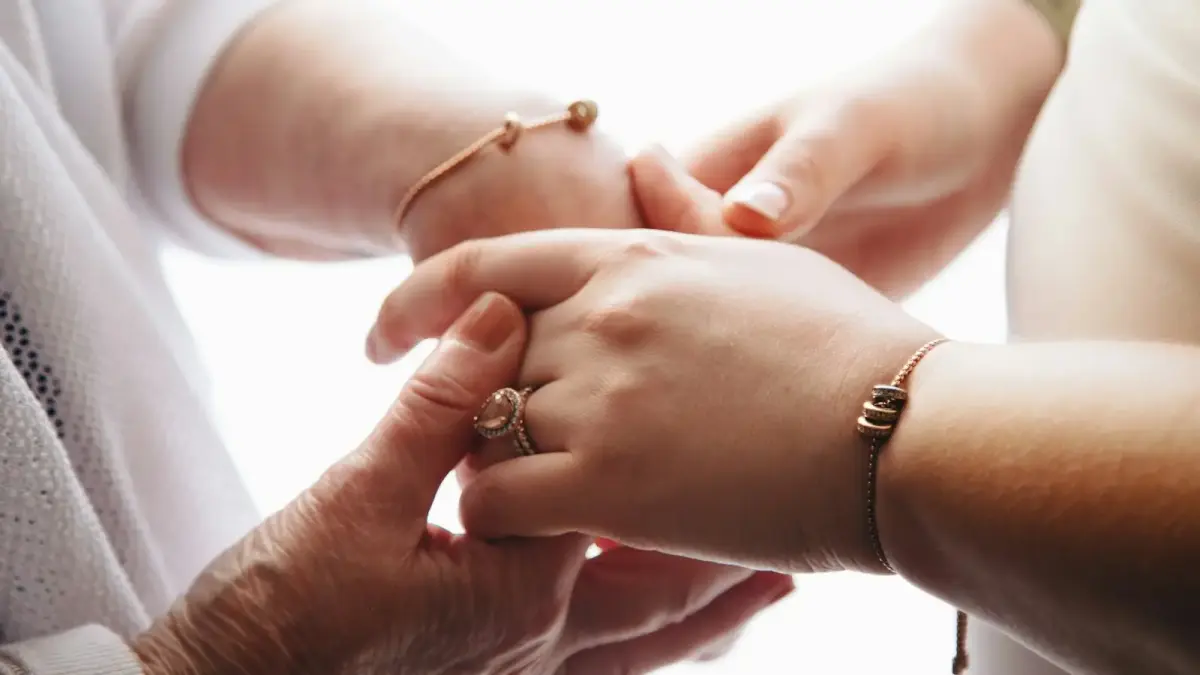
When a woman takes off that ring and puts it in her granddaughter’s palm, she’s not giving away jewelry. She’s transferring a piece of lived experience. And she wants to be present for that transfer because she knows something the rest of us haven’t figured out yet - that the most meaningful exchange in human life isn’t the giving, it’s the watching.
What a funeral denies you
I’ve been to funerals where beautiful objects were distributed. A daughter opened a box and found her mother’s pearls and pressed them against her chest and wept. A son discovered his father’s war medals in a drawer and sat on the bedroom floor holding them, understanding for the first time who his father had been.
Those are real moments. They carry weight.
But here’s what none of them include: the person who loved those objects seeing them loved again. The closed loop. The full circuit of human connection that requires both a giver and a receiver to be present, awake, alive, and looking at each other.
A funeral gives you the object. It gives you the grief. It gives you the memory.
But it cannot give you the moment.
And that moment - the granddaughter putting on the necklace and turning to the mirror and saying, “Grandma, it’s so beautiful” - that is the thing. That is what all of it was for. Every year of wearing it, every anniversary, every time she touched it absently while cooking dinner or driving the car.
All of that meaning was heading somewhere. And the somewhere is a hallway mirror with a twenty-two-year-old looking at her own reflection wearing her grandmother’s love.
If you die first, that scene still happens. But you’re not in it.
And increasingly, people over sixty are saying - quietly, without fanfare, without morbidity - I want to be in it.
It’s not about death, it’s about presence
The people around them often misread it. Children get nervous.
“Mom, why are you giving things away? Are you okay?”
There’s a cultural script that says distributing your possessions means you’re winding down, settling up, getting ready. Friends raise eyebrows. Even doctors have been trained to ask about it as a screening question.
But research tells a different story. A 2023 study published in Psychological Science examined what motivates older adults to begin giving away prized possessions. The researchers expected to find death anxiety as the primary driver.
They didn’t. The strongest predictor was something they called “relational presence motivation” - the desire to create one more shared experience with someone they love, using an object that already contains shared history.
These aren’t people preparing for absence. They’re people doubling down on presence. They’re saying: I have this finite amount of time left, and I would rather spend it watching my daughter arrange my books on her shelf than have those books sit in boxes for six months after I’m gone while everyone argues about who gets what.
It’s not morbid. It’s the opposite. It’s one of the most life-affirming things a person can do.
The father with the vinyl collection
I think about a man I know - a retired teacher, seventy-one, who spent a weekend carefully packing up his record collection. Not all of it. He kept a few.
But the core of it - the Coltrane, the Miles Davis, the Joni Mitchell, the Springsteen - he loaded into crates and drove to his son’s apartment. His son was thirty-eight and had just bought a turntable on a whim.
This man sat on his son’s couch and watched him pull out album after album, reading the liner notes, asking questions. “Dad, I didn’t know you were into jazz.”
The father smiled. “There’s a lot you don’t know. Put on A Love Supreme, track two.”
Then he said the sentence that contains everything.
“I want to watch you hear it for the first time.”
That’s the whole thing. That’s what every person over sixty who gives away their treasures is really saying. Not “I’m done with this” or “I won’t need this where I’m going” - but “I have carried this love for decades and I want to watch it arrive somewhere new while I’m still here to see the look on your face.”
Brene Brown writes about how the deepest human experiences require vulnerability - the willingness to be seen in a moment of genuine feeling. What these givers know intuitively is that vulnerability goes both ways. The granddaughter putting on the necklace is vulnerable, and the grandmother watching her is equally so.
Both are exposed. Both are saying: this matters to me more than I can articulate. Both are choosing the moment over the safety of silence.
You are not being morbid
If you’re over sixty and you’ve started doing this - pulling things from drawers and shelves, thinking about who should have them, imagining the handoff - I want you to know something.
You’re not preparing for the end. You’re not being grim or fatalistic or depressing.
You are doing something that most people never have the courage or clarity to do. You are choosing to be present for the moment your love lands.
You are choosing the hallway mirror over the lawyer’s office. The kitchen table over the estate sale. The look on your grandson’s face when he puts on your leather jacket and it fits him perfectly.
You have figured out the secret that the entire inheritance industry misses: the value of a treasured object isn’t in the object. It’s in the space between two people when one says “this is yours now” and the other one understands what that really means.
And you want to be standing there when it happens.
That’s not death preparation. That’s love in its most complete form - given, received, and witnessed, all in the same breath.
The skillet my mother gave me sits on my stove right now. I use it every Sunday. And sometimes, when the oil heats up and the pan starts to hum the way it always has, I can feel her in the handle - not as memory but as presence.
She’s alive. She calls me every week and asks what I made in it.
And she gets to know - not hope, not imagine, but know - that her love landed. That might be the most radical thing a person can do.