Psychology says people who still handwrite everything important - grocery lists, birthday cards, thank-you notes, the name of a book someone mentioned at dinner - are not resisting technology or clinging to the past, they are the last generation that was taught penmanship as a form of care, and the pen on paper at sixty-one is not nostalgia but proof that the slow, deliberate, unhurried version of themselves still exists underneath decades of rushing
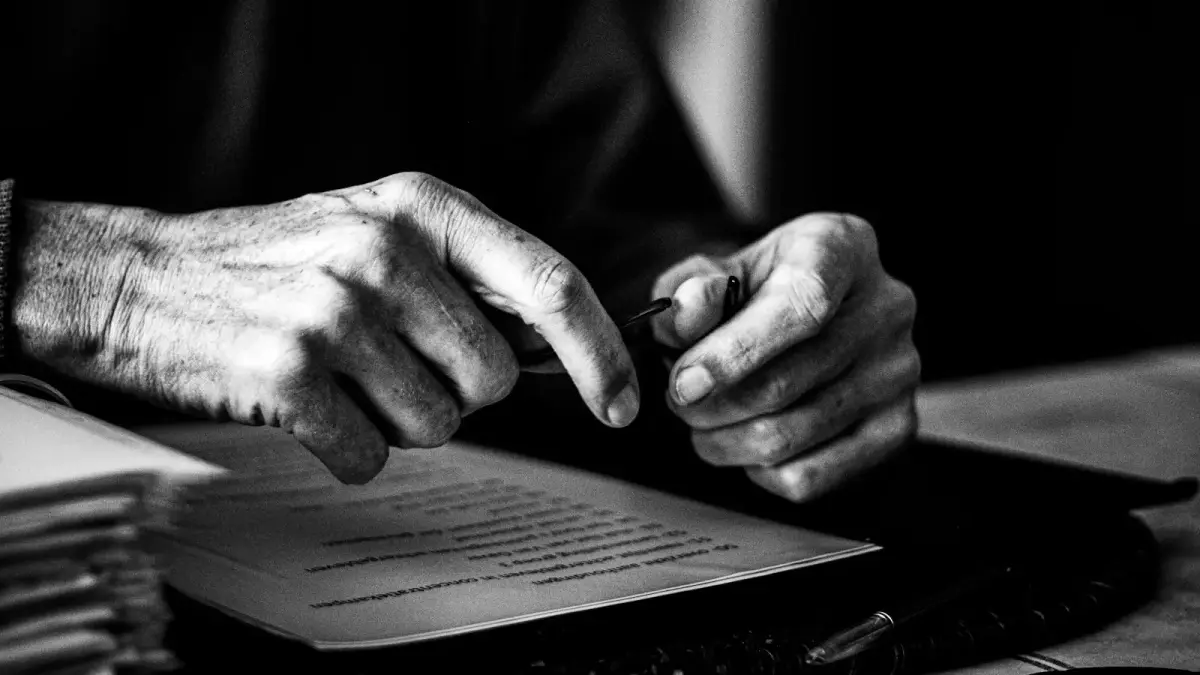
I was standing in my mother’s kitchen last Thanksgiving when I noticed it. A small piece of paper torn from a yellow legal pad, sitting next to the stove. Her grocery list. Written in that careful cursive I’d known my whole life - the same handwriting that had labeled my lunch bags in elementary school, that had signed permission slips, that had filled out every birthday card I’d ever received from her.
Turkey breast. Fresh sage. The good butter.
Three items she could have typed into her phone in four seconds. Instead, she’d sat down at the kitchen table that morning with her reading glasses and a ballpoint pen and written each word like it mattered.
My brother walked in, glanced at the list, and said what I was thinking. “Mom, you know your phone has a notes app, right?”
She looked at him the way she always does when one of us says something that misses the point entirely. She didn’t argue. She just picked up the list and put it in her coat pocket.
I’ve been thinking about that moment for months. Not because it was dramatic, but because I suddenly understood something about her generation that I’d been misreading for years. And I think a lot of us have been misreading it.
What We Get Wrong About the Pen
There’s a lazy narrative floating around about older adults who still handwrite things. It goes something like this: they’re behind. They haven’t caught up. They’re clinging to the way things used to be because change is hard and screens are confusing.
It’s a story that makes younger people feel generous. We offer to set up their apps. We buy them tablets for Christmas. We say things like “it’s so easy once you get used to it” as though the problem is ability and not preference.
But here’s what that narrative ignores completely.
Most people over sixty know how to use a phone. They text. They scroll. They google things at 11 p.m. just like the rest of us. The idea that they handwrite grocery lists because they can’t figure out technology is, frankly, insulting.
They handwrite because something in them remembers that writing by hand is not the same thing as typing. And psychology agrees with them.
A 2021 study published in Frontiers in Psychology found that handwriting activates neural connectivity patterns in the brain that typing simply does not. The researchers, using high-density EEG, observed that the act of forming letters by hand engages regions associated with memory, learning, and emotional processing in ways that keyboard input fails to replicate.
In other words, when your mother writes “sage” on her grocery list, her brain is doing something fundamentally different than when you thumb it into an app. She’s not being slow. She’s being thorough in a way most of us have forgotten how to be.
Penmanship Was Never Just About Letters
If you went to school before the mid-1980s, you had a penmanship class. Not a typing class. A penmanship class.
You sat at a desk and you practiced forming letters. Over and over. The teacher walked between the rows and looked at your work. She corrected your slant. She told you to slow down. She said things like “take your time” and “let each letter breathe.”
Think about what that actually taught you.
Not just how to write legibly - but that the act of putting words on paper deserved patience. That a thank-you note was not just information transfer. That the time you spent forming each letter was itself part of the message.
This was a generation trained to believe that how you said something mattered as much as what you said. That care was visible. That effort was a form of respect.
When your father sits down to write a birthday card to his granddaughter and takes ten minutes to get the words right, he’s not struggling with what to say. He’s honoring a practice he was taught at seven years old - that certain things deserve the weight of your own hand.
That’s not nostalgia. That’s a value system. And it’s one that nobody bothered to name before it started disappearing.
The Quiet Rebellion of Slowness
Here’s where this gets interesting from a psychological perspective.
We live in a culture that has turned speed into a moral quality. Fast replies mean you care. Quick responses mean you’re engaged. If you don’t text back within an hour, something must be wrong.
But a 2014 study published in Psychological Science by Mueller and Oppenheimer found that students who took notes by hand retained information significantly better than those who typed. Not because handwriting is magical, but because it’s slower. The slowness forces processing. You can’t transcribe everything, so your brain has to decide what matters. You have to think while you write.
The people who still handwrite everything important are doing something that the entire wellness industry is trying to sell back to us. They’re being present. They’re engaging with the moment at the speed of thought rather than the speed of technology.
And nobody told them that’s what they were doing.
Nobody said, “You know that thing where you sit at the table with a pen and write out your grocery list? That’s a mindfulness practice.” Nobody gave them credit for something they’ve been doing for sixty years without a meditation app or a breathwork subscription.
They just kept writing. Because it felt right. Because something in their body remembered that the pen was not just a tool but a kind of conversation between the hand and the mind.
The Name of the Book Someone Mentioned at Dinner
I want to stay with a specific image for a moment. Someone mentions a book at dinner. Your mother - or your aunt, or your neighbor, or you - pulls a small notebook from her purse and writes down the title.
She doesn’t ask someone to text it to her. She doesn’t say “I’ll look it up later.” She opens the notebook, finds a clean line, and writes the title in her own handwriting.
Why does this matter?
Because it means she took the recommendation seriously enough to physically record it. The act of writing it down was her way of saying, “I heard you. What you said was worth remembering. I’m going to carry it with me.”
Research on embodied cognition - a field explored extensively by psychologist Lawrence Barsalou - suggests that physical actions like writing create stronger memory traces than passive input. When you write something by hand, your body participates in the remembering. The memory lives not just in your mind but in the motion of your fingers, the pressure of the pen, the visual image of your own handwriting on the page.
The people who still write things down by hand are not doing it out of habit. They’re doing it because their bodies know something that our phones have made us forget. That remembering is not just a mental act. It’s a physical one.
What the Pen Holds
I’ve watched my mother write thank-you notes after every holiday for as long as I can remember. She sits at the dining room table with a box of cards and her good pen - the one with the blue ink that she’s used for at least fifteen years. She writes slowly. She pauses between sentences. Sometimes she crosses something out and starts over on a new card because she wants to get it right.
My sister once asked her why she doesn’t just send a group text. “It’s faster,” my sister said. “Everyone does it.”
My mother looked at her and said, “That’s exactly why I don’t.”
And there it is. The quiet, unspoken philosophy of an entire generation condensed into seven words.
The thank-you note written by hand is not efficient. It’s not scalable. It doesn’t sync across devices. But it carries something that no digital message can replicate - the unmistakable evidence that someone sat down, thought about you specifically, and gave you their time.
Time is the thing we protect most fiercely. The handwritten note is proof that someone spent theirs on you. That’s not old-fashioned. That’s the most generous thing a person can do.
The Person Underneath the Rushing
Here’s what I think is really happening when someone in their sixties picks up a pen instead of a phone.
They’re not refusing to evolve. They’re refusing to let go of a version of themselves that the world has been trying to speed past for thirty years.
Think about what the last three decades have demanded of this generation. Learn email. Learn texting. Learn smartphones. Learn apps. Learn social media. Learn video calls. Learn cloud storage. Every few years, a new system. Every few years, the message: keep up or get left behind.
And most of them did keep up. They adapted. They learned. They bought the phones and downloaded the apps and figured out how to send photos to their grandchildren.
But somewhere in the middle of all that adapting, they held onto the pen. Not because they couldn’t let go, but because the pen was the last place where the original version of themselves still lived. The version that was taught to slow down. The version that believed care was worth the extra time. The version that formed each letter with intention because a teacher once told them it mattered.
The pen on paper at sixty-one is not a relic. It’s a declaration. It says: I know how to do this faster. I’m choosing not to. Because speed was never the point.
You Were Already Doing the Hard Part
If you’re reading this and you’re someone who still writes things by hand - grocery lists, birthday cards, directions, the name of a restaurant someone recommended - I want you to know something.
You were never behind.
You were doing something that entire industries are now trying to teach people how to do. Being present. Engaging physically with the moment. Giving your attention to one thing at a time. Letting the pace of your hand set the pace of your thoughts.
You didn’t need an app for it. You didn’t need a course. You didn’t need someone to explain the neuroscience of embodied cognition or the psychological benefits of slow, deliberate action.
You just picked up a pen. Because that’s what felt true.
And the beautiful part - the part that nobody says out loud - is that every time you write something by hand, you’re keeping alive a form of human connection that can’t be replicated digitally. The curve of your handwriting is yours alone. No one else in the world makes their letters exactly the way you do. Every note you write carries your fingerprint in it - not metaphorically, but literally in the pressure and angle and rhythm of your hand.
That grocery list on the counter is not just a list. It’s evidence that you’re still here. Still unhurried. Still willing to do something the slow way because the slow way was always the more honest way.
The pen was never the thing holding you back. It was the thing holding you together.