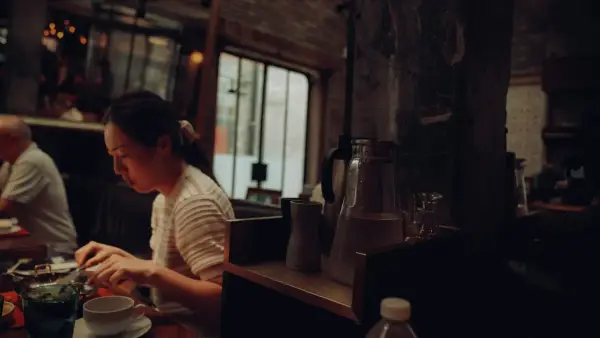
Psychology says people who slip out of a dinner party twenty minutes before they said they would aren't being rude and they aren't being antisocial, they learned somewhere in childhood that the quickest way to protect what they loved about a room was to leave before the magic wore thin, and the small rehearsed exit they mastered at the family dinner table at seven is the same one they are still quietly performing at fifty-six
I have a particular memory of standing in a hallway at a dinner party when I was thirty-two, holding my coat, watching my friends through the doorway as they reached for second helpings of the pavlova. The room was glowing. The candles had burned down to the pretty part, the part right before they start to gutter and smoke.
I wanted to stay. I also knew, with a certainty I couldn’t have explained to anyone, that if I stayed another forty minutes I would be tired and slightly resentful and I would start to find the loudest person in the room irritating in a way I’d regret by morning.
So I hugged the host at the door, told her it had been wonderful, and left twenty minutes earlier than I’d promised. I walked home under streetlights feeling a strange, quiet tenderness for the evening, the kind you only feel when you catch something at its best. I have done this my whole life, and for most of it, I thought it was a failure of stamina. I am starting to think it might be one of the most loving things I know how to do.
The rehearsed exit
If you do this too, you probably have a routine for it. A small choreography you’ve refined across decades without ever naming it.
You start scanning around the time the second bottle gets opened. You notice who is getting louder and who is getting quieter. You clock your own body, the little drop in your ribs, the way sound begins to blur into a kind of hum instead of distinct voices.
Then you begin the exit fifteen minutes before you leave. A trip to help in the kitchen. A casual mention of an early morning. The coat moved to a more accessible spot, not because you’re planning to flee, but because you’ve learned that waiting until the last minute makes the goodbye harder for everyone.
By the time you actually say the words, you have already left three times in your head. The exit itself is almost a formality, a ritual performed with the warm practiced smile of a person who has done this a thousand times. People often tell you that you have a lovely way of leaving. They don’t know it took you thirty years to learn it.
How you came to know the shape of a room
Nobody teaches you this timing. You acquire it, usually in a specific kind of house, where the evening had a ceiling you learned to watch for.
Maybe it was a family dinner that started beautifully and ended with raised voices once a certain glass had been emptied. Maybe it was a holiday that was reliably wonderful until an aunt made her comment, or an uncle brought up the thing nobody was supposed to bring up. Maybe nothing dramatic happened at all, and you just had a mother who got brittle and tired after a certain hour and a father who kept pressing for one more drink, one more story, one more.
Children in those homes become experts in the arc of a room. You learn when the peak is, because the peak is when you need to start bracing. You learn to love the good part with a kind of anticipatory grief, because you know it won’t last, and you learn, eventually, that if you could somehow freeze the evening at the peak, you would.
You can’t freeze it. But you can leave. And some of us, without ever putting it into words, figured out that leaving was the closest thing to freezing we had.
The peak-end rule and what your body already knew
Decades after you developed this instinct, a psychologist named Daniel Kahneman was writing about something he called the peak-end rule. His research, which won him a Nobel Prize and is summarized beautifully in his book Thinking, Fast and Slow, suggested that when we remember an experience we don’t average it out evenly.
We remember the peak. And we remember the end. The middle kind of blurs.
Which means, in a slightly stunning way, that how an experience ends gets to rewrite how we felt about the whole thing. A wonderful evening that deteriorates into exhausted small talk gets filed in memory as a tiring evening. A wonderful evening that ends at the peak, while the candles are still pretty, gets filed as magic.
You, leaving twenty minutes early, have been doing applied Kahneman since you were small. You have been editing the memory in real time, protecting the shape of the evening, not because you don’t love these people but because you do. You want to remember them at their best, and you want them to remember you that way too.
Why introverts feel the peak first
There’s another layer to this, and it’s biological. A 2008 paper in the Journal of Personality and Social Psychology, building on the earlier work of psychologists like Hans Eysenck, explored how introverts and extroverts have different baseline levels of cortical arousal. Introverts, in simple terms, arrive at a social event already fairly stimulated. They don’t need much input to feel plenty.
This is why an hour into a dinner party, while the extroverts in the room are just warming up, you can feel yourself starting to cool. Your system has reached a pleasant saturation. Another hour will not make the evening more. It will just begin to tip it from delight into depletion.
Susan Cain, in her book Quiet, writes tenderly about this exact phenomenon, how introverts often feel most themselves not when they are alone, but at a specific point inside a good gathering, a point that has a beginning and a middle and, crucially, an end. We feel the end coming before anyone else does. We feel it in the way the lights seem to get slightly too bright, or in the way our own voice begins to sound to us from a small distance away.
That isn’t a malfunction. That is a finely tuned instrument telling you something true.
The afterglow you were trying to keep
There’s a smaller body of research, mostly emerging in the last decade, on something social psychologists sometimes call the afterglow effect of meaningful interaction. A 2021 study in the journal Emotion found that the positive feelings from a genuinely connected social evening can persist for days, but only if the evening is remembered as positive.
Which brings us back to the hallway, the coat, the twenty minutes early.
You were not leaving the party. You were leaving with the party, carrying it home with you, the way you might cup a small flame against the wind. You knew, without needing the research, that if you stayed until the bitter drifting end, you would lose the glow. You would trade three days of warmth for forty more minutes of diminishing conversation.
Nobody ever explained this trade to you. You made it anyway, again and again, for years.
The quiet grief of being misunderstood
Of course, not everyone sees it this way. Hosts, especially extroverted ones, can feel a small sting when someone leaves a bit early. They may joke about it. They may, gently, make you the example: oh, Julia always leaves first.
It lands harder than people realize. Because you are not leaving first to escape them. You are leaving first to keep them.
I have lost small amounts of sleep over hosts who seemed hurt by my early exit, turning over in my mind whether I should have pushed through the fatigue, whether leaving was selfish, whether being tired was a character flaw. It took me a long time to understand that forcing myself to stay until I was unpleasant would not have been a gift to anyone. It would have been a performance of politeness that cost me the thing I was there for.
The people who love you, really love you, eventually come to understand this. They learn that when you stay, you are fully there, and when you leave, it means you are honoring both of you. Some of them start to envy your timing. Some of them, much later, start to copy it.
Permission to leave well
If you have been reading this and feeling a slow loosening in your chest, I want you to hear something clearly.
You are allowed to leave the party twenty minutes before you said you would. You are allowed to leave while the candles are still pretty. You are allowed to carry the evening home with you, unspoiled, and to let that warmth last you through Tuesday.
You are not antisocial. You are a person who learned, very young, that love sometimes looks like knowing when to stop. That some of the most tender things we do for the people we care about are the things we do quietly, with our coats, at the door, while nobody is watching.
The small rehearsed exit you have been performing since you were seven is not a flaw in your social wiring. It is a piece of wisdom your nervous system has been carrying on your behalf for most of your life, waiting patiently for you to notice.
So the next time you slip out of a room a little earlier than you said, and you feel that old pang of having done something slightly wrong, I hope you will pause on the walk home and look up at the streetlights. The evening is still warm in your pocket. The people you love are still laughing inside, a little softer now, and they will remember you at your best, because you chose to leave while you were still there.
That is not rudeness. That is a very old kind of tenderness, finally recognizing itself.