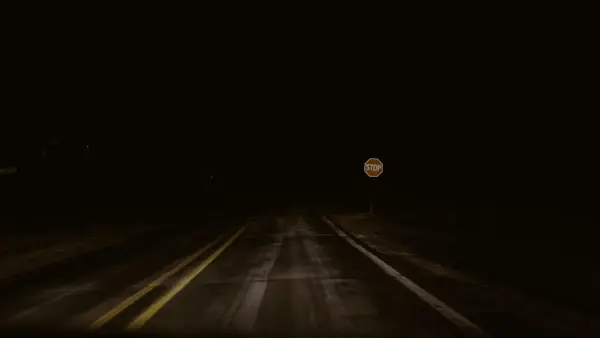
Psychology says the person who always texts 'let me know you got home safe' - who cannot go to sleep until the reply arrives, who lies in the dark watching the phone until the words 'I'm home' appear on the screen - is not controlling or overly attached, they are someone whose nervous system learned long before they had words for it that the people you love can leave a room and simply never come back

I used to set my phone on the pillow next to me like it was another person in the bed.
Not because I was waiting for anything exciting. Not because I was doom-scrolling or hoping someone interesting would text. I was waiting for three words. “I’m home safe.” And until those words appeared on my screen, my body would not let me sleep.
My chest would stay tight. My breathing would stay shallow. I would calculate the drive time in my head - twenty-two minutes, maybe twenty-five with the lights on Fourth Street - and when minute twenty-six arrived without a notification, something ancient and wordless would start climbing up the back of my neck.
I have been this person my entire adult life. The one who sends that text before anyone has even put their coat on. The one who watches the clock. The one whose whole body exhales when the phone finally buzzes and the message says nothing more than “home.”
For years, I thought something was wrong with me. Other people seemed to say goodbye and then just - move on with their evening. I couldn’t understand how they did that. How they let someone walk out the door and into the dark without tracking their safe arrival like it was the only thing that mattered.
It turns out, there is a reason some of us can’t let go of that thread. And it has nothing to do with being controlling.
The space between goodbye and proof of arrival
For most people, the gap between someone leaving and someone arriving is just time. Neutral, unremarkable time. You say goodnight, they drive away, you brush your teeth and go to bed.
But for some of us, that gap is not neutral at all.
It is the most electrically charged stretch of time there is. It is the space where anything can happen. Where the car can hit a patch of ice, where the phone can ring with a voice that isn’t theirs, where the world can change shape between one breath and the next.
This is not catastrophizing. This is not irrational anxiety spinning stories out of nothing.
This is a nervous system that learned - early, deeply, in the body before the mind had any say - that departures are not always followed by returns. That sometimes people leave a room, or a house, or your life, and the next update you get is not “I’m home” but something you will never fully recover from.
A 2017 study published in the journal Psychoneuroendocrinology found that individuals with early experiences of unpredictable loss or separation show heightened cortisol reactivity during periods of uncertainty about a loved one’s safety. Their stress response doesn’t wait for evidence of danger. It activates the moment certainty disappears.
The body doesn’t need a reason. It just needs a gap.
Where this learning begins
You don’t choose to become this person. You get shaped into it.
Maybe you had a parent who left for work and didn’t come home at the expected time, and nobody explained why. Maybe you experienced a loss that arrived without warning - a phone call, a knock on the door, a sudden absence where a person used to be.
Maybe nothing dramatic happened at all. Maybe you just grew up in a household where people came and went unpredictably, where routines shifted without notice, where the simple act of someone walking out the front door carried an unspoken question mark.
Developmental psychologist John Bowlby described this as a disruption in what he called the “secure base.” When a child learns that their attachment figures are reliably present - that they leave and come back, leave and come back, in a predictable rhythm - the child’s nervous system settles into a baseline of trust. Departures become manageable because returns are expected.
But when that rhythm is broken - through loss, through instability, through even well-meaning but emotionally unavailable caregiving - the nervous system never fully learns to trust the return.
And so it watches. It waits. It counts the minutes.
Not because it wants to. Because it was trained to.
What it actually feels like from the inside
Here is what people don’t understand about the “text me when you get home” person.
From the outside, it looks like control. It looks like clinginess, like you can’t give someone space, like you need constant reassurance because you don’t trust them.
From the inside, it feels like survival.
It feels like holding your breath underwater and waiting for permission to surface. The permission is the text. The three words. The proof that the person you love still exists in the world, still occupies a body, still made it through the gap.
There is a very specific physical experience that happens when the text finally arrives. You might not even notice it anymore because it has become so routine. But if you pay attention, you will feel it. A release in the chest. A softening behind the eyes. The shoulders dropping half an inch. The jaw unclenching.
Your whole body was braced for impact. And the text - that tiny, mundane, three-word text - tells your nervous system that the impact is not coming. Not tonight.
Research from the University of Virginia, published in Social Cognitive and Affective Neuroscience in 2013, demonstrated that the brain processes threats to loved ones in the same neural regions it uses to process threats to the self. When someone you love is in an uncertain situation, your brain does not distinguish between their danger and yours.
You are not overreacting. Your brain literally cannot tell the difference between their safety and your own.
The criticism that always misses the point
If you are this person, you have almost certainly heard some version of the following:
“You need to relax.” “I’m a grown adult, I don’t need to check in.” “You’re being a little much.” “Why can’t you just trust me?”
And every time you hear it, something inside you folds in on itself. Because you know they’re right, in a way. You know that rationally, logically, the odds of something terrible happening on a twenty-minute drive are vanishingly small.
But your nervous system does not operate on logic. It operates on pattern recognition. And the pattern it learned - the one etched into your body before you could spell your own name - is that the space between goodbye and confirmation is where the worst things in your life have happened.
The criticism stings because it frames your love as a burden. It takes the most vigilant, devoted, attentive part of you and calls it a problem. It asks you to stop caring so visibly, to tuck your worry away where it doesn’t inconvenience anyone.
And so many of us learn to do exactly that. We learn to not send the text. To not ask. To lie in the dark with our chest tight and our phone face-down, pretending we’re fine, pretending we’re the kind of person who can just let people disappear into the night without needing to know they made it through.
We perform relaxation while our nervous system screams.
Love that learned to be vigilant
Here is what I want you to understand if you recognize yourself in any of this.
You are not broken. You are not too much. You are not controlling.
You are someone whose love learned very early that it needed to be vigilant. That love without vigilance was love that could be blindsided. That the price of relaxing your attention - even for a moment, even for twenty-two minutes - might be a loss you could never undo.
Psychologist Ed Tronick’s research on emotional attunement suggests that our earliest relational experiences create what he calls “implicit relational knowing” - a body-level understanding of how relationships work that operates beneath conscious awareness. You don’t decide to track your partner’s drive home. Your body decides for you, based on everything it learned before you had language.
This is not a flaw in your wiring. This is your wiring doing exactly what it was designed to do - protect you from the kind of loss that shaped it.
The work, if you choose to do it, is not about eliminating the impulse. It is about understanding where it comes from. It is about separating the past from the present - recognizing that the danger your body remembers is real, but it is not necessarily happening right now, in this car, on this drive, with this person.
The tenderness hiding inside the vigilance
There is something nobody talks about when they talk about anxious attachment and hypervigilance and nervous system regulation.
They forget to mention that underneath all of it - underneath the watching and the waiting and the breath-holding and the clock-counting - is one of the purest forms of love a person can offer.
The “text me when you get home” person is not asking for control. They are asking for evidence that the world has not taken another person from them. They are asking for permission to exhale. They are asking, in the simplest possible language, for the one thing their childhood could not reliably give them.
Proof that leaving is not the same as losing.
If you are the person who sends that text, I want you to know that your love is not a burden. It is not clingy or suffocating or too much. It is a love that learned the hard way that people are not permanent, that presence is not guaranteed, that the distance between a front door and a driveway can contain an entire universe of possibility.
And rather than harden against that knowledge, rather than shut down and stop caring, you chose - your body chose, before you even knew it was choosing - to keep watch.
To stay awake in the dark.
To wait for the words.
That is not anxiety. That is devotion shaped by loss. And it deserves to be met not with irritation, but with the only response that has ever actually calmed a nervous system built on uncertainty.
“I’m home. I’m safe. I’m not going anywhere.”