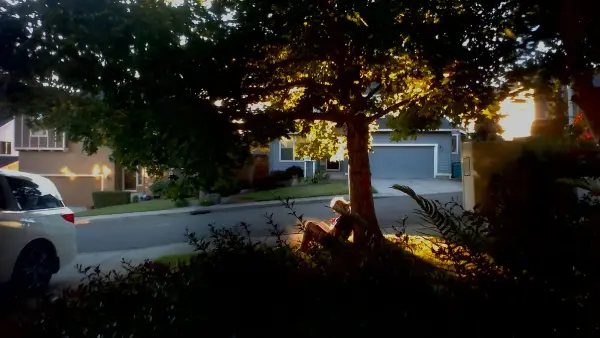
She is 63 and just realized that the hour between her husband going to bed and when she finally turns off the lights is the only hour of the day that belongs entirely to her - not because she doesn't love him but because a girl who shared a bedroom with two sisters and a bathroom with four people and a kitchen table where someone was always needing something learned that the only time she could hear her own thoughts was when everyone else had stopped asking her to listen to theirs, and the woman sitting alone on a couch at eleven-thirty at night is not an insomniac but someone who has been waiting all day for the quiet
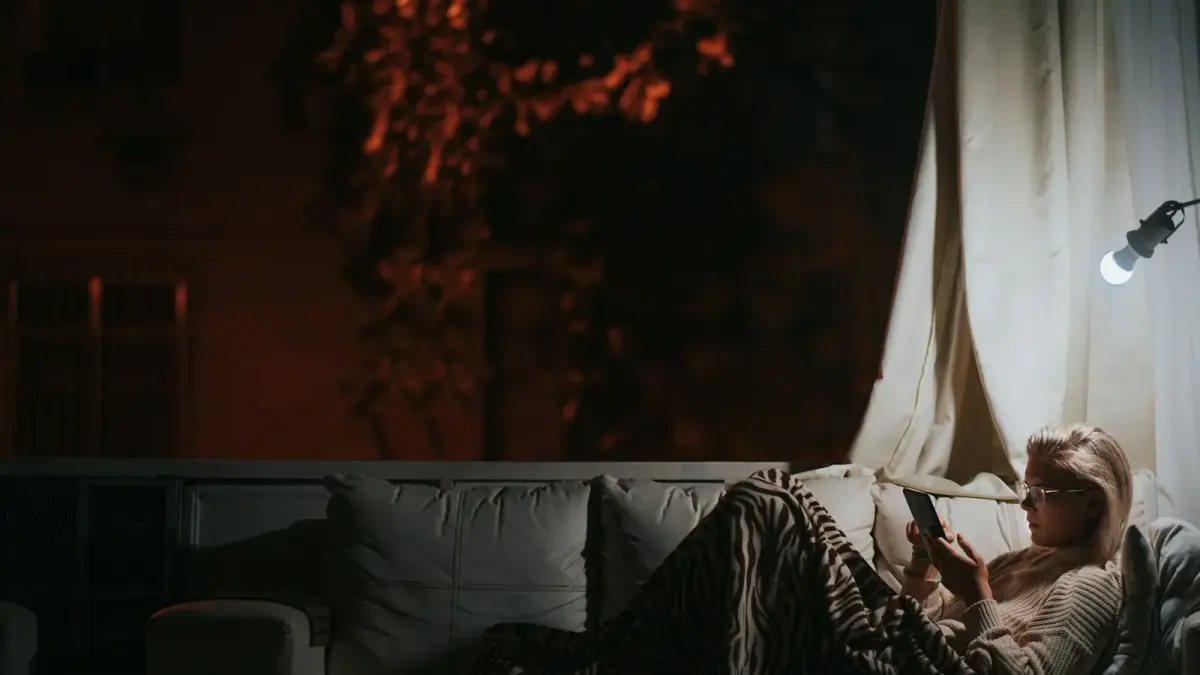
It is 11:47 on a Tuesday night, and I am sitting on my couch with a cup of tea that went cold twenty minutes ago and a television that’s been muted since my husband kissed the top of my head and said goodnight at ten-fifteen.
I’m not watching anything. I’m not reading anything. I am not doing anything that would look, from the outside, like it was worth staying awake for.
But this hour - this specific hour, between his footsteps on the stairs and the moment I finally convince myself to follow - is the best hour of my day. It has been the best hour of my day for longer than I want to admit. And until last month, I had never asked myself why.
The girl in the shared room
I grew up in a three-bedroom house with six people in it. My parents had one room. My brother had the smallest one, barely bigger than a closet, because he was the only boy and that apparently earned you a door that closed. And I shared the remaining room with my two sisters - Debbie on the top bunk, me on the bottom, Carol on a twin bed pushed against the opposite wall.
Privacy was not a concept in that house. It was not even a word anyone used. You brushed your teeth while someone else was in the shower. You changed clothes while facing the wall. You did your homework at a kitchen table where three other people were also doing homework, or making dinner, or arguing about whose turn it was to dry the dishes.
I loved my family. I need to say that clearly because what comes next might sound like a complaint, and it isn’t. It is an observation about what a crowded house teaches a quiet girl.
What it taught me was this: the only time that belongs to you is the time nobody else wants.
The economics of silence
A 2020 study in the Journal of Research in Personality found that adults who grew up in high-density households - defined as more than two people per bedroom - were significantly more likely to develop what the researchers called “solitude-seeking behaviors” in adulthood. Not isolation. Not withdrawal. But a persistent, almost physical need for periods of time in which no one is watching, no one is talking, and no one is waiting for a response.
The study found that this need was unrelated to introversion in the clinical sense. Many of the participants described themselves as social, warm, and comfortable in groups. What they shared was not a discomfort with people but a hunger for emptiness. For air. For a room with no claims on it.
I read that study and felt something shift in my chest. Because I have spent forty years thinking there was something wrong with the way I need to be alone. That a woman who loves her husband and adores her children and genuinely enjoys her friends should not feel the quiet relief I feel when the last voice in the house goes silent.
What the hour contains
I should describe what I actually do during this hour, because the truth of it is almost embarrassingly small.
I sit. Sometimes I pick up a book and read a page or two, but mostly I just hold it. Sometimes I look at my phone, but not in the way I look at it during the day - not scanning, not responding, not keeping up. I look at it the way you look out a window. Unfocused. Unaccountable.
Sometimes I walk to the kitchen and stand there. Not to eat or drink or clean. Just to stand in a room where no one is going to walk in and ask me something. Not a question about dinner or weekend plans or whether I remembered to call the plumber. Just a room that is, for thirty seconds, completely mine.
Susan Cain wrote in Quiet that the need for solitude is not the opposite of love. It is what makes sustained love possible. The introvert who retreats is not fleeing connection but restocking the internal resources that connection requires.
That sentence saved something in me. Because the guilt of this hour is real. I have looked at my husband sleeping upstairs - this kind, patient man who has never once begrudged me a single thing - and felt like a woman with a secret. Not an affair. Something almost harder to confess: that the hour when he is asleep and I am alone is the hour when I feel most like myself.
The bathroom door
When I was twelve, I started locking the bathroom door even when I wasn’t using the bathroom. I would sit on the edge of the tub and just breathe. Three minutes. Five. However long it took before someone knocked and said they needed to get in.
I didn’t know what I was doing then. I called it hiding, and I was a little ashamed of it. A girl who needs to hide in her own house must be broken in some way. That was the logic.
But I wasn’t hiding from danger. I was hiding from presence. From the constant, low-frequency hum of other people’s needs radiating through the walls. My mother calling from the kitchen. My sister asking about a borrowed sweater. My father turning on the television at a volume that filled every room. None of it was hostile. All of it was weight.
A 2018 study in Psychological Science found that what they called “stimulus saturation” in childhood - environments with chronic noise, overlapping conversations, and limited physical space for solitary activity - was a strong predictor of adult sensory-processing sensitivity. The children didn’t develop anxiety. They developed a finely tuned internal meter for how much input they could absorb before something in them needed to go quiet.
I still have that meter. It still works. And it still tells me, every night around ten o’clock, that the day has been enough, and what I need now is nothing.
The women who understand
I mentioned this to a friend last year - carefully, the way you mention something you’re not sure anyone else will recognize. I said I sometimes stay up after everyone’s asleep just to sit in the quiet.
Her eyes changed. Not with sympathy. With recognition.
“I do that too,” she said. “I’ve done it since the kids were small. I told myself it was because I was a night owl. But the truth is I could go to sleep at nine. I just don’t want to. That hour is mine.”
She said the word mine the way some people say the word home. Like she had finally arrived somewhere after a very long commute.
I have since learned that there are a lot of us. Women in their fifties and sixties who stay up not because of insomnia or anxiety or habit but because somewhere between childhood and now, we learned that the price of being needed all day is an hour of needing nothing at night.
We are not lonely. We are not unhappy. We are not pulling away from the people we love. We are pulling toward something that doesn’t have a name because it isn’t a thing. It’s an absence. An absence of claim. An absence of requirement. A space that exists only because everyone else has temporarily stopped filling it.
The confession I didn’t know I was making
I told my husband last month. Not in a serious sit-down conversation. Just over breakfast, casually, the way you say something you’ve been carrying for years and pretend it just occurred to you.
“I think I stay up after you go to bed because it’s the only time I feel like I’m not on anyone’s clock,” I said.
He looked at me for a moment. Not hurt. Not confused. Just quiet in the way that means he’s actually thinking about what I said instead of reacting to it.
“I know,” he said. “I’ve always known that.”
“And you’re not bothered?”
“Why would I be bothered that you need time to be yourself?”
I didn’t cry. But I pressed my lips together in the way that means I’m deciding not to. Because that question - why would I be bothered that you need time to be yourself - was the exact opposite of everything that house taught me. That house taught me that needing space was the same as needing distance. That wanting to be alone was the same as not wanting to be with someone.
It isn’t. It was never that. The girl on the bottom bunk who used to wait for her sisters’ breathing to change before she let her own thoughts come - she wasn’t rejecting anyone. She was waiting for the only appointment she ever made with herself.
And the woman on the couch at eleven-thirty, with her cold tea and her muted television, is still keeping that appointment. Not because the day was bad. Not because the marriage is lacking. Not because something is wrong.
Because something, finally, is quiet. And she has been waiting all day for it.