She's 52 and last Tuesday she sat alone in a restaurant for the first time without a book, a phone, or a reason to be there, and the forty-five minutes she spent doing nothing but watching the room move around her was the first time she understood that solitude was not the absence of company but the presence of someone she had been avoiding for thirty years
She walked in at 2:15 on a Tuesday and asked for a table for one.
That part wasn’t new. She’d eaten alone before - plenty of times. Work lunches between meetings.
A quick sandwich at the airport gate with her laptop propped against a water bottle. A birthday dinner she told everyone she preferred to spend solo, which was half true and half the fact that organizing people felt like more effort than the celebration was worth.
But there had always been something with her. A novel propped against the salt shaker. Her phone angled just right, scrolling something she’d forget in minutes.
A crossword folded into quarters. There was always a prop, always a small performance that told the room: I’m not just sitting here. I have a reason. I belong.
Last Tuesday, she brought nothing.
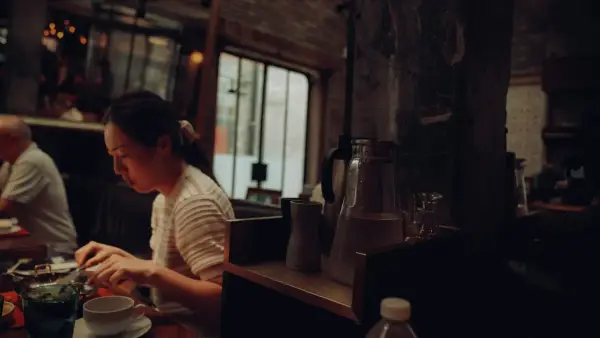
She sat down at the two-top by the window, ordered a coffee, and placed her hands flat on the table. No screen. No pages. No purpose.
Just her, a white tablecloth, and the low hum of a restaurant in the dead hour between lunch and dinner.
She is fifty-two years old. And for the first time in her adult life, she sat in public with absolutely nothing between herself and her own company.
The First Ten Minutes Were Almost Unbearable
Her hands didn’t know where to go. She folded them, unfolded them, touched the rim of her cup, moved the sugar caddy an inch to the left and then back again. She looked toward the door three times.
She almost reached for her bag to check a phone that wasn’t there - a phantom limb of distraction, her fingers curling around empty air.
The discomfort wasn’t social. Nobody was staring. The waiter didn’t seem to care.
The couple two tables over hadn’t glanced in her direction once.
The discomfort was entirely internal. A quiet alarm going off somewhere in her chest that kept asking the same question: what are you doing here?
Not here in this restaurant. Here in this moment. Without a task.
Without a role. Without something to justify the space you’re taking up.
She told me later that those first ten minutes felt like sitting in a waiting room for an appointment she hadn’t made. Like she owed the room an explanation for being a woman alone at a table with nothing to do. Not trespassing against the restaurant’s rules - against her own.
A 2020 study published in the Journal of Personality and Social Psychology found that people who struggle with unstructured solitude - time alone without a task or clear goal - don’t actually dislike being alone. They dislike the absence of a functional identity. When there’s no role to perform, no problem to solve, no person to attend to, they lose access to the version of themselves they’ve practiced being for decades.
And that loss feels, briefly, like disappearing.
She wasn’t afraid of being alone. She was afraid of who she’d find when she stopped performing.
Thirty Years of Earning the Right to Sit Still
She raised three children. She managed a household that ran on her attention to detail and her willingness to be interrupted at any hour of the day or night. She spent her twenties becoming someone’s wife, her thirties becoming someone’s mother, her forties becoming the person everyone at work called when the real problem needed handling.
None of that was wrong. She loved most of it.
But somewhere inside those decades, a quiet exchange took place that she never consciously agreed to. She traded her relationship with herself for a relationship with her usefulness.
Being needed became her resting state. If no one was asking for something, she’d find something to give anyway - reorganize a closet, send the check-in text, anticipate the problem before it arrived.
Stillness felt like negligence. Sitting without doing felt like abandoning her post.
Susan Cain, whose work on introversion and solitude reshaped how we understand the inner lives of quiet people, has written about this pattern with devastating precision. She describes a kind of woman - and it is almost always a woman - who has been so thoroughly trained to orient herself around the needs of others that she experiences her own unoccupied attention as a form of waste.
Not because she doesn’t value herself. But because no one ever modeled for her what it looks like to simply be, without producing something for someone else.
That was her for thirty years. She sat down only when there was a reason to sit.
A meeting. A meal to share. A child’s recital. A doctor’s waiting room.
The chair was never just a chair. It was a station.
Last Tuesday, for forty-five minutes, the chair was just a chair. And she was just a woman sitting in it.
What the Room Sounded Like When She Stopped
Around minute fifteen, something shifted.
I don’t want to oversell it. There was no beam of light from above, no cosmic insight delivered via the specials board. It was smaller than that and, honestly, more important.
She stopped scanning the room for a reason to be in it. And the room came into focus in a way it never had when she was busy being someone in it.
She noticed the light first. It was coming through the window at a low afternoon angle, turning the edge of the tablecloth gold. She noticed the sound of forks against plates from the kitchen - not urgent, just rhythmic, like a clock that kept a gentler kind of time.
She noticed a woman at the bar laughing into her phone. And instead of wondering who she was talking to or whether she looked like she was eavesdropping, she just heard the laugh.
Just the sound of it. Bright and careless and full.
She noticed her own hands on the table. The rings she’d worn for twenty-six years. The small scar on her left thumb from a kitchen accident when her youngest was three.
She looked at her hands the way you look at a photograph you forgot you’d taken - with recognition and a strange tenderness for the person in it.
Daniel Goleman’s work on emotional intelligence describes something he calls open awareness - a state where you’re not directing your focus at any particular target but allowing your attention to rest on whatever arises naturally. It’s the opposite of the hypervigilant, task-oriented scanning that most caregivers run on for years without realizing it.
For someone who has spent three decades in a state of perpetual readiness - ready to help, ready to fix, ready to be needed - open awareness feels, at first, like falling. Like letting go of the wheel on a highway.
But you don’t crash. You float. And floating, it turns out, is not the same thing as drowning.
The Difference Between Loneliness and Coming Home
People confuse these two things constantly, and the confusion costs them decades.
Loneliness is the ache of being surrounded by people and still feeling unseen. It’s the dinner party where you laugh at all the right moments and drive home feeling hollow. It’s being in a marriage where your partner is in the next room and might as well be on another continent.
Loneliness has nothing to do with being alone. Some of the loneliest years of her life were the years her house was fullest.
Solitude is something else entirely. Solitude is the experience of being alone and discovering that you are acceptable company.
Not dazzling company. Not the best version of yourself. Just the version that exists when nobody needs anything and nothing is on fire.
But here’s what nobody tells you: solitude is a capacity, not a default. You don’t just fall into it. You build it.
And most women of her generation were never given the raw materials.
A 2014 study published in Frontiers in Psychology examined what researchers called “the capacity for solitude” - a person’s ability to be alone without distress, distraction, or the compulsive need to fill the quiet. They found this capacity isn’t really about personality type or whether you score as an introvert on a quiz.
It’s about attachment security. People who trust that they are fundamentally okay - that they don’t need to earn their right to exist through usefulness or connection - can sit with themselves without panic. People who learned early that their value was conditional struggle with unstructured alone time well into their fifties and sixties.
She wasn’t avoiding solitude because she was extroverted or social or endlessly busy. She was avoiding it because solitude required something she had never been certain she possessed: the belief that she, by herself, doing nothing, for no one, was enough.
The Person She Had Been Avoiding
Here’s the part that surprised her most.
She expected, if she ever sat still long enough, that she’d feel sad. That the silence would fill with regret - roads not taken, chances missed, the version of herself she might have been if she’d been a little braver or a little less willing to accommodate everyone else first.
That’s what the culture tells women will happen when they slow down. You’ll confront your failures. You’ll mourn your youth.
That’s not what happened.
What happened was simpler and stranger. She just met herself.
Not the disappointed version. Not the grieving version. Just the quiet, curious, slightly tired person who had been there all along underneath the school pickups and the performance reviews and the holiday logistics and the decades of making sure everyone else in the room was comfortable before she thought about her own comfort.
The person sitting at that table liked watching strangers. She liked the weight of a ceramic cup in her hands. She liked the specific quality of a Tuesday afternoon when the world was working and she, for once, wasn’t.
She wasn’t sad. She wasn’t lonely. She wasn’t empty.
She was just there. And being there was enough.
She told me that the forty-five minutes she spent doing nothing felt like both ten minutes and a lifetime. She didn’t solve anything. She didn’t have a breakthrough.
She didn’t write a list of life changes on a napkin. She just sat with the strange, quiet experience of being a person with no task, no audience, and no function. And something inside her unclenched.
This wasn’t loneliness. This was meeting yourself. This was pulling out the chair across from the woman you’ve been too busy to sit with for thirty years and discovering that she’s been waiting - patiently, without complaint, the way she’s always waited - for you to finally show up.
The Table Is Still There
She went back on Thursday.
Same restaurant. Same time. Same table by the window.
She brought nothing again.
It was easier the second time. Not easy - she still felt the pull toward her phone, still caught her brain reaching for something to organize or solve. But the alarm in her chest was gone.
In its place was something she described as a low, steady warmth. Like sitting next to a fire you forgot you’d built.
She isn’t making this a project. She isn’t optimizing it or turning it into a routine with a name. She’s just sitting.
And if you’ve spent decades being available, being useful, being the person who holds things together so that everyone around you gets the luxury of not worrying - I want to tell you what she learned on a Tuesday afternoon with a cup of coffee and a tablecloth turning gold in the light.
You are not the roles you carry. You are not the tasks you complete. You are not only the person other people need you to be.
You are also the woman sitting at the table with nothing in her hands and nowhere to be. And she has been waiting a very long time for you to walk in, pull out the chair, and discover that she was worth the visit all along.