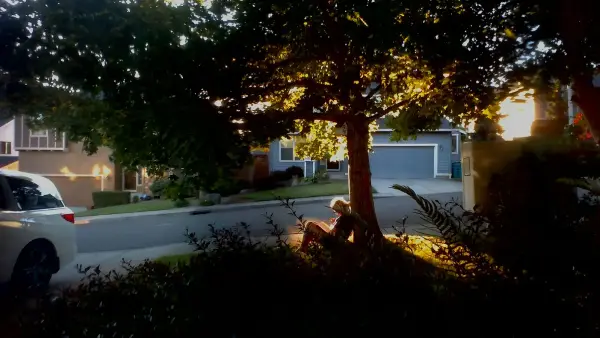
She is 53 and has just realized that every time she visits her mother in the care home she sits in the parking lot for exactly four minutes before going inside, not because she is composing herself but because a daughter who watched the woman who once organized the holidays and balanced the checkbook and remembered every teacher's name now struggle to remember which meal she just ate needs those four minutes to become the version of herself who can walk through the door and pretend that watching someone you love forget the life they built is something a person can do without rehearsing first
The parking lot
I did not notice I was doing it until the third visit in a row.
Engine off. Hands on the steering wheel. Phone face down on the passenger seat. Four minutes. Not five, not three - four, as if my body had measured the exact amount of time it takes to become the person who can walk through those double doors and smile.
My mother is in a care home on the east side of town, in a building that smells like lavender air freshener and something underneath the lavender that nobody mentions. She has been there for fourteen months. And every Tuesday and Saturday at ten in the morning, I pull into the third row of the parking lot, turn off the car, and sit.
I used to think I was gathering myself. Bracing for something hard. But it is not that. I am not dreading the visit. I am rehearsing it. Running through the version of my face that will not betray the distance between the woman she was and the woman she is becoming. Because if my expression slips - if for one second she sees the thing I carry in my chest every time she asks me what day it is - then the visit becomes about me, and it was never supposed to be about me.
The woman who raised me does not need my grief. She needs my face to look like everything is normal.
The woman she was
You have to understand who she was to understand what it costs to sit in that parking lot.
My mother ran a household the way some people run companies. She knew every teacher’s name at every school, every allergy, every friend’s parent’s phone number. She kept a calendar on the kitchen wall with handwriting so precise it looked printed, and every birthday, every dentist appointment, every school play rehearsal was written in blue ink, weeks ahead of time.
She balanced the checkbook on Sunday mornings. Not with a calculator at first - she did the math in her head, and she was never wrong. She knew which bills were due on which date. She knew the balance to the penny. She knew the price of every item in the grocery cart before the cashier finished scanning.
She organized the holidays with the precision of a general directing a campaign. Thanksgiving was not an event; it was a production with a timeline that started in October and required a binder she kept in the hall closet, labeled with a piece of masking tape that said HOLIDAYS in her steady hand.
I took all of this for granted. Every child does. You assume the house runs itself. You assume someone’s competence is permanent, the way you assume the walls will keep standing. You do not understand, until decades later, that what looked like organization was actually love expressed in the only form she knew - making sure nothing fell through, making sure nobody ever had to wonder what came next.
A 2019 study published in Psychological Science found that adult children of parents with cognitive decline consistently reported that their most painful realization was not the loss of memory itself but the loss of the specific competence that had defined the parent’s role in the family. The researchers described it as “identity grief” - mourning not a person but a version of a person that the disease has quietly removed.
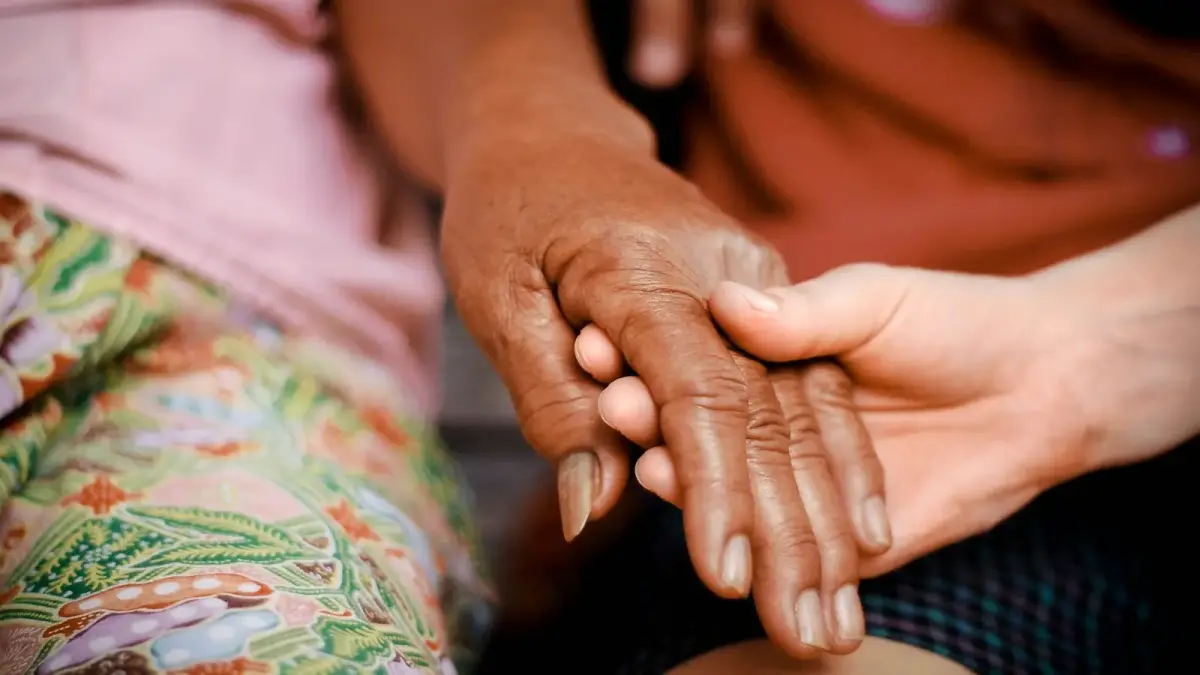
That is what I grieve in the parking lot. Not my mother. My mother is still here. She still laughs at the same jokes, still reaches for my hand when I sit beside her, still hums a song she cannot name but whose melody lives deeper than names can reach. What I grieve is the version of her who would have known, without being told, that today is Tuesday.
The reversal nobody warns you about
Here is the part nobody prepares you for. Not the grief. Not the logistics. Not the slow, bureaucratic cruelty of insurance forms and medication schedules and the conversations with doctors who speak about your mother as though she is a chart rather than a woman who once taught herself to reupholster furniture from a book she borrowed from the library.
The part nobody prepares you for is the moment you realize you have become the archive.
Every story she used to tell - the way she met my father, the apartment they had before I was born, the afternoon my brother fell out of the tree and she drove to the hospital with one shoe on - those stories now live only in me. She cannot retrieve them. She cannot correct my version. She cannot say “no, it was March, not April” the way she used to, with that gentle certainty that made you feel like every fact in the world had been filed somewhere behind her eyes.
I carry the checkbook balance now. Not literally - but I carry the knowledge of who she was, and I carry it alone, and the weight of it is nothing I was trained to hold.
Gabor Mate wrote about the invisible labor of caregiving - how the emotional cost is not measured in hours or tasks but in the constant, low-grade effort of holding someone else’s reality together while yours shifts underneath you. He was describing something I feel every Tuesday and Saturday at ten in the morning. The labor of walking through a door and being the daughter who remembers, for both of us.
The performance
Here is what the four minutes are for.
They are for smoothing my face. For adjusting the muscles around my eyes that want to tighten when she calls me by my sister’s name. For rehearsing the steadiness of my voice when she tells me about the nice woman who visited yesterday and I realize she is describing me.
A 2022 study published in Frontiers in Psychology found that family caregivers of individuals with dementia engaged in what the researchers termed “emotional surface acting” - the deliberate suppression of their own grief responses in order to maintain a calm, reassuring presence for the person they were caring for. The study found that this emotional suppression was strongly associated with caregiver burnout, not because the caregivers were fragile but because the effort of performing normalcy in the presence of ongoing loss is one of the most cognitively demanding forms of emotional labor a human being can sustain.
I could have told them that without the study.
Because the performance is not about pretending everything is fine. It is about becoming the person for whom everything is fine - entering a room as someone who does not flinch when her mother asks the same question three times in twenty minutes, who does not pause when the word “home” means a house that was sold two years ago, who can sit in a chair beside a woman she has known for fifty-three years and pretend that the distance between who her mother was and who she is now is something a daughter can cross without leaving part of herself on the other side.
The things I carry out
When I leave, I sit in the parking lot again.
Not for four minutes this time. Sometimes it is longer. Sometimes I just sit with the engine running and my hands in my lap, processing the hour I just spent holding up both ends of a conversation that used to hold itself.
I carry things out of that building that I cannot put down. The look on her face when she remembered, for one bright second, that I was pregnant with my daughter twenty-six years ago - and then the look that followed, the gentle fog rolling back in, the memory sinking beneath the surface like a coin dropped into deep water. I saw her reach for it. I saw her lose it. And I smiled, because that is what the four minutes in the parking lot trained me to do.
A 2021 study in the Journal of Personality and Social Psychology found that the grief experienced by family members of those with progressive memory loss does not follow the traditional stages of bereavement. Instead, it exists in a state the researchers called “chronic anticipatory grief” - a sustained, open-ended mourning for losses that are still occurring. There is no funeral. There is no moment of completion. There is only the slow, daily work of watching someone you love become someone you recognize less, and loving them anyway, and sitting in a parking lot for four minutes to make sure the love is the only thing they see when you walk through the door.
The archive
I want to tell you something about memory.
Not the clinical kind. Not the kind doctors measure with word lists and clock drawings and questions about what season it is. I mean the living kind. The kind that sits in a daughter’s body like a second skeleton - holding her up, shaping her, reminding her every day that she is carrying a history that used to be shared and is now hers alone.
I remember the checkbook. I remember the binder labeled HOLIDAYS. I remember the calendar on the wall with every appointment in blue ink. I remember the woman who could tell you the exact price of a gallon of milk on any given Tuesday in 1994 and who now looks at me some mornings with a warmth that has no name attached to it - not because she does not love me but because love, it turns out, outlasts the details.
If you sit in a parking lot before visiting someone you love, I want you to know that the four minutes are not weakness. They are not avoidance. They are the quiet, invisible work of a person who has taken on the hardest job a child can inherit - holding the full weight of a family’s memory in a body that was never given instructions for how to carry it.
You are not falling apart. You are holding together. And the fact that you need four minutes to do it does not mean you are failing. It means you understand, better than most people ever will, that love is not something you feel. It is something you rehearse, every Tuesday and Saturday at ten in the morning, in a parking lot where nobody sees you do it.